Why documentation is a ranking topic and an operating risk
Searchers looking for car export documents from Japan usually want exact paperwork expectations, not broad advice. They want to know which files are required, who prepares them, when errors happen, and why shipments get delayed.
In practice, strong exporters treat documentation as part of operations, not a final admin step. If you are reading this after our business management guide, this article narrows in on the paperwork layer.
The reason this topic deserves its own article is simple: document readiness affects payment timing, customs clearance, buyer trust, and shipment release. A delay in one file can create delay across the whole export chain.
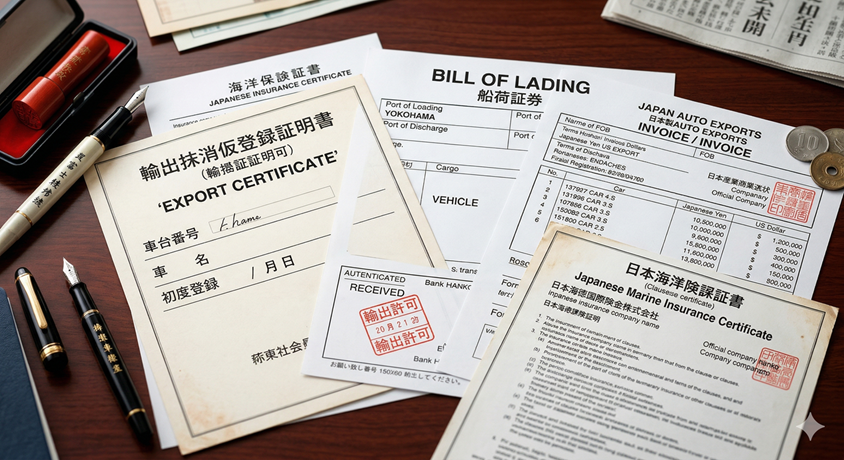
Core export documents
Shipment documents
- Commercial invoice
- Bill of lading
- Packing or shipment reference details
- Customer release records
Vehicle and compliance documents
- Export certificate or deregistration record
- Inspection or compliance papers if required
- Broker or customs forms for destination clearance
- Internal status and payment checkpoints
The exact mix changes by market, but the operational rule stays the same: every file should be linked to the vehicle record, the buyer, and the shipment milestone it affects.
Who prepares what
| Document | Usually owned by | Risk if delayed |
|---|---|---|
| Invoice | Exporter sales or operations | Buyer payment and booking delay |
| Export certificate record | Exporter with local process support | Vehicle cannot move cleanly through the workflow |
| Bill of lading | Shipping line or freight partner | Destination clearance confusion |
| Import-side customs paperwork | Broker or local clearing agent | Port storage and clearance delays |
This ownership map matters because document problems are usually coordination problems. When no team clearly owns a file, everyone assumes someone else has already handled it.
Country-specific checks that change your process
Bangladesh
Cost sensitivity means exporters should validate import-related assumptions before quoting final landed pricing.
UAE
Presentation and condition can matter more, so document consistency should match inspection and vehicle condition notes.
Kenya
Compliance expectations can determine whether a vehicle should be purchased at all, so rule checks should happen before bidding.
The more markets you sell into, the less practical it becomes to manage documents informally. Exporters usually need one shared system for status, versions, and release logic.
Three mistakes that create avoidable delays
- Storing vehicle documents across email, chat, and separate folders
- Waiting until after booking to confirm destination-side requirements
- Not connecting document readiness to payment and shipment milestones
Exporters that also want a full shipment workflow should read the step-by-step export process guide. If shipping method is the main question, use our RoRo vs container comparison. For capital planning behind document delays, use the cost planning article.
When in the workflow each document matters most
One reason exporters struggle with car export documents from Japan is that they think in terms of files instead of milestones. In practice, every important document matters at a different stage. Some files should be checked before bidding or before the vehicle is confirmed for export. Others matter at booking, at shipment release, or when the vehicle arrives at destination. A strong process maps each document to a milestone so the team knows when the file should exist, who owns it, and what happens if it is late.
This is also where many spreadsheet-based workflows become risky. Teams may know the required document list, but they do not know which file is missing until the shipment is already delayed. That is why document management has a direct relationship with cost, customer trust, and delivery speed.
If you want the full timeline around those milestones, read our car export process guide.
Document-control best practices for growing exporters
What strong teams do
- Store each file inside one vehicle record
- Track versions and release status clearly
- Assign document ownership by role
- Connect document status to booking and payment milestones
What weak teams do
- Store files in scattered folders and chats
- Rely on memory for deadline tracking
- Handle exceptions manually every time
- Notice missing paperwork only after delay
As volume increases, document quality becomes a management issue, not only an admin issue. That is why exporters often move toward centralized workflow software after experiencing repeated delays.
Why document mistakes damage profit, not just speed
A delayed or incorrect document does more than slow one shipment. It can extend vehicle holding time, delay payment collection, create storage or correction fees, and damage buyer confidence. The commercial effect is often larger than the admin mistake that caused it. That is why document readiness should be tracked alongside gross profit and shipment timing.
For the cost side of those delays, use our car export business cost article. For the system change behind better control, read the software guide.
External references exporters should monitor
For trade and customs context, exporters should review Japan Customs, JETRO, and the World Customs Organization. These sources help validate the broader customs and trade environment, even though your exact document stack still depends on destination-market rules.
A simple document workflow exporters can standardize
A practical documentation workflow starts before booking. First, confirm the vehicle record is complete and linked to the buyer and destination market. Second, track which documents are required for booking, which are required for release, and which are required at import-side clearance. Third, assign ownership for each file and make version control visible to the team. Finally, connect document readiness to customer communication so buyers know exactly what stage the shipment has reached.
This process is simple in principle, but it becomes difficult when documents are stored in disconnected folders, personal inboxes, or chat threads. That is why growing exporters eventually formalize the workflow. Once shipment volume rises, document management becomes a business-control issue, not a filing issue.
The best operators treat documentation as part of the promise they make to the buyer: accurate status, fewer delays, and smoother import coordination.
Why exporters should audit document errors regularly
Document problems usually repeat because businesses fix the immediate shipment instead of reviewing the pattern. Which files were late most often? Which market caused the most corrections? Which stage of the workflow had unclear ownership? A monthly audit of those questions helps exporters remove the cause of repeated paperwork delays instead of absorbing them as normal operating friction.
That review process also improves training because new team members can follow a documented standard rather than learning only from exceptions.
Good documentation also improves trust. Buyers feel more confident when exporters can explain exactly which file is ready, what is pending, and how that affects shipment timing. That transparency reduces confusion and makes the whole business look more professional. In competitive markets, that kind of reliability matters as much as price.
For that reason, exporters should treat documentation as part of service quality. Accurate paperwork, clear ownership, and timely release are signals that the whole operation is under control. Buyers may not see every internal process, but they do feel the effect of strong documentation when shipments move with fewer surprises.
Strong documentation habits also support growth. As more vehicles and more destination markets are added, the business needs a repeatable standard for how files are named, reviewed, released, and explained to customers. Without that standard, every new shipment adds complexity. With it, the company can grow without losing control. That is why the best exporters treat document workflow as part of their core operating system, not as a side task for admin teams.
That is why documentation deserves strategic attention. It protects shipment flow, buyer confidence, and the exporter’s reputation at the same time.
Just as importantly, better document control improves coordination with partners outside the company. Freight partners, brokers, and buyers all work more effectively when document status is accurate and timely. That reduces repeated follow-up, lowers the risk of last-minute corrections, and makes the whole export process easier to manage at scale.
Document control is also one of the clearest indicators of operational maturity. Businesses that know exactly which file is pending, who owns it, and how it affects shipment timing are far less likely to lose time in avoidable escalation. As export volume rises, that discipline matters even more because each additional shipment increases the chance of confusion if the workflow is informal. Strong document habits therefore support not only compliance, but also scale, customer confidence, and steadier commercial performance.
A reliable document process also improves forecasting. When teams can see which files are complete and which are still outstanding, they can estimate booking readiness, customer update timing, and likely payment milestones with much more confidence. That makes document management more than a compliance step. It becomes a core part of how exporters manage risk, communicate with customers, and protect shipment flow across multiple markets.
Document workflow FAQs
What documents are usually required to export a car from Japan?
Exporters usually need a commercial invoice, an export certificate or deregistration record, a bill of lading, and any market-specific inspection or customs paperwork required by the destination.
Who usually prepares the invoice and bill of lading?
The exporter usually prepares the invoice, while the shipping line or freight partner issues the bill of lading once the booking and shipment details are confirmed.
Why do export document delays happen so often?
Delays usually come from unclear ownership, scattered file storage, and destination requirements that were checked too late in the shipment process.
How should exporters track document readiness across shipments?
Each document should be linked to the vehicle record, the buyer, the shipment milestone it affects, and the team member responsible for it.
How exporters should map documents to shipment milestones
One of the best ways to reduce paperwork errors is to stop treating the document list as one large checklist. Instead, exporters should organize documents by milestone. Some checks belong before purchase or immediately after vehicle confirmation. Others matter before booking, before vessel departure, before customer release, or before destination clearance. Once the paperwork is mapped this way, teams know not only which file is required but also when it becomes commercially important.
This milestone approach improves more than compliance. It improves communication. Sales teams know when they can give a confident buyer update. Logistics teams know whether a booking is truly ready. Management knows which shipments are blocked because of documents versus those blocked by something else. When exporters fail to separate paperwork by stage, every delay feels vague and harder to solve.
The strongest document workflows therefore make stage readiness visible, not just file existence.
Version control and naming rules matter more at scale
At low shipment volume, teams can sometimes survive even with inconsistent file naming and informal version control. That usually breaks down once more vehicles, more destinations, and more staff are involved. Similar file names, duplicate scans, or unclear revisions create avoidable confusion. A buyer may receive the wrong version. A logistics team may work from an outdated reference. A broker may ask for a correction that nobody realizes has already been made in a different folder.
That is why exporters should define simple naming and version rules early. Every file should be traceable to the vehicle, the customer, and the shipment stage it belongs to. Teams should know which version is current, who changed it last, and whether the buyer or partner has already received it. These details sound administrative, but they directly influence shipment reliability and customer trust once the business grows.
In many operations, better naming discipline is the first step toward much better document control.
What a monthly document audit should review
A useful document audit does not only ask whether files were eventually completed. It asks where the friction came from. Which documents were most often late? Which market generated the most corrections? Which stage created the most rework? Did the problem come from unclear ownership, poor file storage, delayed upstream information, or weak partner coordination? These questions help the business fix the source of document problems instead of only cleaning up each individual case.
This review also creates better training material for the team. New staff can learn from real patterns instead of isolated incidents. Managers can identify whether a market-specific checklist is missing or whether the workflow simply needs clearer responsibility. Over time, document audits reduce operational noise because the same mistakes appear less often and become easier to catch earlier.
For exporters handling several destinations, that discipline often becomes a major competitive advantage.
Why document visibility improves partner coordination too
Document control is not only an internal advantage. Freight partners, brokers, and overseas buyers all work better when the exporter can give a clear answer about what is ready, what is missing, and what stage the shipment has reached. That reduces repeated follow-up and lowers the risk of last-minute misunderstanding.
For multi-market exporters, this visibility is often the difference between a workflow that scales and one that becomes harder to manage with every additional shipment.
Over time, this discipline makes document performance measurable. Exporters can see which markets, partners, or shipment stages create the most friction and improve those weak points before they affect more customers. That extra visibility also makes buyer updates more accurate and internal escalation much easier to manage under pressure.
Continue Reading
Read the next guides for export document control
Visit our car export software for Japanese exporters homepage, then follow the car export process from Japan, read how to manage a car export business, and compare RoRo vs container car shipping.
Related Solutions
Put document control inside the operating workflow
Start with the broad exporter-software homepage, then use these supporting pages to keep paperwork tied to inventory status and shipment readiness.
Car export software for Japanese exporters
Keep document status, shipment milestones, and customer updates inside one exporter software workflow.
Car inventory management system for exporters
Attach files, statuses, and ownership to the vehicle record instead of scattered folders.
Car export automation software
Reduce manual document chasing with a more structured export workflow.
Related reading
Car Export Negotiation Strategies & Closing Techniques
Complete negotiation and closing guide for Japanese used car exporters.
Car Export Supplier Relationship Management Guide
Complete supplier relationship management guide for Japanese used car exporters.
Car Export Pricing & Valuation Guide
Complete pricing and valuation guide for Japanese used car exporters.
Car Export Marketing & Lead Generation Guide
Complete marketing and lead generation guide for Japanese used car exporters.
Car Export Logistics & Shipping Operations Guide
Complete guide to logistics and shipping operations for Japanese used car exporters.

About the Author
Muhammad Khabir Uddin
Founder, CarDeal365 · 6+ years in automotive export & SaaS
View LinkedIn Profile