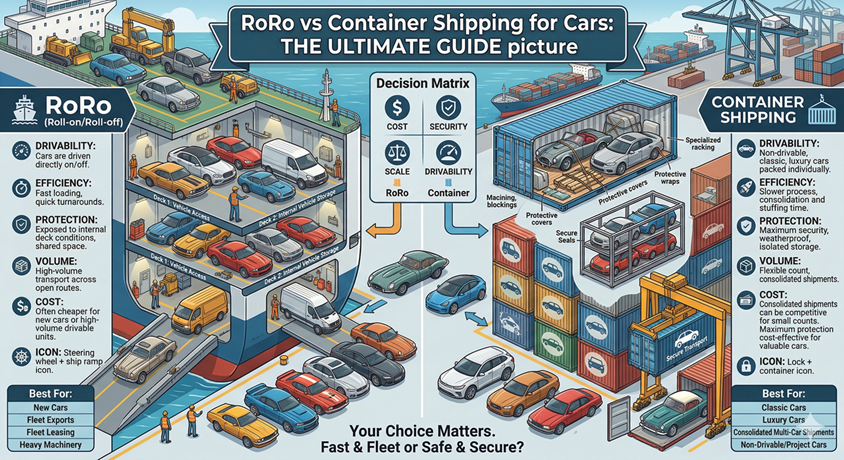
Why this comparison matters
Exporters often ask whether RoRo or container shipping is better. The correct answer depends on the route, the vehicle, buyer expectations, freight availability, and how much control you need over loading and shipment configuration.
If you are building the wider operating process, start with the full export-process guide and our business management article.
Direct comparison
| Method | Best for | Strength | Tradeoff |
|---|---|---|---|
| RoRo | Standard running vehicles on active routes | Usually simpler and often cost-efficient | Less flexible for non-runners or mixed cargo |
| Container | High-value units, mixed cargo, more control | Better loading control and cargo flexibility | Can cost more and involve more coordination |
When RoRo usually wins
- You are shipping standard running vehicles
- The route has steady RoRo service
- You want simpler handling and reliable throughput
- The customer does not need mixed cargo in the shipment
When container shipping usually wins
- You need extra control over how the vehicle is loaded
- You are shipping high-value units or mixed cargo
- The lane or customer requirement makes RoRo less suitable
- You want one shipment to include vehicles plus related parts or equipment
Cost and risk reminders
Do not compare freight in isolation
Look at total landed cost, loading complexity, transit frequency, and how delays affect customer payment timing.
Route changes can erase assumptions
The same vehicle may be a strong RoRo candidate on one route and a better container candidate on another.
To connect shipping decisions to cash planning, see our car export cost article. To avoid paperwork delays after booking, use the export documents checklist.
How exporters actually choose between RoRo and container shipping
In real operations, exporters do not choose shipping methods based on one factor. They weigh route reliability, customer budget, cargo flexibility, vehicle condition, and how urgent the shipment is. A running stock unit going to a stable destination with consistent vessel frequency may fit RoRo perfectly. A higher-value vehicle, a unit that needs more loading control, or a shipment that must include parts and accessories may justify container shipping even if the headline freight price is higher.
That is why experienced teams compare shipping methods at the order level, not at the business level. One company can use RoRo successfully for most standard units while reserving containers for premium units, special customer requests, or mixed-cargo shipments. This hybrid approach is common among exporters who serve multiple destination markets because shipping lanes, customer expectations, and import-side handling conditions are rarely identical.
The commercial mistake is to build a fixed rule like “RoRo is always cheaper” or “container is always safer.” Both claims are incomplete. The right decision depends on the full export context.
Operational checklist before booking
Before booking RoRo
- Confirm the vehicle is running and suitable for the line
- Check route frequency and expected waiting time
- Align buyer expectations on transit and release timing
- Make sure core export documents will be ready before cutoff
Before booking container
- Confirm cargo mix and loading plan
- Estimate handling complexity and added inland movement
- Review whether the added control justifies the cost
- Coordinate documents, photos, and packing references clearly
If those checks are not standardized, shipping decisions become inconsistent and buyers receive mixed expectations. That is one reason exporters often adopt a centralized workflow after reading our car export software guide or comparing manual vs software systems.
Route, buyer, and margin examples
Consider a budget-focused buyer importing common Japanese used cars into a market where RoRo service is regular. In that case, the exporter may value predictability and simpler handling more than the extra flexibility of a container. Now compare that with a buyer who needs high-value units, added protection, or mixed cargo such as spare parts or accessories. The cost equation changes, because container shipping may protect the overall commercial outcome better even if the freight line item is higher.
The same vehicle can therefore produce different shipping decisions depending on destination, promised delivery window, and customer profile. That is why your quoting logic should connect shipping choice to the broader margin model. If you want to see how freight affects capital pressure, read our car export business cost guide. If you need the end-to-end shipment workflow, continue with the Japan export process guide.
A disciplined exporter does not ask only which method is cheaper. The better question is which method produces the best outcome for this buyer, this vehicle, and this route.
External references and trade context
Exporters comparing RoRo and container shipping should also monitor trade and logistics references such as JETRO, Japan Customs, and UNCTAD transport and trade logistics resources. Those sources help exporters understand the wider customs and transport environment around route planning, documentation, and logistics constraints.
Common mistakes when comparing RoRo and container freight
Comparing headline freight only
Exporters can choose the wrong method when they ignore handling, timing, cargo flexibility, and customer expectations.
Using the same rule for every route
A route with strong RoRo availability may justify one model, while another market may work better with container control.
Treating shipping as a separate department decision
The best choice should align with sourcing, documents, buyer promises, and cash planning.
Exporters who document these decisions consistently usually improve margin and customer trust at the same time because the shipment method is no longer chosen ad hoc.
A simple decision model exporters can use
A practical model is to score each shipment on five factors: vehicle type, route stability, customer sensitivity to cost, need for cargo flexibility, and urgency. When most of those factors point toward standard handling and simpler flow, RoRo often makes sense. When more of them point toward control, mixed cargo, or special handling, container shipping becomes more attractive. This type of structured review keeps the decision consistent instead of emotional.
It also helps sales and operations stay aligned. The buyer gets a shipping method that fits the real requirement, while the exporter keeps documentation, pricing, and delivery expectations inside one consistent process. That is a much stronger model than switching methods ad hoc from one order to the next.
If you are building shipment decision rules at scale, pair this article with the software guide and the exporter problems guide.
Shipping decisions also shape the customer experience. When exporters choose the right method, delivery expectations are clearer, documentation is easier to coordinate, and margin surprises are less common. When they choose the wrong method, the problem often shows up later as buyer frustration, extra handling, or delayed release. That is why the comparison between RoRo and container shipping is not a narrow logistics topic. It is part of the commercial promise exporters make on every shipment.
Another useful rule is to compare shipping methods against the customer promise, not only the exporter workflow. If a buyer values the lowest practical landed cost and the route is stable, RoRo may be the stronger fit. If the buyer needs more control, mixed cargo, or special handling confidence, container shipping may protect the relationship better. Making that comparison explicitly helps the exporter avoid one-size-fits-all decisions and creates clearer commercial logic for the team.
For that reason, shipping choice should be documented as part of the order workflow. The team should know why a method was chosen, what assumptions were made about timing and cost, and how that decision affects documents and customer communication. When those reasons are recorded, future quoting becomes smarter and the business builds a repeatable knowledge base instead of relying on memory. Over time, that kind of discipline improves not only logistics performance but also commercial consistency.
In the end, the better shipping method is the one that matches the vehicle, the route, and the buyer requirement with the least operational friction and the clearest commercial logic. Exporters who make that choice deliberately usually perform better over time.
Because of that, the right shipping method is really a decision about workflow quality. It affects schedule confidence, documentation readiness, customer messaging, and ultimately repeatability. Exporters that treat shipping as part of the full operating system usually gain better long-term results than those who choose only by habit.
A strong exporter also reviews shipping outcomes after the shipment is complete. Did the selected method support the promised transit expectation? Did it keep margin where expected after handling and coordination? Did it make customer communication easier or harder? Answering those questions turns each shipment into a learning loop. Over time, that feedback improves pricing discipline, route selection, and overall confidence in the shipping decision model.
That review matters most when exporters serve multiple markets. A route that works well for one customer segment may create too much cost or operational drag for another. By comparing shipment outcome against quote, transit expectation, and buyer satisfaction, exporters can refine when RoRo should remain the default and when container shipping creates better commercial value. That feedback loop is what turns one-off shipping decisions into a repeatable shipping strategy.
How vehicle type changes the shipping decision
Vehicle type has a much bigger impact on shipping choice than many beginners expect. Standard running units with predictable handling often suit RoRo well when the lane is active and the buyer mainly values lower landed cost and simpler movement. Higher-value units, special-condition vehicles, and shipments that need more loading control can make container shipping more attractive even before freight is quoted. The point is not that one method is always premium and the other is always basic. The point is that the vehicle itself changes the operational risk and the customer expectation around shipment quality.
This becomes even more important when exporters serve buyers with different tolerance for delay, cosmetic risk, or cargo configuration. A practical decision model should therefore begin with the unit and the buyer promise, not with the freight habit of the company. Once that logic is clear, shipping choice becomes much more consistent.
That consistency helps both pricing and customer communication.
The real comparison is total workflow impact
Exporters sometimes compare RoRo and container shipping as if the only question were transit method. In reality, the better comparison includes booking complexity, yard coordination, document handling, customer updates, and how easily the shipment fits the rest of the workflow. A shipping method that looks cheaper in isolation may still create more internal friction if it complicates handling or weakens predictability for the buyer.
This is why mature teams ask broader questions before deciding. Which method is easier to manage for this lane? Which one supports the promised delivery expectation? Which one creates fewer documentation complications? Which one protects margin after the full handling picture is included? Those answers give a much more useful comparison than freight price alone.
The strongest exporters are often the ones that choose the smoother overall workflow, not only the cheaper transport line item.
Why the shipping method should be visible in your operating system
Once a shipment method is chosen, that decision should not live only inside email or a booking conversation. It should be visible in the order record, together with the reason for the choice, expected timing, customer implications, and any document checkpoints that depend on it. This helps sales, operations, finance, and customer-facing staff work from the same assumptions. It also improves future quoting because the business can compare actual outcomes against the original logic.
When exporters record shipping decisions systematically, they build a practical knowledge base. Over time, the company can see which routes favor RoRo, which customer segments justify containers, and where past assumptions were wrong. That learning loop improves profitability because each new shipment is informed by more than memory or habit.
For growing exporters, that visibility is one of the easiest ways to make shipping decisions more repeatable.
Why post-shipment review improves future method choice
The final check happens after delivery. Exporters should review whether the chosen method matched the quoted expectation, protected margin, and supported customer satisfaction. If the shipment created avoidable handling, timing, or communication problems, that feedback should influence the next booking decision on the same route.
This habit turns shipping choice into a repeatable management system instead of a one-time logistics decision.
That is why shipping choice should always be reviewed as part of the full customer promise. The best method is the one that keeps cost, timing, handling, and communication aligned for that exact order. When teams record that logic clearly, later quoting and route planning become more dependable as well. It also improves internal consistency across repeat bookings.
Shipping method FAQs
Is RoRo usually cheaper than container shipping for cars?
Often yes for standard running vehicles on active routes, but exporters should compare total landed cost, timing, and handling complexity instead of freight alone.
When is container shipping the better choice?
Container shipping becomes more attractive when the shipment involves high-value vehicles, mixed cargo, extra loading control, or customer and route requirements that make RoRo less suitable.
Can non-running vehicles use RoRo?
Usually not. Many RoRo services expect running vehicles, so non-runners often push exporters toward container options or special handling arrangements.
How should exporters choose between RoRo and container?
They should compare route stability, vehicle type, buyer expectations, cargo flexibility, urgency, and document handling rather than relying on freight price alone.
Authority note
This comparison was reviewed by Muhammad Khabir Uddin using the shipment decision patterns we see across exporter workflows. The method choice is rarely just about freight price. It is usually about risk, cargo type, route reliability, and customer expectations together.
The strongest exporters standardize shipping decisions inside one process so pricing, documentation, customer updates, and booking logic all stay aligned.
Continue Reading
Read the guides behind smarter shipping decisions
Start with our car export software for Japanese exporters homepage, then follow the car export process from Japan, review car export business costs, and check the export documents from Japan guide.
Related Solutions
Connect shipping choices to the wider export software stack
Start with the broad exporter-software homepage, then use these supporting pages for automation and the feature modules behind shipment control.
Car export software for Japanese exporters
Manage shipping decisions together with documents, status updates, and customer communication in one exporter workflow.
Car export automation software
Standardize booking logic and reduce manual coordination across shipments.
Car export software features
See the modules that support transport orders, workflow visibility, and reporting.
Related reading
Co-Loading & Consolidated Container Shipments
How small-volume exporters share a container when they can't fill one alone.
Demurrage and Detention Charges in Car Export
The port storage costs that can erode the savings of either shipping method.
Exporting Japanese Kei Cars and Mini Trucks
Why 3-4 kei trucks fit in the same container as 1-2 passenger cars.
Free ToolShipping Cost Calculator
Estimate RoRo vs. shared-container freight per vehicle using the figures in this guide.
AI Translation for Japanese Auction Sheets
How AI translates Japanese auction sheet notes and grading shorthand into usable data for non-Japanese-speaking export teams, and why tra...
Vehicle Shipping Workflow
How to track a vehicle's shipping status internally, from booking through delivery: defining stages, assigning owners, and connecting shi...
Digital Bill of Lading Management
How exporters manage the Bill of Lading digitally: telex release vs.
Export Documentation Management Software
What export documentation management software should actually do: pulling documents from the vehicle record, tracking document status aga...
How to Choose a Freight Forwarder for Car Export from Japan
Complete guide to choosing a freight forwarder for car export from Japan.
Used Car Import Age Limits & Compliance Matrix
Complete country compliance matrix for Japanese used car imports.
FOB vs CIF
What each shipping term actually means for car exporters.

About the Author
Muhammad Khabir Uddin
Founder, CarDeal365 · 6+ years in automotive export & SaaS
View LinkedIn Profile