Introduction
Japan is one of the world's largest exporters of used vehicles, supplying high-quality cars to countries across Africa, Asia, Europe, and the Middle East. Thanks to strict vehicle regulations and regular inspections, Japanese cars are well-maintained and highly desirable in global markets.
However, the car export process from Japan involves multiple steps — from auctions to shipping and documentation. Without a proper system, it can become complex and error-prone.
This complete guide explains each step clearly so you can understand how to manage and optimize your export business.
🌍Overview of the Car Export Workflow
The typical export workflow includes:
Each step must be handled carefully to avoid delays and losses.
🏁Vehicle Sourcing (Auctions & Dealers)
Most exporters source vehicles from Japanese car auctions or local dealers.
🚘 Auction Sourcing
- Access thousands of vehicles daily
- Competitive pricing
- Detailed inspection reports
🏪 Dealer Sourcing
- Fixed pricing
- Faster transactions
- Easier negotiation
👉 Auctions are more popular due to variety and lower cost.
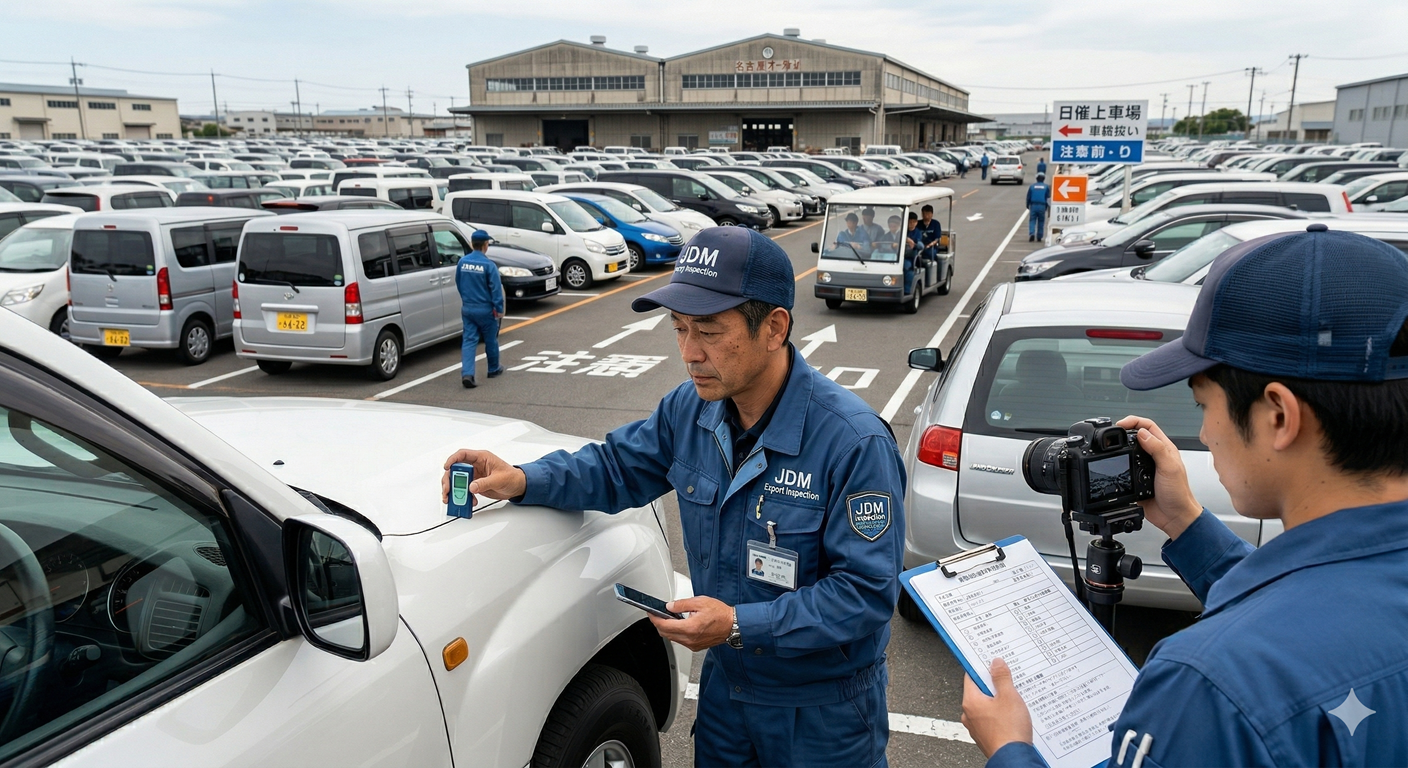
🔍Vehicle Inspection & Verification
Before purchasing, it's important to verify the condition of the vehicle.
Key Checks:
- Auction inspection sheet
- Mileage verification
- Accident history
- Engine and mechanical condition
Tip: Always review the auction grading system to understand vehicle quality.
💳Purchase & Payment
Once you win a bid or select a vehicle:
- Complete payment within deadline
- Include auction fees and service charges
- Ensure payment confirmation
Common Payment Methods:
👉 Delayed payment can result in penalties or cancellation.
📄Export Documentation
Documentation is one of the most critical steps.
Required Documents:
- Export Certificate
- Commercial Invoice
- Bill of Lading (B/L)
- Packing List
- Inspection Certificate (if required)
⚠️ Common Mistakes:
- Incorrect buyer details
- Missing documents
- Data mismatch
👉 Proper documentation ensures smooth customs clearance.
🚢Shipping Arrangement
After documentation, the vehicle is prepared for shipping.
RoRo (Roll-on/Roll-off)
- Cost-effective
- Faster
- Best for standard vehicles
Container Shipping
- More secure
- Suitable for high-value cars
- Can ship multiple vehicles
Key Tasks:
🌐Delivery & Import Clearance
Once the vehicle arrives:
- Customs clearance is completed
- Import duties and taxes are paid
- Vehicle is delivered to the buyer
Each country has different import regulations, so understanding your target market is essential.
⚠️Common Challenges in Car Export
Many exporters face these issues:
1. Poor Inventory Tracking
Leads to confusion and delays.
2. Documentation Errors
Causes shipment holds.
3. Auction Mismanagement
Missed opportunities and losses.
4. Shipping Delays
Impacts customer satisfaction.
🚀How to Simplify the Entire Process
Managing everything manually is difficult. That's why modern exporters use vehicle export tracking software.
👉 This reduces errors and improves efficiency.
💡Best Practices for Successful Export
- Always verify vehicle condition
- Maintain accurate records
- Track every step of the process
- Build relationships with auction houses
- Use automation tools early
📈Future of Car Export from Japan
The industry is moving toward:
Exporters who adopt technology will gain a strong competitive advantage.
🗺️Where the process usually slows down
The car export process from Japan is straightforward on paper but slower in practice when handoffs are weak. Exporters usually feel friction in four places: moving auction purchases into inventory, coordinating yard and inspection updates, finalizing documents before booking, and keeping customers informed while freight milestones change.
That is why process content matters for SEO and operations together. Searchers want a simple step-by-step guide, but real exporters need to know where delays actually happen. If you are only mapping the happy path, the article may rank for basic questions but it will not solve the real operational problem.
To connect process timing with financial planning, use our car export cost guide. For paperwork, use the document checklist article.
🚢How shipping choice changes the workflow
One reason the export process from Japan is often explained too simply is that shipping decisions reshape later steps. A RoRo shipment can create one type of operational cadence, while container shipping may create a different loading and documentation rhythm. Exporters who understand this difference make better promises to buyers and avoid unrealistic delivery expectations.
If shipping method is still unclear, compare both directly in our RoRo vs container shipping guide.
📚External references for trade and logistics context
Exporters should also monitor official information from Japan Customs, JETRO, and UNCTAD trade logistics resources. These references help exporters stay aligned with the wider customs and transport environment while they optimize their own internal process.
⏱️How exporters reduce total cycle time
Reducing cycle time in the car export process from Japan is rarely about one dramatic change. It is about removing small delays at each handoff. Confirming destination suitability before purchase, assigning document owners early, choosing the right shipment method, and updating buyers proactively all reduce friction across the export chain. When these controls are missing, the process feels slow even if every team is working hard.
The most effective exporters therefore track more than shipment dates. They measure how long a vehicle spends between purchase and yard arrival, between inspection and booking, between booking and document completion, and between arrival and payment release. Those timing checkpoints turn a vague process problem into something managers can actually improve.
To understand why those delays also affect cash flow and margin, review the cost planning guide. To reduce document friction specifically, use our export documents checklist.
🔄Why process visibility matters more than process theory
Many exporters understand the steps in theory but still struggle in practice because the workflow is not visible enough. Knowing that a vehicle must be purchased, prepared, documented, shipped, and released is not the same as knowing exactly where each unit stands today. Process visibility is what allows teams to follow up early, resolve exceptions faster, and keep buyers informed without confusion.
That visibility is especially important when multiple vehicles are moving at once. It turns a complicated export chain into something managers can control and improve instead of simply react to.
For most exporters, the goal is not to make the process shorter in theory. It is to make it more predictable in practice. Predictability improves quoting, buyer communication, cash planning, and team workload. That is why the best export businesses document their process clearly, measure timing at each stage, and use one system to keep status visible from purchase to shipment release. Process maturity becomes a competitive advantage because customers experience the difference directly.
A well-managed export process also supports better commercial positioning. Buyers notice when updates are clear, shipment timing is realistic, and document status is communicated early. Those details turn an operational process into a trust advantage. In competitive export markets, that operational trust can influence repeat business as much as price.
The exporters that improve fastest are usually the ones that map the process in enough detail to identify avoidable waiting time. Once the full chain is visible, managers can see whether the real delay is in sourcing quality, yard work, document ownership, booking coordination, or buyer communication. That level of process clarity is what turns a static step-by-step guide into a genuine operating advantage. It also makes training easier because new staff can follow a defined workflow instead of depending on verbal instruction alone.
When exporters make the process visible and measurable, they improve not only speed but also trust, predictability, and commercial control. That is why process management deserves as much attention as sourcing or sales in a serious car export business.
Clear process ownership also reduces management stress. Instead of chasing updates manually, leaders can review the same workflow view the team uses and focus on resolving bottlenecks early. That creates a more scalable operating environment and gives customers a smoother experience from purchase to shipment. It also improves training, because every team member can follow the same milestones, status rules, and handoff expectations without depending on informal verbal updates. For growing exporters, that consistency is what turns a basic shipment process into a durable operating system.
🧭Why destination checks should happen before purchase, not after
The car export process from Japan begins earlier than many people think. In reality, destination-market suitability should be reviewed before the vehicle is even purchased. Age limits, emission expectations, inspection rules, buyer preferences, and likely landed-cost range all influence whether a unit should move into the export workflow at all. If these checks happen only after the purchase, the business is already carrying unnecessary risk.
This is one reason experienced exporters build country rules into sourcing discipline from the start. They do not wait for logistics or documentation to discover that a unit is weak for a specific destination. Instead, they use the destination context to decide which vehicles enter the process and which should be ignored. That makes the rest of the workflow faster because fewer bad-fit units create friction later.
Good process starts with good selection. That principle saves time, money, and management attention at every later step.
🏗️Yard intake is where process quality becomes visible
Once a vehicle reaches the yard, the export process becomes tangible. This is where teams confirm that the purchased unit is the correct one, attach photos, note condition, and assign location, and update the next operational stage. If yard intake is inconsistent, the rest of the workflow becomes harder to trust. Shipping teams may work with outdated status, sales teams may overpromise to buyers, and document preparation may begin before the unit is actually ready.
That is why strong exporters treat yard intake as a control point rather than a simple physical handoff. Every unit should emerge from intake with a clean status, complete reference details, and visible readiness information. The better this stage is managed, the less confusion appears later in booking, customer updates, and margin analysis.
A reliable export process depends on this stage more than many teams initially realize.
💬Buyer communication should follow operational milestones
A common weakness in export operations is treating customer communication as a separate activity from the workflow itself. In practice, buyer updates are strongest when they follow clear milestones: vehicle secured, yard received, inspection completed, booking confirmed, shipment departed, documents released, and delivery pending. This gives customers a predictable information rhythm and reduces repeated follow-up.
It also protects the exporter from overpromising. When updates are tied to real milestones rather than estimates made too early, the buyer receives more accurate information and the internal team feels less pressure to explain inconsistent status later. In competitive export markets, structured communication creates trust because it shows that the business controls its process rather than improvising it.
That is why communication quality should be considered part of workflow quality, not something outside of it.
⚠️Exception handling is part of the real process
Step-by-step guides often describe the ideal export flow, but real operations include exceptions: missing documents, vessel changes, yard delays, damaged units, customer payment lag, or destination-side compliance surprises. The strongest exporters do not avoid every exception. They build a process that makes exceptions visible early and manageable without chaos.
This means the workflow should identify which shipments are blocked, why they are blocked, who owns the next action, and how that affects customer communication. When exceptions are handled informally, they spread confusion because every team has a different version of the problem. When exceptions are handled inside the same structured process, management can respond faster and buyers receive clearer updates.
A mature export process is not one without exceptions. It is one that stays stable when exceptions appear.
📏Process metrics exporters should measure beyond shipment dates
Shipment dates alone do not tell management enough. Exporters should measure how long units spend between purchase and yard receipt, between yard receipt and inspection completion, between inspection and booking, and between booking and document release. These stage-level metrics expose where the process is truly slowing down.
The benefit of this measurement is clarity. A team can then see whether the real issue is source quality, transport coordination, slow document ownership, delayed booking, or weak buyer response. Once timing is visible by stage, managers can improve the system instead of pushing people harder inside a vague workflow. This is also one of the strongest arguments for dedicated export software: good systems make milestone timing much easier to monitor consistently.
The more measurable the workflow becomes, the easier it is to improve with confidence.
🌍Why process variation by market should still follow one standard
Different countries create different compliance and shipping realities, but the business still needs one core operating standard. Some markets require tighter documentation discipline. Others create different shipping preferences or buyer communication expectations. Yet if each market is handled as a completely separate workflow, management loses consistency and training becomes difficult.
A better model is one master process with controlled market-specific variations. The core stages remain consistent, but the required documents, market rules, and communication details can vary by destination. This keeps the operation scalable while still respecting market reality. Exporters that manage this balance well usually look more organized internally and more reliable externally.
In short, flexibility should exist inside a standard, not instead of one.
👥Why process clarity also improves staff training and accountability
As export companies grow, process clarity becomes a training advantage. New staff can follow defined statuses, ownership rules, and milestone expectations instead of relying on memory, verbal instruction, or old spreadsheet habits. This reduces onboarding time and prevents the business from depending too heavily on a few experienced individuals to keep everything moving.
It also improves accountability. When the workflow is visible, managers can see which stage is slow and who owns the next action. That is much healthier than a culture where delays are discovered late and responsibility is debated after the fact. Clear process design therefore supports not only speed, but also calmer management and stronger internal trust.
For exporters planning growth, that is one of the most valuable outcomes of process maturity.
🔗The handoff between operations, documents, and shipping needs explicit ownership
Many delays in the car export process from Japan happen during handoffs, not during the visible major steps. A vehicle may be ready in the yard but not marked ready for documents. Documents may be nearly complete but not clearly released to the booking team. Shipping may be planned, but the buyer may not have received a clear timing update. These gaps are usually not caused by one major error. They are caused by unclear ownership between teams.
That is why a mature process should define the trigger for each handoff. What exact condition moves a unit from purchase to yard intake, from yard intake to shipment preparation, from shipment preparation to booking, and from booking to document release? When those triggers are visible, every team works with the same version of readiness. This improves timing, lowers rework, and reduces customer confusion.
It also gives management a cleaner way to review bottlenecks. Instead of asking people to explain the whole history of a file, leaders can see where the handoff stalled and which team owns the next action. That is one of the most practical benefits of structured workflow management.
For growing exporters, handoff clarity is often what separates a busy process from a controlled one.
🏁Why the best exporters treat process control as a customer-facing advantage
Customers rarely see the internal details of the export process, but they feel the quality of it. Accurate timelines, fewer surprise delays, faster answers, and cleaner document handling all shape whether a buyer trusts the exporter enough to place repeat orders. In that sense, process control is not only an internal efficiency topic. It is a market-facing trust signal.
This is why the strongest exporters communicate from a controlled workflow instead of relying on guesswork. They can explain what stage the unit is in, what happens next, and what risk still exists. That level of clarity makes the company look more reliable and reduces friction even when conditions change. Buyers are generally more patient with delays when the exporter can explain them clearly and show the next step with confidence.
Over time, that credibility becomes part of the business model. Good process does not only move cars. It helps retain customers and protect reputation.
That is also why process reviews should be continuous. Exporters who revisit their workflow after delays, document issues, or shipment bottlenecks steadily build a stronger system. Each refinement makes future orders easier to manage, easier to communicate, and easier to scale across a larger customer base.
VisualThe end-to-end export flow and where bottlenecks appear
Most exporters know the main stages. The harder part is controlling the handoffs between them, especially where documents, booking deadlines, and customer timing all intersect.
❓FAQs
How long does it take to export a car from Japan?
Typically 2–6 weeks depending on destination and shipping method.
What is the cheapest shipping method?
RoRo shipping is generally the most cost-effective option.
Do I need a license to export cars from Japan?
Yes, depending on your business setup and country regulations.
🔥Conclusion
The car export process from Japan involves multiple steps, but with the right knowledge and tools, it can be managed efficiently. From sourcing vehicles to final delivery, every stage plays a critical role in your success.
By using modern systems and following best practices, you can reduce risks, improve operations, and grow your export business globally.
👉 If you want to manage the entire workflow seamlessly, consider using a complete solution like CarDeal365.
Book a Free DemoContinue Reading
Use these guides to build the full export process
Begin with our car export software for Japanese exporters homepage, then review the car export documents checklist, study the Japanese car auctions guide, and compare RoRo vs container car shipping.
Related Solutions
See the workflow layers behind this export process
Start with the broad exporter-software homepage, then use these supporting pages for sourcing control and inventory visibility.
Car export software for Japanese exporters
Manage the broad operational chain from purchase through shipment, documents, and reporting.
Car auction software for exporters
Control the sourcing step with cleaner purchase records and cost capture.
Car inventory management system for exporters
Track every vehicle as it moves through yard, document, and booking milestones.
Related reading
Car Export Payment Fraud Prevention & Security Guide
Complete payment fraud prevention and security guide for Japanese used car exporters.
Building a Car Export Brand & Reputation Management Guide
Complete branding and reputation management guide for Japanese used car exporters.
Car Export Shipping Insurance Guide
Complete guide to shipping insurance for Japanese used car exporters.
Seasonal Trends in Japanese Used Car Export
Complete guide to seasonal trends in Japanese used car export.
Car Export Customer Financing Guide
Complete guide to customer financing for Japanese used car exporters.

About the Author
Muhammad Khabir Uddin
Founder, CarDeal365 · 6+ years in automotive export & SaaS
View LinkedIn Profile