🚗 Ultimate Guide to Car Export Software & Managing a Car Export Business

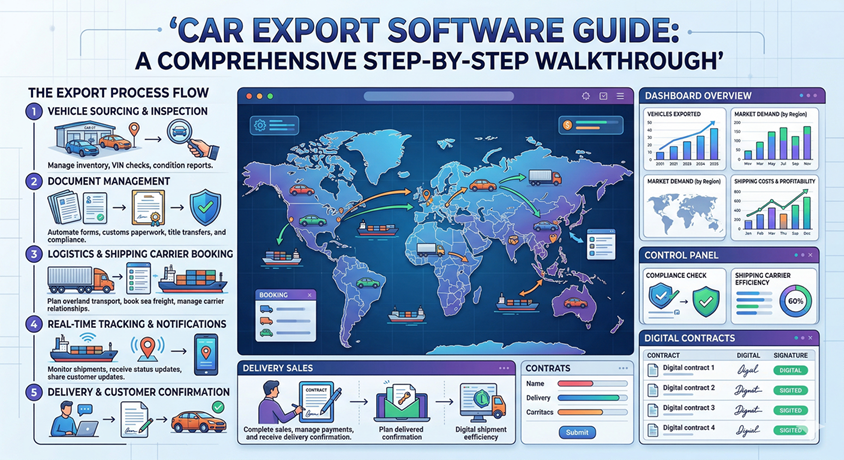
The global used car export industry is growing rapidly, with Japanese vehicles dominating markets across Africa, Asia, the Caribbean, and the Middle East. Exporters today face increasing demand, tighter competition, and more complex operations than ever before.
Managing a car export business is not just about buying and selling vehicles. It involves handling auctions, tracking inventory, managing clients, coordinating shipping, and ensuring accurate documentation.
Without the right system, these processes can become overwhelming, leading to errors, delays, and lost revenue.
That's where Japanese used car export software comes in.
In this complete guide, you'll learn everything about managing a car export business, the role of software, key challenges, and how to build a scalable and profitable operation.
🌍 What is a Car Export Business?
A car export business involves sourcing vehicles (mainly from Japan), preparing them for export, and selling them to international buyers.
Core Activities:
- Purchasing vehicles from auctions or dealers
- Managing inventory and stockyards
- Handling export documentation
- Coordinating shipping and logistics
- Managing customer relationships
👉 It is a multi-step, process-driven business that requires precision and coordination.
⚙️ What is Car Export Software?
Car export software is a centralized system that helps exporters manage all aspects of their business in one place. Instead of using spreadsheets, emails, and multiple disconnected tools, software integrates everything into a single platform.
Shipping Coordination
Manage logistics, generate documents, and track shipments live.
Client Management
Store client data, track orders, and manage all communications.
Reporting & Analytics
Sales reports, profit tracking, and performance insights at a glance.
👉 It transforms manual operations into automated workflows.
🔄 Complete Car Export Workflow (Japan Focus)
Understanding the full workflow helps you see where software adds value.
🚘 Vehicle Sourcing
Exporters purchase vehicles from Japanese auctions and local dealers.
Challenges
- • Tracking multiple vehicles across different auctions
- • Managing and organizing auction data efficiently
👉 Software helps by organizing and tracking all vehicles in one place.
🔍 Inspection & Verification
Vehicles are evaluated using auction inspection sheets and condition grading scores.
Challenges
- • Misinterpreting auction grade data
- • Missing hidden defects that affect resale value
👉 Software stores and organizes inspection details for easy access and comparison.
💳 Purchase & Payment
After winning a bid, payment must be completed quickly and fees calculated accurately.
Challenges
- • Payment delays causing auction penalties
- • Incorrect cost calculation affecting profit margins
👉 Software automates cost tracking and maintains accurate payment records.
📄 Documentation
Required documents include export certificate, invoice, and bill of lading.
Challenges
- • Errors in documents causing customs delays
- • Missing paperwork leading to shipment holds
👉 Software auto-generates and validates all required export documents.
🚢 Shipping & Logistics
Vehicles are shipped via RoRo or container — both requiring careful coordination.
Challenges
- • Difficulty tracking multiple simultaneous shipments
- • Managing logistics partners and vessel schedules
👉 Software provides real-time shipment tracking for every order.
🌐 Delivery & Client Handling
Clients receive updates after shipment, and delivery is confirmed at destination.
Challenges
- • Poor communication leading to client dissatisfaction
- • Lack of visibility and transparency for buyers
👉 Software centralizes all client interactions and provides status updates.
⚠️ Common Problems in Car Export Business
1. Inventory Mismanagement
- • Lost or duplicate vehicle data
- • No real-time inventory tracking
2. Auction Mismanagement
- • Missed bids and lost opportunities
- • Poor purchase decision-making
3. Shipping Delays
- • Lack of logistics coordination
- • No tracking visibility for clients
4. Documentation Errors
- • Incorrect or missing details
- • Customs clearance failures
5. Poor Client Management
- • Disorganized communication channels
- • Lost client opportunities due to slow response
👉 These problems limit growth and reduce profitability. Software solves all of them.
⚖️ Manual vs Software-Based Systems
❌ Manual System
- Excel-based tracking — error-prone
- High human error rates across all tasks
- Limited scalability as volume grows
- No real-time visibility or reporting
✅ Software System
- Automated workflows — fast and reliable
- Real-time data across all operations
- Scalable to any business size
- Instant reports and performance insights
| Feature | Manual | Software |
|---|---|---|
| Accuracy | Low | High |
| Speed | Slow | Fast |
| Scalability | Limited | High |
| Error Risk | High | Low |
👉 Software clearly provides a competitive advantage over manual systems.
🔑 Key Features to Look for in Car Export Software
📦 Inventory Management
- Real-time tracking
- Vehicle categorization
- Status updates
🚗 Auction Integration
- Import auction data
- Track bids
- Analyze history
🚢 Shipping Management
- Track shipments
- Manage logistics
- Generate documents
👥 Client Management
- Store client data
- Track orders
- Manage communication
📊 Reporting & Analytics
- Sales reports
- Profit tracking
- Performance insights
🚀 Benefits of Using Car Export Software
Increased Efficiency
Automation reduces manual work and saves significant time across all operations.
Improved Accuracy
Minimizes human errors that cause costly delays and documentation failures.
Better Decision Making
Access to real-time data and insights lets you act fast and confidently.
Scalability
Grow your business volume without increasing workload or headcount.
Centralized Operations
Manage everything — inventory, auctions, shipping, clients — in one platform.
💡 How to Choose the Right Software
Understand Your Needs
Define your current pain points — whether you're a small exporter or a large operation, your requirements differ.
Check Features
Ensure the platform covers your full workflow from auction buying to client delivery.
Evaluate Scalability
Choose software that grows with you — avoid tools that cap out at your current volume.
Consider Cost vs Value
Focus on ROI — the right software pays for itself through time saved and errors avoided.
Support & Reliability
Ensure the vendor provides long-term support and regular updates to match industry changes.
🌟 Why Exporters Choose Modern Solutions
Modern platforms like CarDeal365 provide end-to-end workflow management — from auction to shipment — without needing multiple disconnected tools.
👉 This eliminates the need for multiple tools and reduces operational complexity.
📈 Future of the Car Export Industry
The industry is rapidly evolving. Businesses that adopt modern tools today will lead the market tomorrow.
Automation
Routine tasks handled automatically without human input.
AI-Driven Insights
Smart recommendations for purchasing, pricing, and shipping.
Real-Time Global Ops
Manage multi-country operations from a single dashboard.
Digital Platforms
Full mobile visibility wherever your team is located.
👉 Early adopters of modern platforms will gain a major competitive advantage.
📊 What software should improve in the first 90 days
A car export software platform should create visible operational improvement quickly. In the first 90 days, exporters should expect clearer stock visibility, faster status reporting, more consistent document tracking, and fewer buyer-update gaps. If those outcomes do not improve, the issue is usually not missing features. It is usually weak implementation discipline, unclear role ownership, or incomplete process design.
The best teams treat software rollout as an operations project rather than an IT purchase. They define status stages, build reporting rules, assign document owners, and make sure each department uses the same process. That is what turns software into a true operating system.
To compare this transition model with older workflows, see manual vs software export systems. To understand the financial effect of those improvements, use the cost planning guide.
🧱 The core system exporters should build around
The strongest software setup is not the one with the longest feature list. It is the one that becomes the operational backbone of the business. Inventory, shipping, documents, client updates, and reporting should all reference the same order and vehicle records. When those layers live in separate tools, managers lose time reconciling information instead of improving performance.
That is the real reason software matters for exporters: it creates one reliable operating model that can scale with volume.
🧭 How exporters should choose software based on business stage
A startup exporter, a growing team with multiple buyers, and a larger multi-branch company should not evaluate software the same way. Early-stage businesses usually need fast clarity on sourcing, inventory, and basic document control. Mid-stage exporters need deeper order visibility, buyer coordination, and better reporting because the number of moving units increases. Mature exporters need stronger permissions, multi-user accountability, branch visibility, and the ability to standardize process across larger teams.
This matters because many software buying mistakes come from choosing a system designed for the wrong stage. Some businesses buy a simple inventory tool and later discover it cannot support logistics or role-based workflow. Others buy a bloated system with features they do not yet use and then fail to implement it properly. The better approach is to choose software that solves current operational pain while also supporting the next stage of growth.
For most Japanese used car exporters, that means prioritizing vehicle records, auction linkage, workflow status, documents, buyer visibility, and reporting first. Nice-to-have features should come after the core workflow is stable.
📐 The data model behind strong export software
Good software is not only about visible screens. It is about how information is structured underneath. Exporters usually need four linked records to operate cleanly: the vehicle record, the buyer or customer record, the shipment or order record, and the document layer attached to both. If those records are not connected properly, the software may still look polished but it will create the same confusion as spreadsheets.
A strong vehicle record should hold chassis or VIN details, auction source, purchase price, inland movement, photos, current yard location, preparation status, and the document set attached to that unit. A strong customer record should reflect order history, destination market, contact flow, and payment checkpoints. A strong shipment record should show booking logic, method, dates, and document readiness. When all of those pieces reference one another, managers can see what is happening without manually rebuilding the story.
This is one of the clearest differences between real exporter software and general business tools adapted to the industry later.
📊 The management metrics your software should expose every week
The best software does not merely store data. It makes performance visible in a way that changes management behavior. Exporters should be able to review key numbers weekly, not only at the end of the month. Those numbers usually include units purchased, units shipped, gross profit per vehicle, average stock age, document delays, shipment delays, buyer payment lag, and route-level sales performance.
If a system cannot surface these numbers clearly, management still ends up asking staff for screenshots, spreadsheet exports, or manual reports. That defeats the point of centralized software. Visibility should be built into the system so the same source of truth serves operations, sales, logistics, and finance. Exporters who manage this way usually react faster to weak stock, weak buyers, and weak process stages because the pattern becomes visible earlier.
This is also why software selection should include reporting quality as a core criterion, not as a secondary feature.
🛠️ A practical implementation roadmap for the first 60 days
Software implementation fails when businesses try to migrate everything at once. A cleaner approach is to define the minimum viable operating workflow first. In the first phase, exporters should configure vehicle fields, auction sources, user roles, inventory statuses, and the most important document checkpoints. In the second phase, they should bring historical stock and active buyers into the system. In the third phase, they should formalize shipment statuses, reporting logic, and role-based review routines.
This staged rollout reduces disruption and gives teams time to adopt the system with real discipline. It also creates early wins because staff can feel the benefit of better status tracking and fewer follow-up questions before the system becomes more advanced. Most teams do not need a perfect rollout. They need a controlled rollout with visible progress and clear ownership.
The real goal is not installing software. The real goal is standardizing the workflow the business depends on every day.
🚩 Signs your business has already outgrown spreadsheets
You ask the same status questions repeatedly
If management constantly asks where a vehicle is, whether documents are ready, or whether a buyer has paid, the problem is not communication effort. The problem is that status is not visible enough.
Different departments keep different versions of the truth
When sales, yard, finance, and logistics all maintain separate records, small disagreements become operational delays and margin leakage.
Training new staff takes too long
If a new employee must learn from scattered chats, old spreadsheets, and verbal explanations, the process is too informal to scale safely.
🌍 Why destination-market complexity should influence software selection
Exporters selling into one market can sometimes survive on lighter workflow discipline for longer. Exporters serving multiple countries cannot. Each market creates different vehicle preferences, shipping logic, compliance checks, document expectations, and customer communication patterns. As destination diversity grows, software becomes less about convenience and more about risk control.
This is where role-based access, route-level reporting, and structured document status become essential. A team serving Kenya, Bangladesh, UAE, and Caribbean markets at the same time needs the system to preserve market context, not just vehicle data. Otherwise the business ends up managing international complexity in message threads and memory. That is unstable, especially once multiple branches or international buyers are involved.
Software that supports global exporter operations should therefore make destination context visible at every stage, from sourcing to final shipment release.
🎯 Questions to ask in a software demo before you buy
Exporters should not evaluate software demos by the design alone. The better questions are operational. Can the system show one vehicle from auction purchase through stockyard, shipment, and customer delivery? Can it show who changed a status and when? Can it connect documents to the shipment milestone they affect? Can it separate access for admin, logistics, sales, and finance? Can management see reporting without waiting for manual exports?
A good demo should also reflect your real workflow. Ask the vendor to show an auction purchase becoming an active inventory unit, then moving into shipment preparation, then into customer delivery. That sequence reveals far more than a feature list. It shows whether the system is truly built for exporter operations or only marketed that way.
If the system cannot support that flow clearly, it is unlikely to become a reliable operating system later.
🏁 Why software becomes a competitive advantage, not only an efficiency tool
At first, most exporters adopt software to save time and reduce mistakes. Over time, the strategic value becomes larger than efficiency alone. Better status visibility improves buyer communication. Better reporting improves sourcing decisions. Better document control reduces avoidable delays. Better role separation improves accountability. All of those changes affect customer trust and management control at the same time.
That is why the right software often becomes a competitive advantage. Customers feel the difference when quotations are clearer, shipment updates are faster, and problems are resolved earlier. Managers feel the difference when stock, margin, and workflow are visible without manual reconciliation. Teams feel the difference when they no longer spend their day proving what happened. The software itself is not the advantage. The repeatable operating system it creates is the advantage.
For serious exporters, that is the standard worth aiming for.
🔍 What a serious exporter should compare before signing a contract
Before committing to any software platform, exporters should compare more than price and features. They should evaluate onboarding support, migration discipline, workflow flexibility, report clarity, and whether the vendor actually understands auction-driven export operations. The quality of implementation support often matters as much as the software itself because a weak rollout can make a good system look ineffective.
It is also wise to compare how easily the platform can support future growth. Ask what happens when more buyers, more destinations, more branches, or more process checkpoints are added. A system that works only for today can quickly become a barrier tomorrow. The best purchasing decision is usually the one that improves current control while reducing the need for another major system change later.
That long-view approach is what separates software buying from software shopping.
🔗 Related Guides (Recommended Reading)
How to Manage a Car Export Business
Practical strategies and tools for day-to-day export management.
Best Car Export Software in 2026
How to evaluate and choose the best software for your operations.
Car Export Process from Japan
Step-by-step guide covering auctions, shipping, and documentation.
Manual vs Software Car Export Systems
Detailed comparison across all key operational dimensions.
Japanese Car Auctions Guide
Grading system, bidding strategies, and major auction houses explained.
Visual: The exporter operating system software should connect
The strongest exporter platforms connect every team to one live vehicle and order record, then turn that record into document control, buyer visibility, shipment milestones, and management reporting.
❓ Frequently Asked Questions
What is car export software?
Is car export software necessary for small businesses?
Can software reduce operating costs?
🔥 Ready to Transform Your Car Export Business?
Managing a car export business is complex, but with the right approach and tools, it becomes efficient and scalable.
From sourcing vehicles to delivering them to international buyers, every step requires precision and coordination. Manual systems can no longer keep up with modern business demands.
👉 Car export software is the key to efficiency, growth, and long-term success.
Book a Free DemoContinue Reading
Read the related software buying guides
Start on our car export management software page, then compare manual vs software car export systems, review the best car export software for 2026, and read about common problems in car export business.
Related Solutions
Explore the solution pages behind this guide
If this guide matches your search intent, start with the main car export management software page, then review automation depth and feature coverage.
Car export management software
See the full platform for inventory, auctions, documents, shipment control, and team handoffs.
Car export automation software
Review how exporters automate repetitive operational steps as they scale.
Car export software features
Compare the modules that support sourcing, stock control, logistics, and reporting.
Related reading
Car Export Quality Assurance & Grade Selection Guide
Complete quality assurance and grade selection guide for Japanese used car exporters.
Building a Car Export Brand & Reputation Management Guide
Complete branding and reputation management guide for Japanese used car exporters.
Car Export Team Management Guide
Complete guide to building and managing a car export team.
Car Export Inventory Management Guide
Complete guide to inventory management for Japanese used car exporters.
About the Author
Muhammad Khabir Uddin
Founder, CarDeal365 · 6+ years in automotive export & SaaS
View LinkedIn Profile