Why cost planning decides whether exporters scale or stall
Many new exporters focus on the purchase price of the vehicle and miss the real operating picture. A car export business runs on working capital discipline. Freight, yard handling, transport, repairs, auction fees, compliance, and delayed customer payment can turn an apparently good deal into weak margin very quickly.
That is why car export business cost is not just a budgeting question. It is an operating question. Every delay between purchase, reconditioning, document approval, booking, and delivery keeps cash tied up longer. Every unclear handoff pushes risk back into the business.
If you are building your plan after reading our guide on how to start a car export business, this article goes one level deeper into the numbers you should model before you scale volume.
Startup budget vs working capital
Startup budget is what you spend to get the business running: company registration, admin setup, basic systems, and operational access. Working capital is the money required to keep vehicles moving through the pipeline until buyers pay and shipments close.
For exporters, working capital is usually the larger issue. A business can look lean on paper but still fail if too much money is tied up in stock, port handling, or customer receivables.
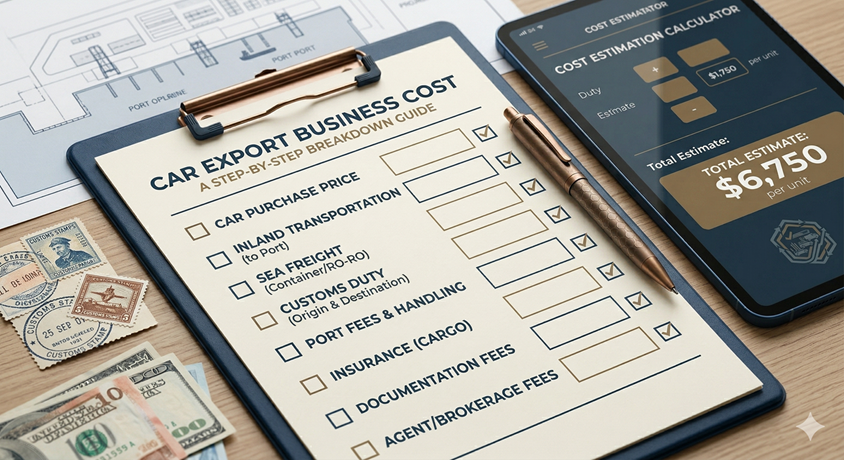
| Category | Typical planning range | Notes |
|---|---|---|
| Company and admin setup | $500 to $3,000 | Varies by business structure and local requirements |
| Auction access and dealer network setup | $300 to $2,000 | Depends on partner access and membership model |
| Auction fees and transport to yard | $250 to $900 per vehicle | Immediate margin impact after purchase |
| Inspection, repair, cleaning | $100 to $1,200 per vehicle | Condition-driven and easy to underestimate |
| Freight and port handling | $800 to $2,500 per vehicle | Strongly route-dependent |
| Documents and broker support | $80 to $300 per shipment | Mistakes create delays and trust issues |
The key is that none of these categories exist in isolation. The real pressure comes when several vehicles are in motion at the same time and customer payment timing is less predictable than expected.
Sample working-capital scenarios
Lean operator
3 to 5 vehicles monthly, limited staff, disciplined turnover. Working capital often lands around $15,000 to $60,000.
Growing exporter
5 to 15 vehicles monthly, multiple destinations, more yard and freight coordination. Working capital can climb into the low six figures quickly.
Multi-market operator
Higher-value units, mixed customer terms, more shipment overlap. Capital pressure becomes an operating-system problem, not only a finance problem.
This is why exporters that want predictable margin usually combine cost control with a centralized workflow. Manual spreadsheets do not give enough visibility once multiple units are moving at once. If you need help structuring that workflow, see our complete guide to car export software.
Where margin usually leaks
Underestimating post-auction cost
Transport, repairs, and port handling often matter more than minor purchase-price differences. An exporter who wins a bid cheaply can still lose margin if the unit needs more yard work or sits too long before booking.
Slow inventory turnover
Aging stock ties up cash and increases pressure to discount or accept weaker buyer terms. Exporters who do not measure days from purchase to shipment usually feel this problem before they can explain it.
Weak document control
A small paperwork issue can delay a whole shipment and extend the cash-conversion cycle. For a deeper document checklist, use our Japan export documents guide.
Car Export Negotiation Strategies & Closing Techniques
Complete negotiation and closing guide for Japanese used car exporters.
Car Export Supplier Relationship Management Guide
Complete supplier relationship management guide for Japanese used car exporters.
Car Export After-Sales Service & Customer Retention Guide
Complete guide to after-sales service and customer retention for Japanese used car exporters.
Car Export Vehicle Inspection & Quality Control Guide
Complete vehicle inspection and quality control guide for Japanese used car exporters.
Car Export Legal & Compliance Guide
Complete legal and compliance guide for Japanese used car exporters.
KPIs that matter more than revenue
- Gross profit per vehicle
- Days from purchase to shipment
- Average reconditioning spend by source type
- Freight variance by route and shipping method
- Customer payment lag
These indicators help you see whether your cost structure is healthy or only looks healthy while volume is low. If you also need help deciding between shipping modes, read our RoRo vs container shipping guide. For a step-by-step export flow, use the Japan export process guide.
External references for trade and logistics planning
The exact cost model always depends on route, regulation, and market conditions. Exporters should also monitor guidance from sources such as JETRO, Japan Customs, and UNCTAD transport and trade logistics resources to understand how shipping, compliance, and port conditions affect operating cost.
Those sources will not give you a ready-made margin model, but they do help validate the broader cost environment exporters operate in.
A realistic startup capital example
Assume a new exporter wants to move five vehicles per month and serve buyers in two markets. The founder may begin with basic registration and admin setup, a small team, auction access through a partner, and a limited marketing budget. On paper, this can look manageable. In reality, the business may still need tens of thousands of dollars in working capital because multiple vehicles will be in different stages at the same time: purchased, transported, cleaned, documented, booked, or waiting on payment release.
That is where many new operators make their first major planning mistake. They think only about launch cost, not operating float. A business can survive with a lean office setup, but it cannot move consistently if every shipment depends on delayed buyer money or last-minute borrowing. That is why the car export business cost conversation is really about cash-flow resilience.
If you are still validating your business model, compare this with our complete guide to managing a car export business and the most common exporter problems.
Country and market differences that affect cost
Bangladesh
Budget-sensitive buyers often compare landed cost very closely, so small mistakes in freight or handling assumptions can directly reduce margin.
UAE
Presentation, speed, and condition can matter more, which may justify additional prep or higher handling standards before shipment.
Kenya
Compliance and import suitability checks can affect sourcing decisions before the vehicle is ever purchased, which shifts cost planning earlier in the workflow.
The lesson is simple: exporters should build route-aware and market-aware cost models rather than one generic spreadsheet for every shipment.
How software helps control cost leakage
Many cost problems do not start in finance. They start in operations. A missing yard update, an unclear document owner, a delayed booking, or a weak customer handoff can all increase the cash-conversion cycle. That is why cost control improves when exporters centralize inventory, shipment status, buyer communication, and reporting.
For a deeper workflow view, read the complete software guide and our comparison of manual and software export systems.
How growing exporters protect profit while scaling volume
The most dangerous period in a car export business is often the growth phase. Volume increases, but controls do not improve at the same speed. More vehicles are moving, more customers are waiting, and more capital is tied up, yet the business is still operating on lightweight tools. This is where profit can look strong at the sales level but weak at the operational level.
Exporters protect margin during this phase by reviewing route profitability, measuring stock age, tightening shipment handoffs, and standardizing customer payment checkpoints. The exact metric set will vary by company, but the management principle stays the same: if you cannot see where cash is slow or where margin leaks, you cannot scale confidently.
That is also why many exporters eventually adopt systems that connect sourcing, operations, and reporting instead of keeping finance questions inside spreadsheets alone.
Why margin discipline beats revenue growth
In the car export business, revenue growth can hide weak profit control for a long time. A company may be moving more units every month while quietly absorbing higher repair costs, slower turnover, and more working-capital pressure. Margin discipline matters because it forces exporters to evaluate every route, vehicle type, and customer segment by real commercial outcome, not just by volume. The businesses that scale sustainably are the ones that treat cost visibility as a management habit, not a finance exercise once problems already appear.
Seen this way, car export business cost is not only about what you spend. It is about how confidently you can control capital while stock, documents, and shipments are moving. Exporters with tighter visibility usually protect profit better because they can act before small delays turn into margin loss.
The exporters that stay profitable longest are usually not the ones with the highest raw turnover. They are the ones with better purchasing discipline, better process control, and better visibility into how capital is tied up across the workflow.
Once exporters understand cost this way, better decisions follow naturally. They price with more confidence, buy with more discipline, and review routes with clearer expectations about working capital and real margin.
Strong cost control gives exporters room to grow without losing financial discipline.
It also makes growth less risky.
How working-capital pressure builds faster than new exporters expect
A common planning mistake is assuming that capital pressure grows in a straight line with shipment volume. In practice, pressure often compounds much faster because several vehicles can be waiting at different stages at the same time. One unit is waiting for inland transport. Another is in the yard. A third has a booking but the buyer has not completed payment. A fourth is ready for release but documents are still being finalized. That overlap is what makes the car export business cost model more demanding than many newcomers expect.
The issue is not just that more money is tied up. The bigger issue is that management can lose track of where the money is tied up. If the business cannot see which units are delayed, which routes are slower to convert into cash, and which buyers consistently stretch payment timing, working capital becomes reactive instead of planned. This is why healthy exporters review stock age, payment lag, booking delays, and cost variance together instead of treating each as a separate department issue.
Seen this way, cost control is really about reducing the amount of time capital stays trapped inside the workflow.
A simple per-vehicle cost template exporters should standardize
Every exporter should have a standard per-unit cost template before scale creates confusion. That template should include purchase price, auction fee, inland transport, yard work, repair or cleaning, freight, port handling, documents, broker or agent support, and any route-specific charges. Just as important, it should also include expected selling price and target gross margin. Without this full view, teams often talk about whether a unit was bought well without seeing whether it actually performed well after all costs were included.
The value of a standard template is consistency. Buyers can use it when evaluating auction opportunities. Operations can use it when adding downstream costs. Management can use it when reviewing route profitability. Over time, this creates better sourcing discipline because the team stops treating costs as surprises that appear later in the cycle. It also makes it much easier to compare route performance by market and customer type.
For exporters trying to improve pricing quality, this kind of structure is often more valuable than simply chasing lower purchase prices.
What cost reviews should happen monthly
A monthly cost review should answer a few direct questions. Which vehicle categories delivered the strongest gross margin after full cost? Which routes showed the highest freight or handling variance? Which buyers were slowest to convert shipments into cash? Which units aged too long before booking? Which corrective costs appeared repeatedly after purchase? These questions help management identify patterns that single-shipment reviews often miss.
This review is also where exporters can separate one-time problems from structural weakness. One delayed shipment may not matter much. A recurring delay pattern on a specific route or customer type is a management issue. The same logic applies to yard spend, repair variance, and document-related cost. Once those patterns are visible, the company can improve policy, sourcing, or workflow design instead of absorbing the losses as normal business friction.
That discipline is what turns cost planning into an operating advantage rather than a bookkeeping exercise.
Why route-by-route profitability should guide growth decisions
Not every route deserves the same growth effort. Some destinations produce steady turnover and predictable handling. Others look attractive on revenue but create slower payments, higher correction cost, or more pricing pressure after arrival. A business that reviews profitability by route can decide where to expand with much more confidence.
This is one of the clearest ways cost analysis becomes a strategic tool. Instead of chasing every possible shipment, the exporter can focus capital on the routes and customer segments that convert into healthier margin and lower operating stress.
Cost planning FAQs
How much working capital does a small car export business usually need?
It varies by route and volume, but even lean exporters moving only a few vehicles each month often need meaningful float for purchases, inland transport, repairs, freight, and the time between shipment and customer payment.
Which costs do new exporters underestimate most often?
New exporters often underestimate post-auction transport, repair work, port handling, document coordination, and the amount of cash that stays tied up while vehicles move through the workflow.
Why is working capital more important than startup setup cost?
Because the real pressure starts after launch, when several vehicles are in motion at the same time and customer payment does not always arrive as quickly as expected.
How does software help control car export business cost?
Software helps by making stock age, shipment bottlenecks, document readiness, and route profitability visible in one workflow so management can react before margin leaks grow.
Continue Reading
Follow the guides behind better export margin control
Start with our car export software for Japanese exporters homepage, then read how to manage a car export business, compare RoRo vs container car shipping, and review the car export process from Japan.
Related Solutions
Control the cost drivers discussed in this article
Start with the broad exporter-software homepage, then use these supporting pages for purchase visibility and inventory discipline.
Car export software for Japanese exporters
See the broad software layer that ties purchasing, operations, shipping, and reporting together.
Car auction software for exporters
Capture purchase price, fees, and lot-level sourcing data earlier in the workflow.
Car inventory management system for exporters
Keep status, location, and readiness clean so hidden delays stop eroding margin.

About the Author
Muhammad Khabir Uddin
Founder, CarDeal365 · 6+ years in automotive export & SaaS
View LinkedIn Profile