Introduction
The car export industry has become increasingly competitive, especially for businesses dealing with Japanese auctions, international buyers, and complex logistics.
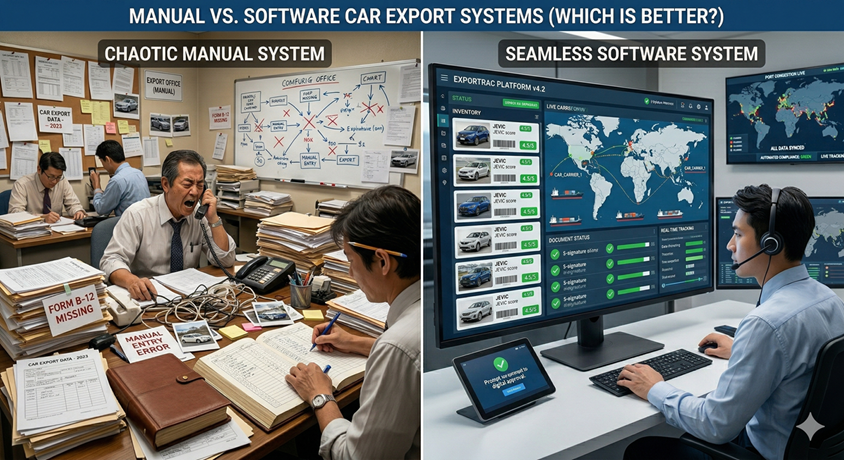
Traditionally, many exporters relied on spreadsheets, emails, and manual tracking systems to manage operations. While this worked in the past, it is no longer efficient in today's fast-paced global market.
This raises an important question:
👉 Should you continue with a manual system, or switch to a car export software solution?
In this complete guide, we'll break down both approaches in detail and help you decide which is best for your business.
📊What is a Manual Car Export System?
A manual system refers to managing your business using:
- Excel spreadsheets
- Paper records
- Emails and messaging apps
- Separate tools for auctions, shipping, and clients
🧾 Typical Workflow in Manual Systems:
- 1Record vehicle details in Excel
- 2Track auction bids manually
- 3Communicate with buyers via email/WhatsApp
- 4Create invoices manually
- 5Track shipments separately
⚙️What is a Software-Based Car Export System?
A software system is a centralized platform that manages:
Everything is handled in one place with automation and real-time updates.
⚖️Manual vs Software: Detailed Comparison
📦 1. Inventory Management
- Data stored in spreadsheets
- High chance of duplication or errors
- No real-time updates
- Centralized database
- Real-time tracking
- Organized by brand, model, year, and status
👉 Winner: Software
🚗 2. Auction Management
- Track auctions manually
- Risk of missing bids
- No historical data tracking
- Auction data integration
- Bid tracking and alerts
- Access to past records
👉 Winner: Software
🚢 3. Shipping & Logistics
- Separate tracking systems
- Manual document preparation
- High risk of delays
- Automated document generation
- Shipment tracking
- Centralized logistics management
👉 Winner: Software
👥 4. Client Management
- Scattered client information
- Hard to track orders and history
- Complete customer database
- Order tracking
- Communication history
👉 Winner: Software
📊 5. Reporting & Decision Making
- Time-consuming reports
- Limited insights
- Instant reports
- Profit analysis
- Performance tracking
👉 Winner: Software
📉Limitations of Manual Systems
While manual systems may seem low-cost, they come with hidden disadvantages:
👉 As your business grows, these problems become bigger.
🚀Advantages of Software Systems
Switching to software provides major benefits:
💰Cost Comparison: Manual vs Software
Manual System Costs:
- Employee time
- Errors and losses
- Missed opportunities
Software System Costs:
- Subscription or setup cost
- Server/infrastructure (if dedicated)
Reality: Manual systems may look cheaper, but software delivers higher ROI over time.
🧠When Should You Switch to Software?
You should consider switching if:
👉 If you said "yes" to even 2–3 of these, it's time to upgrade.
🌍Real-World Scenario
Manual Exporter:
- Uses Excel
- Misses auction opportunities
- Faces shipment delays
- Struggles with client communication
Software-Based Exporter:
- Tracks everything in one system
- Wins more auctions
- Ships faster
- Provides better customer service
👉 The difference is efficiency and growth.
🔮Future of Car Export Management
The industry is moving toward:
👉 Manual systems will become obsolete in the coming years.
💡Why Exporters Are Moving to Modern Solutions
Modern platforms like CarDeal365 provide:
- End-to-end workflow management
- Auction to shipment tracking
- Centralized inventory system
- Client and order management
👉 This eliminates the need for multiple tools and manual work.
🧠When manual systems still work and when they break
A manual car export system can still work for a very small operator with low shipment volume, short communication chains, and a founder who personally checks every auction purchase, invoice, and shipment. In that environment, spreadsheets and messaging apps may feel efficient because the team is small and the workflow is simple.
The problem begins when the business grows. Once multiple staff members handle sourcing, stockyard updates, shipping coordination, customer communication, and payment follow-up, the manual system starts to fail in predictable ways. Two spreadsheets show different vehicle status. Customer notes live in chat instead of the order file. Shipment documents are saved in email threads rather than inside a shared workflow. Managers ask for weekly reports that take hours to prepare and are already outdated when they are delivered.
That is the real divide between manual and software-based operations. The issue is not preference. The issue is control. If your team can no longer trust that everyone is looking at the same data, the business has already outgrown the manual model.
📈ROI of switching from manual to software
The return on software is not only about saving admin time. The bigger gain is tighter operational consistency. Exporters usually see improvement in four areas after moving away from a manual car export system: fewer data errors, faster shipment coordination, better visibility on vehicle status, and clearer customer communication.
Operational gains
- Less duplicated work across teams
- Faster report generation
- Improved order and shipment visibility
- Better document control
Commercial gains
- More reliable buyer updates
- Better response time on inquiries
- Clearer gross profit tracking
- More confidence to scale volume
If you are also comparing the cost of that transition, use our car export business cost guide. If you want the broader operating view, read how to manage a car export business.
📚External references and implementation advice
When exporters digitize their workflow, they should align that change with broader trade and logistics best practice. Sources such as JETRO, Japan Customs, and UNCTAD transport and trade logistics guidance all point to the same underlying requirement: exporters need consistency across data, logistics, and compliance.
That does not mean software alone solves every problem. It means exporters should design roles, document ownership, shipment milestones, and reporting rules before rolling out a system. Software works best when it supports a clean process rather than trying to rescue a chaotic one.
🧪A practical migration plan for exporters
Exporters moving from a manual car export system to software should avoid a full overnight switch. The better approach is phased migration. Start with one source of truth for vehicle records, then add shipment milestones, document status, and buyer communication. Once reporting and ownership rules are stable, the business can reduce spreadsheet dependency with far less disruption.
This phased model matters because exporters are not running a single department. Auction buying, inland transport, yard processing, document preparation, shipment booking, and customer updates all affect each other. If even one of those stages stays outside the system, teams fall back into duplicate data and conflicting updates. That is why the migration plan should be operational, not just technical.
To connect this transition with cost control and management strategy, read the cost planning guide and our management playbook. The best software decision is the one that strengthens the actual workflow exporters use every day.
📋Questions owners should ask before choosing a system
Before choosing between manual processes and software, exporters should ask three direct questions. First, can the business still trust one version of vehicle status across all teams? Second, can management see shipment, document, and customer-update progress without asking different people for separate reports? Third, can the business grow volume without adding the same amount of admin workload? If the answer to those questions is no, then the company is already paying the hidden cost of a manual system. Software is not only a convenience at that point. It becomes the structure required for reliable growth.
The practical conclusion is that manual systems usually survive because founders compensate for them personally. Once the business needs repeatable control instead of founder memory, software becomes the more reliable model. That shift is not about technology fashion. It is about creating a workflow that can be trusted by the whole team, measured by management, and improved over time.
For exporters deciding today, the real choice is between temporary convenience and long-term control. Manual tools may feel familiar, but they rarely create the visibility needed for reliable scaling. A software-led workflow gives management a better way to monitor status, coach teams, and improve operations continuously.
⚖️The hidden cost of staying manual for too long
The cost of a manual car export system is rarely visible as one big line item. It appears as repeated small losses: duplicated data entry, delayed buyer updates, unclear stock status, inconsistent shipment notes, and management time spent rebuilding reports by hand. Because those losses are spread across different teams, many exporters underestimate them. The business feels busy, but leadership cannot always see how much of that effort is avoidable.
This is why manual systems can survive longer than they should. Founders and senior staff compensate for the gaps personally. They remember exceptions, chase updates in chat, and correct information before the buyer sees the inconsistency. That can work temporarily, but it does not scale. The business starts depending on people remembering the process rather than the process carrying the work reliably. Once that happens, growth becomes fragile because every additional shipment creates more opportunities for confusion.
Seen properly, the hidden cost of manual work is not only wasted time. It is the inability to build a workflow the wider team can trust without constant founder intervention.
👥How team structure changes the software decision
A solo exporter or very small team may tolerate manual coordination longer than a business with dedicated buyers, operations staff, yard coordination, logistics support, and customer-facing sales. Once roles become specialized, the system must do more than store information. It must help different people act on the same information consistently. That is why team structure matters so much in the manual vs software decision.
If several people touch the same order, vehicle, or shipment, manual tools quickly produce conflicting versions of reality. One team thinks the stock is ready. Another thinks documents are still pending. A third sends a buyer update based on older information. Software reduces that risk by making status visible and ownership clearer. It does not remove human judgment, but it gives the team a more stable operating environment. The more roles involved in your export process, the stronger the case for software becomes.
This is why growing exporters usually reach a point where manual familiarity becomes less valuable than shared visibility.
🚀How to transition without disrupting live operations
Many exporters delay switching systems because they worry the transition itself will create confusion. That concern is reasonable, but the solution is phased adoption rather than delay. The safest migration usually begins with one shared vehicle record and one shared status model. Once the team is using that consistently, the business can move document checkpoints, shipment milestones, and reporting into the same workflow.
This step-by-step model keeps operations moving while the team learns the new system in a controlled way. It also creates early wins. Staff feel the benefit of fewer repeated questions and cleaner status updates before the full rollout is complete. Exporters who treat the migration as an operational improvement project rather than a one-day software switch usually succeed faster. The goal is not to digitize everything instantly. The goal is to replace the riskiest manual dependency first and expand from there.
That is often the most practical path from spreadsheet dependence to real process control.
📌When the decision is no longer optional
There is usually a clear moment when the manual vs software debate stops being strategic and becomes operationally urgent. That moment arrives when managers cannot answer basic status questions quickly, when weekly reports require manual cleanup, or when buyers receive different answers from different staff. At that point, the business is already paying the price of weak visibility.
For many exporters, software adoption becomes necessary not because the team wants new technology, but because the old way no longer supports reliable delivery, cleaner management, or confident growth.
❓FAQs
Is a manual system still usable for small exporters?
A manual system can work at very low volume, but once more vehicles, staff, or destinations are involved, visibility becomes slower and errors become much harder to control.
When does software become the better choice?
Software becomes the better choice when status questions, document follow-up, shipment handoffs, and management reporting start taking too much manual chasing.
Is export software too expensive for smaller teams?
Usually not. The hidden cost of spreadsheets and manual processes often shows up in repeated admin work, stock confusion, missed updates, and management time.
Can software eliminate all manual work?
No. Human decisions still matter, but software removes repetitive tracking, reporting, and handoff work so the team can focus on higher-value decisions.
🔥Conclusion
When comparing manual vs software car export systems, the answer is clear:
If you want to compete in today's market and grow your export business, adopting a software solution is no longer optional — it's essential.
👉 For a complete, all-in-one solution, CarDeal365 is built to manage your entire car export workflow efficiently.
Book a Free DemoContinue Reading
Go deeper on software-led export operations
See the broader workflow on our car export management software page, then compare the best car export software for 2026, review top problems in car export business, and continue with the full car export software guide.
Related Solutions
Explore the software-first workflow
If you are moving away from spreadsheets, start with the main car export management software page, then compare automation depth and feature coverage.
Car export management software
See the centralized operating system exporters use instead of disconnected tools and spreadsheets.
Car export automation software
Understand how automation replaces repetitive admin and manual handoffs.
Car export software features
Review the modules that support sourcing, stock control, documents, and reporting.
Related reading
Top Used Car Dealer Software
A fact-checked roundup of leading used car dealer software: DealerCenter, AutoManager, Frazer, ProMax, Wayne Reaves, DealerSocket, and Vi...
Top Dealer ERP Systems
A fact-checked roundup of leading dealer ERP systems for franchise and multi-location groups: Tekion, CDK Global, Reynolds and Reynolds, ...
CarDeal365 vs DealerCenter
An honest comparison of CarDeal365 and DealerCenter: what DealerCenter does well as a US domestic dealer management system, and where an ...
How AI Helps Car Exporters
Where AI actually helps in a car export business today: plain-English reporting, auction sheet reading and translation, pricing guidance,...
Car Automation Software Checklist for Japanese Exporters
Use this car automation software checklist to see what Japanese exporters should automate first across auctions, inventory, documents, sh...

About the Author
Muhammad Khabir Uddin
Founder, CarDeal365 · 6+ years in automotive export & SaaS
View LinkedIn Profile