Introduction
The car export business, especially when dealing with Japanese used vehicles, is highly profitable — but also operationally complex. Exporters must manage auctions, inventory, shipping, documentation, and international clients simultaneously.
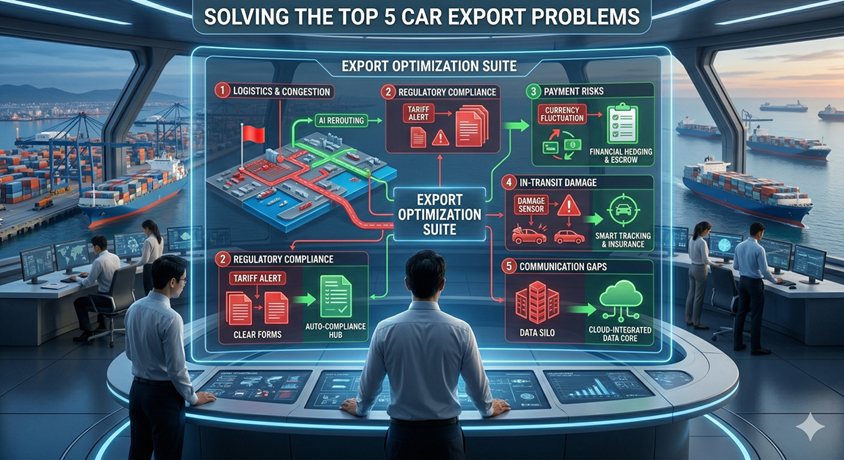
While the opportunity is huge, many exporters struggle with inefficiencies that slow down growth and reduce profitability. In this guide, we'll explore the top 5 problems in the car export business and provide practical solutions to overcome them using modern strategies and tools.
🌍Why Car Export Businesses Face Challenges
Car export is not a simple buy-and-sell process. It involves:
- Multiple stakeholders (auction houses, shipping companies, buyers)
- Cross-border regulations
- Complex logistics
- High transaction volumes
Without proper systems, even small mistakes can lead to delays, losses, or unhappy customers.
Inventory Mismanagement
The Issue
Many exporters still rely on spreadsheets or manual tracking. As inventory grows, this leads to:
- Duplicate entries
- Missing vehicle data
- Confusion about stock status
- Difficulty locating vehicles in stockyards
📉 Impact
- Lost sales opportunities
- Poor stock visibility
- Delayed decision-making
✅ Solution
- Track all vehicles in real time
- Organize by brand, model & location
- Update vehicle status instantly
💡 Best Practice: Assign unique IDs to each vehicle and maintain digital records.
Auction Mismanagement
The Issue
Japanese car auctions move fast. Without proper tracking software:
- You may miss bidding opportunities
- Lose track of selected vehicles
- Fail to analyze past bidding data
📉 Impact
- Lower profit margins
- Missed deals
- Poor buying decisions
✅ Solution
- Import auction data automatically
- Provide real-time updates
- Track bidding history
💡 Best Practice: Set bidding limits and use data insights to avoid overpaying.
Shipping & Logistics Delays
The Issue
Shipping involves coordination between multiple parties. Common problems include:
- Delayed bookings
- Poor shipment tracking
- Miscommunication with logistics providers
📉 Impact
- Late deliveries
- Increased costs
- Customer dissatisfaction
✅ Solution
- Track shipments in real time
- Automate booking processes
- Maintain digital logistics records
💡 Best Practice: Choose reliable shipping partners and monitor performance regularly.
Documentation Errors
The Issue
Car export requires accurate documentation. Mistakes include:
- Incorrect buyer details
- Missing paperwork
- Data inconsistencies
📉 Impact
- Customs delays
- Financial penalties
- Shipment rejection
✅ Solution
- Auto-generate invoices & documents
- Validate data before submission
- Store all records digitally
💡 Best Practice: Double-check critical documents before shipment.
Poor Client Management
The Issue
Managing international buyers manually can lead to:
- Lost communication
- Missed follow-ups
- Lack of order tracking
📉 Impact
- Reduced customer trust
- Fewer repeat orders
- Weak business relationships
✅ Solution
- Store all client information
- Track orders and payments
- Maintain communication history
💡 Best Practice: Provide regular updates to clients about their orders and shipments.
Bonus Problem: Lack of Business Insights
Without proper data, exporters struggle to identify profitable vehicles, track performance, or make strategic decisions.
Use analytics tools to:
⚙️How Modern Software Solves All These Problems
Instead of handling each issue separately, modern exporters use car export software to manage everything in one place.
👉 This significantly reduces operational complexity.
📈Future of Car Export Business
The industry is rapidly evolving toward:
Exporters who fail to adapt may struggle to compete.
🧩Why these five problems keep repeating
Most car export business problems are not isolated incidents. They are system problems. Inventory confusion, auction mistakes, shipping delays, paperwork errors, and poor client communication usually come from the same root issue: the business is operating without a single source of truth.
That is why exporters often feel like they are solving the same problem every month. One week the issue appears in auction tracking. The next week it appears in shipping. The week after that it shows up in document release or buyer updates. The symptom changes, but the underlying weakness is the same. Teams are working across disconnected tools, delayed updates, and inconsistent handoffs.
The fastest-growing exporters usually fix the root process rather than the symptom. They centralize vehicle status, document readiness, shipment milestones, and customer communication so the same issue does not reappear in a different form later.
🛠️How exporters prevent these issues before they happen
Operational controls
- One vehicle record from auction to delivery
- Assigned owners for each shipment milestone
- Weekly review of delays and gross profit
- Clear document-status tracking
Commercial controls
- Consistent buyer update templates
- Route-specific shipping decisions
- Market-based sourcing rules
- Margin review before final quote release
If your team is already experiencing these issues, the solution is usually not to work harder inside the same broken workflow. The solution is to improve the system that teams rely on every day. That is why this article connects naturally to manual vs software export systems and the full car export software guide.
📚Authoritative sources exporters should watch
Beyond internal workflow fixes, exporters should monitor credible external trade and customs sources such as JETRO, Japan Customs, and the World Customs Organization. Those sources help exporters stay aligned with the wider trade environment while they improve their internal process.
The operational lesson is consistent: the more complex the export chain becomes, the more dangerous informal processes become.
📍What a stable export workflow looks like
A stable car export business does not eliminate every exception. It makes exceptions visible early. Strong exporters know where every purchased vehicle stands, which documents are complete, which shipment is booked, what the buyer has been told, and what margin is still expected on the order. That level of visibility is what prevents small problems from turning into expensive ones.
This is why operations leaders should review these issues together rather than department by department. Auction, inventory, documents, shipping, and customer communication are not separate workflows. They are one export workflow with different owners. If your team only solves problems at the final stage, you are solving them too late.
Use the Japan export process guide to map the full flow and the software guide to see how stronger systems reduce repeated operational mistakes.
📉Why scaling makes these problems worse
A small exporter can sometimes survive with informal fixes because the founder still sees everything directly. That stops working as volume grows. Once more vehicles, more markets, and more team members are involved, hidden process problems multiply faster than revenue. A missed update that seemed harmless at low volume becomes repeated delay at higher volume. A weak handoff that only caused confusion once a month becomes a weekly issue. This is why operational maturity matters before scale, not after it.
The best operators treat scale as a systems challenge. They build consistent status rules, shared visibility, and reporting discipline early so growth does not expose the same weaknesses over and over again.
Exporters that solve these issues well usually do two things consistently. They make the workflow visible enough that teams can spot trouble before it becomes expensive, and they review patterns instead of isolated mistakes. A delayed document, a shipment problem, or a bad auction purchase should trigger a process question: why did the system allow this to happen, and what rule would stop it next time? That mindset is what separates reactive exporters from scalable exporters.
This is why operational reviews matter so much in the car export business. When managers regularly review auction outcomes, shipment delays, documentation issues, stock age, and customer complaints together, they can see the pattern behind the noise. That pattern is where the real improvement opportunity sits. Businesses that learn from those patterns become more resilient because they stop treating recurring issues as unavoidable.
A useful management habit is to convert each recurring problem into a dashboard question. Which shipments were delayed and why? Which vehicles sat too long after auction? Which documents caused the most rework? Which customers needed repeated status clarification? When teams answer those questions every week, the business gains a much clearer view of what is actually slowing growth. That visibility is what makes operational improvement sustainable rather than temporary. Over time, the exporter stops operating in crisis mode and starts operating from evidence.
That is the real path to a stronger export business: fewer surprises, faster correction, and better visibility before problems damage margin or customer trust.
🧩Why recurring problems usually point to one weak system
Export businesses often describe their pain in separate categories: inventory issues, shipping issues, document issues, auction issues, or buyer communication issues. In practice, these usually connect back to one weak operating system. The company does not have one reliable place where vehicle status, shipment readiness, document progress, and customer expectations stay aligned. When that shared visibility is weak, each department experiences the same underlying problem in a different form.
That is why fixing a single symptom rarely solves the wider issue. Hiring someone to chase documents may help temporarily, but it does not solve poor handoff design. Asking staff to send more updates may help for a week, but it does not solve missing status visibility. A stronger business asks a more useful question: what process rule, ownership rule, or system visibility gap allowed this problem to repeat? Once leadership starts solving problems at that level, the same issues appear less often across the whole operation.
This is one of the clearest differences between reactive exporters and scalable exporters.
📋A weekly review framework that reduces repeat mistakes
One of the best ways to reduce exporter problems is to review them in the same meeting every week. Instead of handling each issue only when it becomes urgent, management should check a short set of operational signals: units with delayed shipment milestones, documents still incomplete, aged stock, buyer payment lag, vehicles with unclear yard status, and customer complaints or repeated follow-up requests. That review helps teams catch patterns earlier, before they grow into margin loss or trust issues.
The benefit is not just faster reaction. It is better learning. A business can see whether delays are coming from one market, one route, one team handoff, or one type of sourcing mistake. Those patterns are what allow stronger rules to be built. Once a weekly review becomes part of management rhythm, repeated issues become easier to explain and easier to fix at the root instead of being absorbed as normal chaos.
For many exporters, this simple habit is the point where operational improvement becomes systematic instead of occasional.
🔄How problem reviews improve customer trust over time
Customers may not see the internal details of your export workflow, but they feel the quality of it through response time, clearer updates, fewer surprises, and more reliable timing. That means operational problem-solving is not only an internal efficiency project. It is also a commercial trust project. Exporters who reduce repeated mistakes usually look more professional because buyers experience fewer contradictions and delays.
This is why problem reviews matter beyond the back office. If you fix the underlying causes of status confusion, weak document control, and shipment delay, buyers receive more accurate communication. That improves repeat-business potential and makes the exporter easier to trust even when a real exception occurs. In competitive markets, that kind of reliability is often a stronger differentiator than small pricing differences.
A better process therefore improves both margin protection and customer confidence at the same time.
🎯How exporters should prioritize which problem to fix first
Not every exporter problem deserves the same urgency. A useful rule is to fix the issues that most directly affect stock visibility, shipment movement, document readiness, and buyer trust. Those areas usually create the largest downstream impact because they influence both margin and customer experience. Once those foundations are stable, smaller workflow improvements become easier to manage.
This helps leadership avoid the common mistake of solving the loudest issue instead of the most expensive recurring one. Better prioritization usually produces better operational calm as well.
Over time, that prioritization model helps exporters build a calmer operation because the root bottlenecks are addressed before they spread into multiple departments and customer touchpoints. It also improves management focus.
❓FAQs
What problem hurts car exporters most often?
One of the biggest issues is poor visibility across inventory, documents, and shipment status because that single weakness creates repeated delays and confused customer updates.
How can exporters reduce repeat process errors?
They should centralize each vehicle record, assign clear ownership for every stage, and track document and shipment checkpoints in one shared workflow.
Is software useful for small exporters too?
Yes. Small exporters benefit because structure added early prevents weak process habits from becoming much more expensive as shipment volume grows.
Which issue should exporters fix first?
Fix the issue that most directly damages stock visibility, shipment timing, or customer communication because those bottlenecks usually create the biggest downstream cost.
🔥Conclusion
The car export business offers great opportunities, but it also comes with operational challenges. From inventory issues to shipping delays, these problems can limit your growth if not addressed properly.
The good news is that each of these challenges has a clear solution. By adopting modern tools, improving processes, and focusing on efficiency, you can transform your operations and scale your business successfully.
👉 If you want to eliminate these problems and manage everything efficiently, consider using a complete solution like CarDeal365.
Book a Free DemoContinue Reading
Learn how exporters fix recurring workflow problems
Visit our car export management software page, then read the car export software guide, compare the best car export software for 2026, and review manual vs software car export systems.
Related Solutions
Map recurring exporter problems to the right software layer
Start with the car export management software page, then use these supporting pages to fix inventory and process-control issues.
Car export management software
Fix repeated workflow problems inside one operating system for purchasing, status control, documents, and shipping.
Car inventory management system for exporters
Fix poor stock visibility, location confusion, and delayed status updates.
Car export automation software
Reduce the manual coordination that creates repeatable export bottlenecks.
Related reading
How to Start a Car Dealership Abroad
Complete guide to starting a car dealership abroad for Japanese used car importers.
How to Scale a Car Export Business
What actually breaks as a car export business grows from a handful of units to high volume, and what to fix at each stage: staffing, syst...
How to Start a Car Export Business from Japan
Complete guide on how to start a car export business from Japan.

About the Author
Muhammad Khabir Uddin
Founder, CarDeal365 · 6+ years in automotive export & SaaS
View LinkedIn Profile