Why used car pricing is genuinely hard, not just a formula
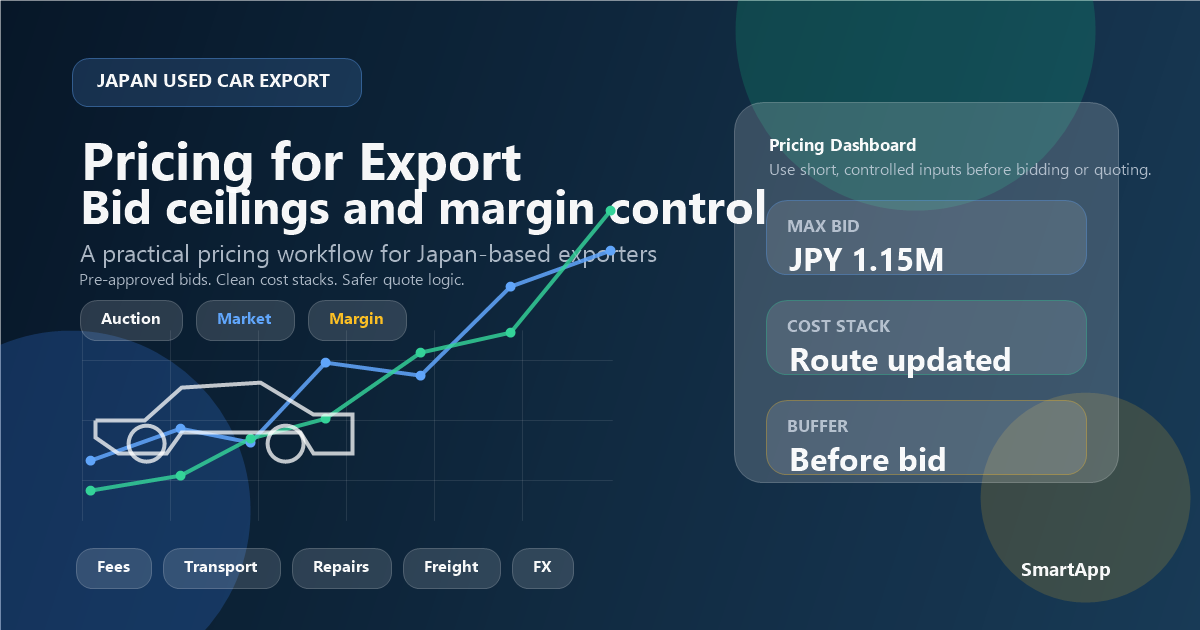
Pricing a used vehicle isn't as simple as purchase cost plus a fixed margin. Two units of the same model and year can have meaningfully different resale value depending on grade, mileage, equipment, and how strong demand is in a specific destination market that month. Staff pricing purely from memory or gut feel tend to either underprice strong units (leaving margin on the table) or overprice weak ones (letting them age on the lot). Our pricing guide for export covers the underlying methodology this AI guidance should be built on.
What data pricing guidance should actually use
| Input | Why it matters for pricing |
|---|---|
| Auction grade and condition | Directly drives resale value expectations |
| Mileage and equipment | Affects buyer comparison against similar units |
| Comparable sale prices | Reflects what buyers actually paid recently, not list price |
| Destination market | Same unit can command different prices in different markets |
A suggestion, not an automatic decision
The most important design choice in AI pricing guidance is what it doesn't do: it shouldn't silently set the listed price without a person confirming it. A suggested price is a starting point that reflects patterns in the data, but a manager who knows about a current market shift, an upcoming promotion, or a specific buyer relationship should still have the final say.
Practical Rule
Treat an AI price suggestion as a well-informed opinion from the data, not a number that gets published automatically.
Pricing differently per destination market
Demand for the same model and grade can vary significantly between destination countries — a popular model in one market might be a slow mover in another. Pricing guidance that tracks comparable sales per market, rather than one global average, gives a much more realistic starting point for exporters selling into several countries at once.
FAQs
Does AI set the final price automatically?
It shouldn't. AI pricing tools work best as a suggested starting point based on grade, condition, and comparable sales, with a manager reviewing and confirming the final listed price.
What data does AI pricing guidance actually use?
Typically the vehicle's auction grade and condition scores, mileage, equipment, and prices realized on comparable units, rather than a single fixed formula applied to every car.
Why not just price based on the auction purchase cost plus margin?
Because purchase cost tells you your floor, not what the market will actually pay. Two similarly priced purchases can have very different resale value depending on grade and destination-market demand.
Can pricing suggestions account for destination market differences?
Yes, if comparable sale data is tracked per market, since demand and price tolerance for the same model can vary significantly between destination countries.
Supporting guides in this series
How AI Helps Car Exporters
The pillar guide covering every AI capability in this series.
AI Vehicle Description Generator
The listing-content counterpart to accurate pricing.
Japanese Used Car Pricing for Export
The full manual pricing methodology behind this guidance.
AI Chatbot for Car Dealerships
What an AI chatbot should and shouldn't handle for a car dealership: routine availability and spec questions answered instantly, with a c...
AI Translation for Japanese Auction Sheets
How AI translates Japanese auction sheet notes and grading shorthand into usable data for non-Japanese-speaking export teams, and why tra...
Japanese Used Car Export to Africa
Complete guide to exporting Japanese used cars to Africa.
AI Sales Assistant for Car Dealers
Another area where AI assists but doesn't decide alone.
Conclusion
AI pricing guidance is most useful as a fast, data-backed starting point drawn from grade, condition, and comparable sales — not as a system that quietly sets prices without review. Used that way, it helps staff avoid the two most common pricing mistakes: underpricing strong units and letting weak ones age at the wrong price.
See how CarDeal365 connects grade, condition, and comparable data to pricing decisions.
Book a Demo
About the Author
Muhammad Khabir Uddin
Founder, CarDeal365 · 6+ years in automotive export & SaaS
View LinkedIn Profile