Why grading codes alone aren't the whole picture
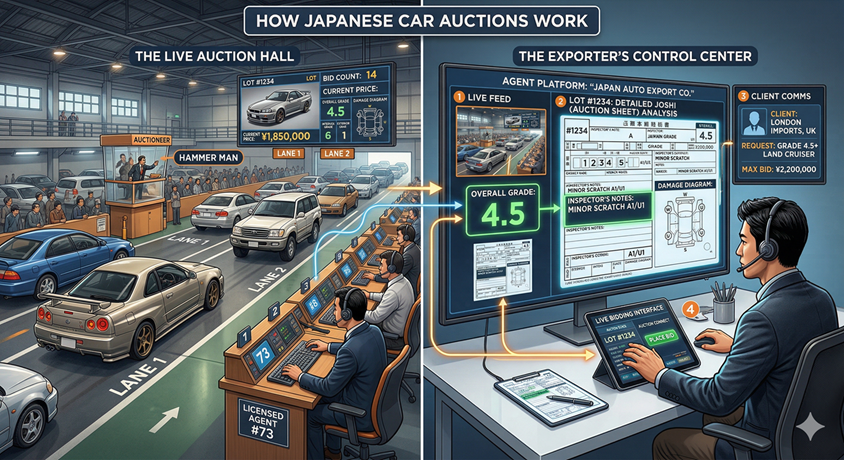
Japanese auction sheets are built around a standardized grading system — an overall grade, interior and exterior scores, and a damage diagram with coded markers. That structure is genuinely useful and widely understood across the industry. But auction sheets also carry free-text notes from the inspector, often handwritten, covering details that don't fit the standard codes: a specific repair history, an odor note, a modification, or something the inspector felt was worth flagging separately. Reading the codes without translating those notes means missing exactly the details that don't fit a neat category — often the ones a buyer cares about most.
What actually needs translation
| Content type | Handling needed |
|---|---|
| Grade and damage diagram codes | Standardized lookup, not really "translation" |
| Inspector free-text remarks | Genuine translation of handwritten or printed Japanese |
| Auction-specific abbreviations | Requires vocabulary tuned to auction conventions, not general Japanese |
| Equipment and option codes | Standardized lookup with translated labels |
Generic translation vs. auction-tuned translation
General-purpose translation tools aren't built for the specific shorthand and abbreviations used across auction houses, and can misread condensed notes or auction-specific terms that don't appear in everyday Japanese. Translation tuned specifically to auction sheet vocabulary, and paired with the standard grading codes for context, produces far more reliable output than running a photo through a generic translation app.
Keeping a human check in the loop for high-value units
Automated translation reduces how often you need someone with deep auction sheet fluency for routine units, but it doesn't eliminate the value of a spot-check, especially on higher-value or unusual vehicles where a misread note could matter more. Treat automated translation the same way as other AI-assisted steps in this series: a fast, reliable first pass that a knowledgeable person can verify when the stakes are higher.
FAQs
Why do auction sheets need translation, not just reading?
Auction sheets combine standardized grading codes with handwritten or printed Japanese notes about specific condition details. Reading the codes alone misses the free-text notes that often matter most for a specific unit.
What kind of notes appear on an auction sheet that need translation?
Inspector remarks about specific repairs, paint work, odor, smoking history, modifications, or other condition details that don't fit neatly into the standard grade and damage diagram codes.
Can machine translation alone handle this reliably?
Generic translation tools often struggle with auction-specific abbreviations and shorthand. Translation tuned to auction sheet vocabulary and paired with the standard grading codes gives more reliable results.
Does this replace the need for someone who understands Japanese auction conventions?
It reduces reliance on that specific skill for day-to-day operations, but a spot-check by someone familiar with auction sheet conventions is still worthwhile for high-value or unusual units.
Supporting guides in this series
How AI Helps Car Exporters
The pillar guide covering every AI capability in this series.
Auction Sheet Management
The full workflow this translation capability feeds into.
Used Car Export Software
Where grade and condition data feeds into pricing and margin.
AI Chatbot for Car Dealerships
What an AI chatbot should and shouldn't handle for a car dealership: routine availability and spec questions answered instantly, with a c...
AI-Powered Vehicle Description Generator
How an AI vehicle description generator drafts consistent, accurate listing content from real vehicle data, and why it still needs a huma...
AI for Used Car Pricing
How AI pricing guidance works for used cars: using grade, condition, and comparable sale data to suggest a starting price, while keeping ...
Conclusion
Auction sheet grading codes are only half the story; the handwritten and printed notes carry details that often matter most for a specific unit. AI translation tuned to auction sheet vocabulary turns those notes into usable data quickly, while a human spot-check on higher-value units keeps accuracy where it counts most.
See how CarDeal365's AI Auction Sheet Reader extracts and translates auction sheet data automatically.
Book a Demo
About the Author
Muhammad Khabir Uddin
Founder, CarDeal365 · 6+ years in automotive export & SaaS
View LinkedIn Profile