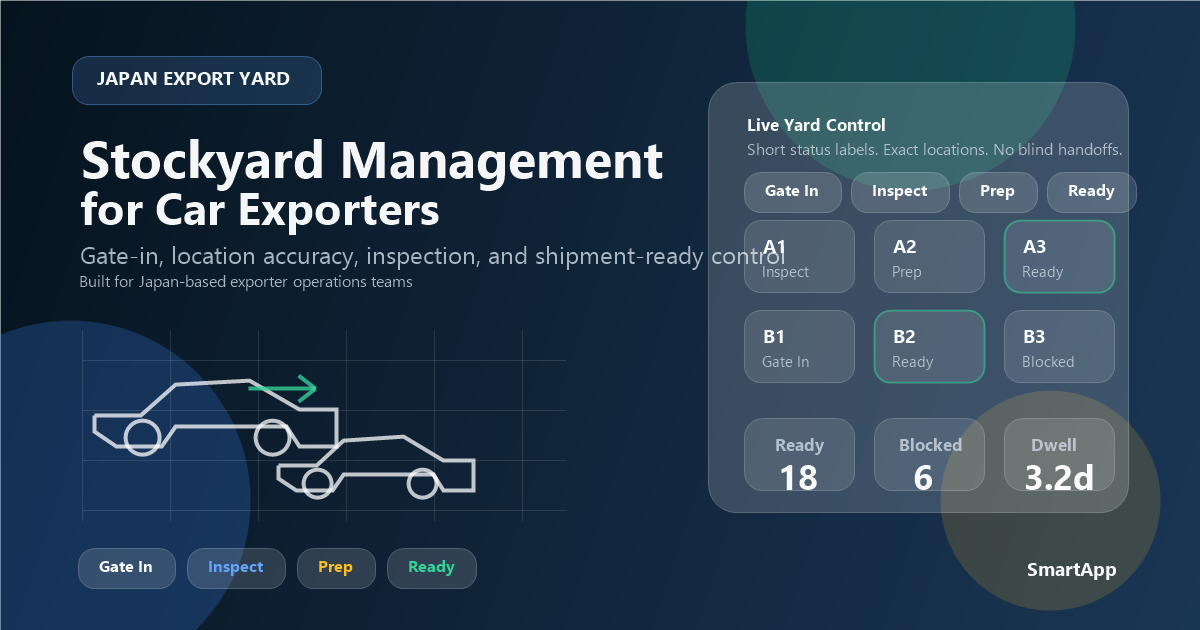
Why inventory management is where dealership margins are actually won or lost
It's tempting to think of inventory management as an administrative task: keep a list, know what's in stock, done. In practice, inventory management is where a dealership's margin gets decided. A unit that sits unsold for an extra 45 days is quietly costing money in floor plan interest, depreciation, and opportunity cost, even if nobody notices because the spreadsheet still technically "shows it's there."
Good inventory management isn't about having a list. It's about having a list that tells you something useful the moment you look at it: what's aging, what's ready to sell, what's blocked and why, and what it actually cost to acquire.
What a proper vehicle record should track
Each vehicle needs to carry enough information that any staff member can answer basic questions about it without calling around. That means more than a make, model, and price.
| Field group | What belongs there |
|---|---|
| Identity | VIN, make, model, year, trim, mileage |
| Condition | Photos, inspection notes, known issues, reconditioning status |
| Acquisition | Source, purchase price, fees, date acquired |
| Location | Lot, bay, or yard position, and movement history |
| Status | In stock, in prep, listed, reserved, sold, delivered |
| Documents | Title, inspection certificate, sale paperwork |
Aging stock is a visibility problem, not a market problem
Most aging-inventory problems aren't caused by a weak market. They're caused by nobody noticing a unit has aged until it's already lost value. Without an aging report, a $12,000 unit that should have had its price adjusted at day 30 is still sitting at the original price at day 90, quietly costing more in holding cost than the eventual discount would have.
The fix is simple to describe and easy to skip: review inventory age on a fixed schedule, flag anything past your dealership's normal sale window, and have a default action (price review, promotion, wholesale-out decision) ready before it becomes urgent.
Practical Rule
If you can't answer "which units are past our normal sale window?" in under a minute, your inventory system isn't giving you aging visibility.
Designing a status workflow your whole team actually uses
A vehicle status system only works if everyone uses the same set of statuses and updates them at the same trigger points. Loosely defined statuses ("almost ready," "should be fine") create the same confusion a spreadsheet does, just inside a nicer-looking tool.
A workable status set is usually short: received, in inspection, in reconditioning, listed, reserved, sold, delivered. Each status should have a clear owner responsible for moving it forward, so a unit doesn't sit in "in reconditioning" for three weeks because nobody was assigned to finish the job.
Managing inventory across multiple lots or yards
Dealerships operating more than one location need inventory visibility that works across sites, not a separate spreadsheet per lot. Sales staff at one location should be able to see stock at another without a phone call, and management needs a combined view to compare aging and turnover between locations. This is one of the clearest signs a dealership has outgrown spreadsheets: the moment "which lot has that model" becomes a recurring question, it's a visibility gap, not a staffing gap.
Common inventory management mistakes
No aging reports
Without them, price adjustments happen too late, if at all.
Status updates that lag reality
If the system says "in stock" for a unit that sold three days ago, nobody trusts the system.
Documents stored separately from the vehicle record
Finding the title or inspection report shouldn't require a search through email.
FAQs
What is dealer inventory management?
Dealer inventory management is the process of tracking every vehicle a dealership holds, including its condition, cost, location, and sale status, so the business always knows what it has, what it's worth, and how long it has been sitting.
What causes aging inventory at a dealership?
Aging inventory usually comes from poor visibility: nobody notices a unit has been in stock too long until it's already a problem. Without aging reports, pricing doesn't get adjusted and units sit past their optimal sale window.
How often should inventory data be updated?
Inventory status should update at every meaningful event: intake, inspection, price change, reservation, sale, and delivery. Batch updates once a week or once a month are too slow to catch problems early.
How is dealer inventory management different from a general inventory system?
Each vehicle is a unique asset with its own condition, documents, and cost basis, unlike a SKU with a stock count. Dealer inventory management needs to track that individuality, not just quantity on hand.
Supporting guides in this series
Car Dealership Software
See where inventory fits into the wider dealership system.
Vehicle Stock Management
A deeper look at physical stock and yard-level operations.
Dealer ERP
When inventory needs to connect to finance and reporting as one system.
How to Manage a Used Car Dealership
The pillar guide covering every operational area of the series.
How to Start a Car Dealership Abroad
Complete guide to starting a car dealership abroad for Japanese used car importers.
How to Scale a Car Export Business
What actually breaks as a car export business grows from a handful of units to high volume, and what to fix at each stage: staffing, syst...
CarDeal365 vs AutoManager
An honest comparison of CarDeal365 and AutoManager (DeskManager): what AutoManager does well as a US/Canada domestic dealer management sy...
ERP vs CRM for Car Dealers
A direct comparison of ERP and CRM for car dealers: what each one covers, where they overlap, and a decision framework for which one to p...
Best Software for Car Exporters in 2026
Compare the best car export management software for small and medium exporters in 2026.
Barcode vs VIN Tracking
Which method should actually run your vehicle inventory.
Conclusion
Dealer inventory management stops being an administrative chore once it's treated as a margin lever. Track the right fields per vehicle, define a status workflow the whole team follows consistently, and review aging on a fixed schedule instead of hoping someone notices.
See how CarDeal365 gives every vehicle one connected record from intake to sale.
Book a Demo
About the Author
Muhammad Khabir Uddin
Founder, CarDeal365 · 6+ years in automotive export & SaaS
View LinkedIn Profile