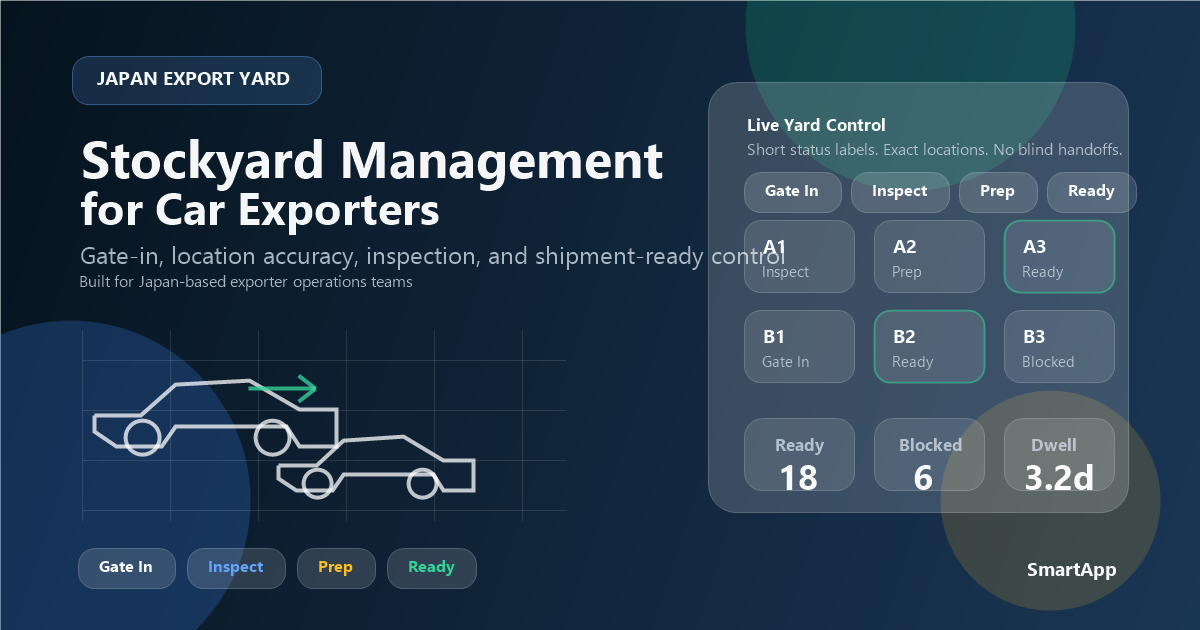
Why the yard and the spreadsheet tell different stories
Vehicle stock management is the part of inventory work that happens with your hands, not your keyboard: a unit gets moved to make room for a delivery truck, pulled out for a test drive, pushed to the back row during a wash, or shifted into the service bay for a quick repair. None of that is unusual. What's unusual is how rarely those moves get logged anywhere, which means the system's idea of "where is this car" quietly drifts away from reality.
This gap is invisible until someone needs the vehicle urgently — a buyer is on the lot ready to see it, or a delivery is scheduled — and staff spend twenty minutes walking the yard because the system said one thing and the yard said another.
Location tracking that people will actually keep updated
The best location system is the simplest one your team will actually use consistently. Elaborate row-and-bay numbering schemes fail if updating them takes longer than walking over and looking. A workable structure usually has a small number of named zones (front lot, back lot, service bay, wash bay, delivery staging) plus a simple row or bay number within each zone.
The habit that matters more than the system is the trigger: anyone who moves a vehicle updates its location immediately, not "later" or "at the end of the day." Once that habit slips, the whole point of tracking location is lost.
Reconditioning workflow: the stage where units silently stall
Reconditioning is one of the most common places for stock to age invisibly. A vehicle goes in for detailing, minor repair, or inspection, and without a clear owner and deadline, it can sit for weeks while everyone assumes someone else is handling it.
| Stage | Owner | Target time |
|---|---|---|
| Intake inspection | Yard lead | Same day |
| Mechanical repair | Service team | 2–5 days |
| Detailing/photos | Prep team | 1–2 days |
| Ready to list | Sales | Same day as prep completion |
Assigning a clear owner and target time to each stage turns reconditioning from an open-ended task into something that can be flagged the moment it runs late.
Physical stock counts: the reality check the system needs
No matter how good the logging habit is, physical counts catch what falls through the cracks: a unit that was sold but never marked sold, a vehicle moved off-site for a photo shoot and forgotten, or a trade-in sitting in a corner that never made it into the system at all.
A full count on a fixed schedule — monthly for most dealerships — plus spot checks whenever something looks off, keeps small discrepancies from turning into a stock list nobody trusts.
Common vehicle stock management mistakes
Logging location "later"
Later rarely happens, and the record drifts from reality within days.
No owner assigned to reconditioning stages
Work without an owner is work that quietly stalls.
Skipping scheduled physical counts
Small discrepancies compound into a stock list nobody trusts.
FAQs
What is vehicle stock management?
Vehicle stock management is the physical, yard-level side of inventory control: knowing exactly where each vehicle sits, what stage of preparation it's in, and keeping that physical reality in sync with the system's records.
How is stock management different from inventory management?
Inventory management covers the full record of a vehicle including cost, documents, and sale status. Stock management focuses specifically on the physical side: location, movement, and reconditioning progress on the lot or yard.
How often should physical stock counts be done?
Most dealerships benefit from a full physical count on a regular cycle, such as monthly, with spot checks whenever a discrepancy is suspected. Larger or multi-lot operations may need more frequent partial counts.
What causes the system to drift out of sync with the yard?
Usually informal moves that never get logged: a unit shifted to make room for another, a vehicle pulled for a test drive and parked somewhere else, or reconditioning work finished without updating status.
Supporting guides in this series
Dealer Inventory Management
The full-record side of inventory that stock management feeds into.
Car Dealership Software
See where yard-level tracking fits into the wider system.
Auction Bidding Software
Where new stock enters the pipeline before it reaches the yard.
How to Manage a Used Car Dealership
The pillar guide covering every operational area of the series.
How to Start a Car Export Business from Japan
Complete step-by-step guide to starting a car export business from Japan.
Top Dealer ERP Systems
A fact-checked roundup of leading dealer ERP systems for franchise and multi-location groups: Tekion, CDK Global, Reynolds and Reynolds, ...
CarDeal365 vs DealerCenter
An honest comparison of CarDeal365 and DealerCenter: what DealerCenter does well as a US domestic dealer management system, and where an ...
ERP vs CRM for Car Dealers
A direct comparison of ERP and CRM for car dealers: what each one covers, where they overlap, and a decision framework for which one to p...
Used Car CRM
Why generic CRM tools fall short for used car sales, what a used car CRM needs to track, and how to connect customer records to real vehi...
Barcode vs VIN Tracking
Which method should actually run your vehicle inventory.
Conclusion
Vehicle stock management is where good inventory data either holds up or falls apart. Simple, consistently-used location tracking, clear reconditioning ownership, and regular physical counts keep the system and the yard telling the same story — which is the whole point of tracking stock in the first place.
See how CarDeal365 keeps physical stock and system records aligned.
Book a Demo
About the Author
Muhammad Khabir Uddin
Founder, CarDeal365 · 6+ years in automotive export & SaaS
View LinkedIn Profile