Introduction
Japanese car auctions are the backbone of the global used car export industry. Every week, hundreds of thousands of vehicles are listed across auction houses in Japan, offering exporters access to a wide variety of cars at competitive prices.
For anyone involved in car export, understanding how Japanese car auctions work is essential. Whether you are a beginner or an experienced exporter, mastering the auction process can significantly improve your buying decisions and profitability.
This complete guide will walk you through everything — from auction types and bidding strategies to inspection sheets and common mistakes.
🌍What Are Japanese Car Auctions?
Japanese car auctions are large-scale marketplaces where vehicles are sold to registered buyers through a bidding system.
Key Characteristics
- Thousands of cars listed daily
- Strict inspection and grading systems
- Competitive pricing
- Fast-paced bidding environment
👉 Only licensed dealers or registered exporters can participate directly.
🏢Major Auction Houses in Japan
Japan has several well-known auction groups:
Each auction house has its own system, but the core process is similar.
🚗Types of Vehicles Available
You can find almost every type of vehicle:
👉 This variety makes auctions ideal for exporters targeting different markets.
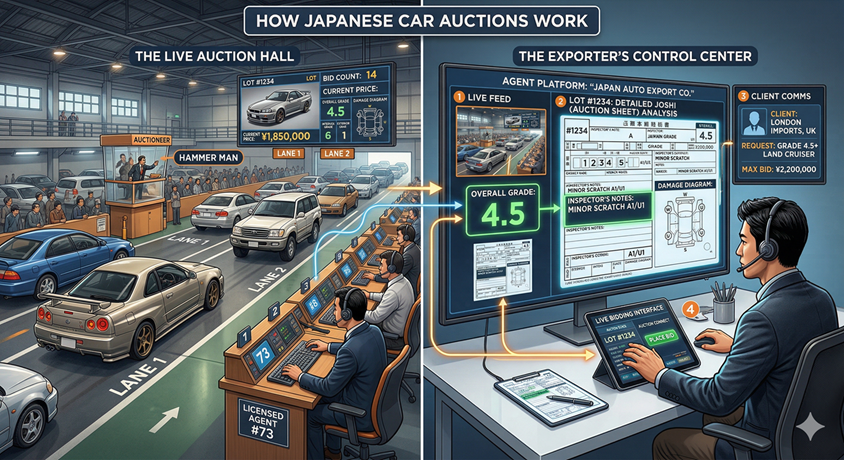
🔄How the Auction Process Works (Step-by-Step)
Vehicle Listing
Sellers (dealers, companies, or individuals) submit vehicles to auction houses. Each listing includes:
Inspection & Grading
Before auction, vehicles are inspected by professionals.
| Grade | Condition |
|---|---|
| S / 6 | Almost new |
| 5 / 4.5 | Excellent condition |
| 4 / 3.5 | Good condition |
| 3 / RA / R | Damaged or repaired |
👉 The grading system helps buyers quickly assess quality.
Auction Day Bidding
Vehicles are listed in sequence, each auctioned within seconds. Buyers place bids in real time.
👉 Highest bidder wins the vehicle.
Winning & Confirmation
If you win, the auction confirms the sale, provides a payment deadline, and the vehicle moves to export processing.
👉 Some vehicles have a reserve price — the seller must approve the final bid.
Payment & Ownership Transfer
Buyers must:
- Complete payment within a few days
- Pay auction fees and taxes
- Receive ownership documents
Export & Shipping
After purchase:
- Vehicle is transported to port
- Export documents are prepared
- Shipping arranged (RoRo or container)
📄Understanding Auction Inspection Sheets
The inspection sheet is one of the most important documents.
It Includes
- Overall grade
- Interior and exterior condition
- Engine status
- Mileage verification
- Repair history
Symbols & Notes
- Scratches, dents, rust marks
- Repaired areas
- Replacement parts
👉 Learning to read this sheet correctly is critical.
💡Bidding Strategies for Exporters
⚠️Common Mistakes to Avoid
Ignoring Inspection Reports
Leads to buying damaged vehicles unknowingly.
Overbidding
Reduces profit margins and defeats the purpose of auction sourcing.
Poor Planning
Buying vehicles without considering demand in your target market.
Missing Payment Deadlines
Can result in penalties or account suspension from the auction house.
⚙️How Software Improves Auction Management
Modern exporters use Japan car auction software to simplify auction operations.
👉 This improves efficiency and reduces errors.
📈Future of Japanese Car Auctions
The industry is evolving toward:
👉 Exporters who adapt early will benefit the most.
🔎How experienced exporters evaluate auction risk
Learning how Japanese car auctions work is only the first step. Experienced exporters do not simply read auction sheets and bid. They build a risk model around every potential purchase. That model includes vehicle grade, mileage, repair tolerance, destination-market fit, freight route, reconditioning cost, and expected days in stock.
This is why auction knowledge has such strong SEO and business value. Exporters who understand the grading system but ignore market fit still overpay. Exporters who understand prices but ignore downstream cost still lose margin. The strongest operators treat the auction decision as the first operational checkpoint in the full export process.
If you need to connect auction buying with downstream workflow, pair this article with the export process guide and the cost planning guide.
📈Bidding strategy mistakes foreign exporters make
Chasing low price without downstream cost logic
The cheapest auction win is not always the best export buy once transport, repair, and destination fit are included.
Ignoring grade context
Two vehicles can look similar on headline details but differ significantly in repair risk or commercial appeal.
Not tracking bid history and outcome
Without historical learning, teams repeat the same overbidding mistakes again and again.
📚Authoritative references for auction and export context
Foreign exporters should always combine auction knowledge with reliable trade context from sources such as JETRO, Japan Customs, and UNCTAD logistics guidance. Those references do not replace hands-on buying skill, but they help keep auction decisions connected to the wider export environment.
📦Connecting auction buying to export performance
The strongest exporters do not treat auctions as an isolated sourcing channel. They treat auctions as the first step in a measurable export workflow. A good buy is one that fits the destination market, supports expected margin after freight and preparation, and can move through documentation and shipment without unnecessary delay. That is the difference between smart bidding and simple bidding.
This is also why auction discipline improves when businesses track outcomes over time. Which grades produced too many corrections? Which source types created higher repair cost? Which vehicle categories sold faster in each market? When exporters keep those feedback loops, auction performance improves because the team is learning from real downstream outcomes, not from isolated win rates.
For the shipping side of that decision, compare RoRo and container shipping. For the financial side, review car export business cost planning.
🎯Why auction discipline improves overall profitability
Auction discipline matters because sourcing quality shapes everything that happens later. A vehicle that looks cheap but needs unexpected work, moves slowly, or fits the destination market poorly can weaken gross profit before freight is even booked. Exporters who learn to match auction decisions with route, market, and downstream cost usually outperform those who only focus on winning bids.
That is why the most useful auction knowledge is commercial knowledge. It helps exporters buy stock that can actually move profitably through the whole export chain.
The exporters who consistently buy well at Japanese car auctions are rarely the ones chasing the most bargains. They are the ones connecting auction knowledge with downstream results. They know which stock turns quickly, which grades create hidden work, which markets tolerate certain conditions, and how freight and document timing affect the final deal. That is why auction learning is one of the highest-value skills in the whole car export chain.
In other words, auction success is not measured only by the hammer price. It is measured by how well the purchased unit performs after shipping, compliance checks, and resale. Exporters who understand that full picture can source more confidently and protect margin more consistently over time.
Exporters also benefit from separating auction excitement from auction logic. Winning a unit feels productive, but a purchase only creates value when it fits market demand, downstream cost, and expected turnover. That discipline is especially important for growing businesses because one weak buying decision can create repair cost, shipment delay, and pricing pressure later. In that sense, auction discipline is a form of risk control as much as it is a sourcing skill.
Done well, auction skill becomes one of the clearest drivers of export consistency and long-term profitability.
That advantage grows with every well-reviewed purchase. Over time, disciplined exporters build a sourcing record that is easier to trust, easier to scale, and easier to align with destination-market demand. Instead of reacting to each auction day as a separate event, they build a repeatable buying model that improves profitability across the entire business.
🧾How auction grades should influence bid ceilings
Many exporters know the grading symbols but still struggle to turn them into smart pricing discipline. The reason is simple: auction grades are useful, but only when paired with market expectations and downstream cost. A grade that looks acceptable for one destination may still be a weak buy for another if repair tolerance is lower or if buyers in that market are more sensitive to cosmetic condition.
This is why experienced exporters set bid ceilings by market, vehicle type, and likely post-purchase work, not by grade alone. A clean grade 4 unit in a high-demand segment may justify stronger bidding because it is likely to move quickly and protect resale confidence. A lower-grade unit may still work commercially, but only if the destination market accepts that condition and the total landed cost leaves enough room for margin. The auction grade informs the decision. It should not replace the decision.
The better your team becomes at translating grade into commercial outcome, the more consistently you will source profitable stock.
🏢Why auction house differences matter more than beginners expect
Not all auction houses feel the same in practice. Exporters often discover that certain lanes, seller types, or house cultures create different buying behavior and different levels of predictability. Some environments may offer stronger volume and liquidity. Others may suit buyers looking for particular vehicle categories or more stable condition expectations. This does not mean one auction house is universally better. It means exporters should learn where their buying model performs best.
That learning process becomes easier when teams track outcome by source: which auction houses produced the best stock turns, which created more correction cost, and which matched certain destination markets more reliably. Once those patterns are visible, bidding becomes more disciplined because the team is buying with historical evidence rather than habit. That is one of the clearest ways mature exporters outperform inexperienced ones.
Auction house knowledge, in other words, is not trivia. It is part of commercial decision quality.
🧠How smart exporters combine auction sheets with market demand
A strong auction decision is never based on condition data alone. It also depends on what buyers in your destination market actually want. Mileage sensitivity, preferred body style, transmission preference, fuel type, and acceptable cosmetic condition can all vary by market. That means the same vehicle can be a strong purchase for one destination and an average or weak purchase for another.
This is why exporters who keep market feedback loops make better auction decisions over time. They know which segments sell fast, which conditions create resistance, and where customers are more sensitive to repair history or presentation. Auction sheets help them evaluate the unit. Market knowledge helps them evaluate the likely resale outcome. Together, those two layers create stronger bid discipline and better margin protection.
Auction success becomes far more repeatable when sourcing teams are connected to real market performance instead of isolated from it.
📷Photos, notes, and verification should reduce uncertainty early
One of the most expensive auction mistakes is assuming that the grade alone tells the full story. Exporters should combine the sheet, the visible photos, any agent-side notes, and their own market logic before bidding. This reduces the chance of paying aggressively for a vehicle that will later require more repair, generate buyer hesitation, or move more slowly than expected.
A practical rule is to treat every piece of pre-purchase information as a way to reduce uncertainty. If the available information still leaves the commercial outcome too vague, the safer choice may be to skip the unit rather than chase the possibility of a bargain. Good exporters are not only skilled at finding good buys. They are disciplined enough to avoid ambiguous buys that create avoidable risk later.
Over time, this discipline improves both profitability and management calm because fewer purchases become operational surprises.
📅Why auction planning before sale day improves results
Strong auction buying usually begins before the bidding starts. Teams that prepare a shortlist, define bid ceilings, review destination fit, and agree on no-go conditions before sale day make calmer and better decisions. Teams that review vehicles only at the last moment are more likely to overreact to price movement, ignore hidden cost, or buy units that do not fit the planned sales mix.
This preparation step is especially important for exporters handling multiple destinations or multiple buyers at the same time. A prepared buying list protects attention and helps the team compare alternatives instead of becoming emotionally attached to one unit. It also supports stronger internal accountability because management can review whether the final purchase stayed within the planned commercial logic.
Auction planning is therefore not admin work. It is part of professional sourcing discipline.
🌐How multi-market exporters buy differently
Exporters serving more than one country usually become better auction buyers because they learn to compare a unit against several possible outcomes. A vehicle that may be average for one market could be a very efficient buy for another. This flexibility creates opportunity, but only if the team has clear knowledge of demand, condition tolerance, and landed-cost logic by market.
Without that discipline, multi-market exporting can also create confusion. Teams may buy stock hoping one market will absorb it later, only to discover the unit fits none of them well. That is why good multi-market buying requires stronger data, not looser standards. The more markets you serve, the more valuable clean sourcing rules become.
When market fit is visible and deliberate, auction buying becomes more resilient and more scalable.
🔁The post-purchase review loop that improves future bidding
Many exporters review auction performance only by win rate or purchase volume. That is too shallow. The more useful review asks what happened after the purchase. Did the unit need more repair than expected? Did it sell slower than planned? Did the destination market respond well? Was the total landed margin strong enough after all costs and delays were included?
When teams measure auction decisions against downstream outcomes, future bidding becomes smarter because the feedback is commercial, not emotional. This is how mature exporters build a repeatable sourcing advantage. The team stops chasing isolated wins and starts building a buying model with evidence behind it.
That review loop is one of the most important long-term advantages in the whole auction business.
🧮How to build a disciplined maximum bid formula
A disciplined exporter does not arrive at a maximum bid by instinct alone. The ceiling should reflect auction price, inland transport, inspection or preparation work, freight, destination charges, expected selling price, and a realistic target margin. When any of those components are vague, the bid becomes more speculative than commercial. This is especially risky in competitive lanes where emotion can push buyers beyond the level the vehicle can support profitably.
The advantage of using a bid formula is not just cost control. It also creates internal consistency. Different buyers inside the same company can make decisions using the same logic rather than relying on individual habit. Over time, that improves sourcing quality because management can review performance against a known standard. It becomes easier to see whether losses come from market conditions, poor assumptions, or poor discipline.
This method is particularly important for exporters serving multiple destinations. A unit that makes sense for one route may fail on another once freight, taxes, or buyer expectations are included. The formula therefore needs to reflect the intended market, not just the vehicle itself.
When bid ceilings are calculated this way, auction buying becomes more professional, more teachable, and more scalable.
🤝Why agent relationships and feedback improve auction performance
Even experienced exporters benefit from strong communication with agents, inspectors, and internal buyers who can provide quick clarification when a unit looks promising but uncertain. Good relationships do not remove risk, but they can improve the quality of context available before bidding. That context becomes especially valuable when exporters are assessing popular units, ambiguous condition notes, or segments where minor differences in presentation strongly affect resale.
The same principle applies after the purchase. Teams should capture feedback from buyers, repair staff, and destination-market sales results so the sourcing team learns which assumptions were correct and which were weak. That ongoing feedback loop turns auction buying from a daily reaction into a continuously improving system. Over time, it creates a meaningful commercial edge because the team is learning faster than competitors who evaluate results only loosely.
Auction knowledge becomes most powerful when it is shared, reviewed, and refined across the entire export business.
VisualThe auction decision ladder exporters should use before bidding
Strong auction teams do not jump from listing to bid. They move through a repeatable ladder that links vehicle condition to market fit, landed cost, pricing discipline, and feedback after the unit is sold.
❓FAQs
Can anyone participate in Japanese car auctions?
No, you need a registered exporter or agent to access auctions directly.
Are auction cars reliable?
Yes, due to strict inspection systems, but always verify the inspection report before bidding.
What is the best grade to buy?
Grade 4 to 4.5 offers a good balance between price and quality for most markets.
🔥Conclusion
Understanding how Japanese car auctions work is essential for success in the car export business. From vehicle selection to bidding strategies, every step plays a critical role in profitability.
By mastering the auction process and using the right tools, you can make smarter decisions, reduce risks, and grow your export business efficiently.
👉 To manage auctions, inventory, and shipping in one place, consider using a complete solution like CarDeal365.
Book a Free DemoContinue Reading
Connect auction buying to the full export workflow
Explore our car auction software for exporters page, then follow the car export process from Japan, read how to manage a car export business, and review car export business cost planning.
Related Solutions
Turn auction knowledge into a controlled sourcing workflow
Start with the car auction software page, then use these supporting pages to connect sourcing decisions with inventory and the wider export workflow.
Car auction software for exporters
Manage purchases, lot references, landed costs, and intake status in one workflow.
Car export management software
See how auction sourcing connects to inventory, documents, and shipment planning.
Car inventory management system for exporters
Track what happens after each purchased vehicle reaches the yard and enters stock.
Related reading
Japanese Auction Sheet Abbreviations Glossary
Decode the grade codes and damage-map symbols referenced throughout this guide.
Japan Car Auction Calendar & Buying Cycle Guide
How the weekly rhythm of USS, TAA and JU halls should shape your buying calendar and cash flow.
Exporting Salvage & Accident-Damaged Japanese Used Cars
A candid guide to the grade R/RA segment of the auction market.
Auction Purchase Management
How to manage auction purchases across a whole buying week: reconciling invoices and fees per lot, consolidating units into shipments, an...
Japanese Car Auction Fees Explained
Every fee you pay when buying at Japanese car auction — USS, TAA, JU buyer fees, transport to port, deregistration, export customs, agent...
Bidding at USS Tokyo & USS Yokohama
Ultimate exporter guide to bidding at USS Tokyo and USS Yokohama used car auctions.
Auction-to-Shipment Automation
Learn how auction-to-shipment automation removes delays in Japanese car export operations by connecting buying, yard status, documents, b...
TAA Auction Guide
How Japan's TAA network works for export buyers.

About the Author
Muhammad Khabir Uddin
Founder, CarDeal365 · 6+ years in automotive export & SaaS
View LinkedIn Profile