The Dominance of USS Auctions
In the ecosystem of global automotive exports, Japan's used car auction network is the undisputed engine. And at the absolute center of this network sits **USS (Used Car System) Co., Ltd.** Commanding over 30% of the entire wholesale automotive auction market share in Japan, USS operates 19 auction sites across the country.
For any international vehicle exporter, mastering USS bidding is a necessity. USS is not just another auction group; it is the benchmark for pricing, vehicle grading, and liquidity. When exporters talk about setting "market prices" or evaluating bidding trends, they are almost always referring to historical data sourced from USS Tokyo and its sister yards.
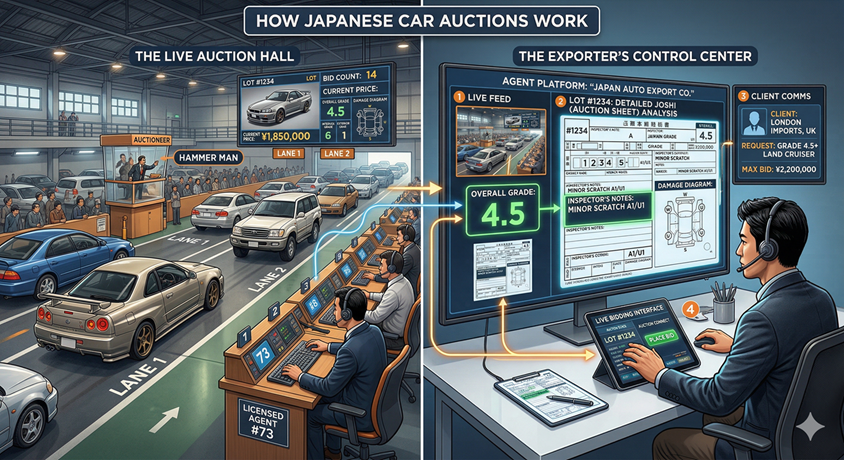
Navigating these high-speed auctions requires specific operational expertise. Bids are processed in fractions of a second, lanes bidding simultaneously handle thousands of cars, and minor errors in reading inspection sheet notes can result in JPY 100,000 losses.
USS Tokyo (Noda): The World's Largest Hub
Despite its name, **USS Tokyo** is physically located in Noda City, Chiba Prefecture. It is not just the largest auction in Japan; it is the largest wholesale used vehicle market in the world.
Every Thursday, the USS Tokyo site undergoes an intense operational cycle:
- Volume: Between 10,000 and 15,000 vehicles are auctioned off in a single day.
- Simultaneous lanes: USS Tokyo utilizes **12 bidding lanes** running concurrently. This means 12 vehicles are sold every few seconds. An exporter bidding on multiple lots must monitor 12 screens or utilize automated multi-lane bidding software.
- Key Bidding Corners: USS Tokyo groups vehicles into specific "corners" to streamline the buyer's search:
- One Owner Corner: Vehicles with a clean domestic history, highly valued for export due to complete maintenance logs.
- Low Mileage Corner: Cars with under 20,000 or 30,000 kilometers on the odometer. They command premium pricing in markets like New Zealand and the Caribbean.
- LHD Corner: Left-hand drive vehicles, targeting South American (Chile, Peru), Central Asian (Mongolia), and West African markets.
- Junk/Reclaimed Corner: Damaged vehicles bought cheap for auto parts harvesting.
Because USS Tokyo is the liquidity hub, prices here represent the benchmark. Sourcing from USS Tokyo is highly efficient, but competition from global exporters is fierce, which can drive up margins on popular models like the Toyota HiAce or Land Cruiser Prado.
USS Yokohama: Premium Imports & Friday Sourcing
Held every Friday, **USS Yokohama** serves as a strategic counter-weight to USS Tokyo's Thursday rush. Located in Yokohama near the major shipping ports, USS Yokohama holds a unique position in the used car export industry.
While its volume (typically 2,000 to 4,000 cars per week) is lower than USS Tokyo, it specializes in premium categories:
- Import Car Corner: Yokohama is a major market for imported European (Mercedes-Benz, BMW, Audi, Porsche) and American vehicles in Japan. These vehicles are often left-hand drive (LHD) and are highly sought after by buyers in Eastern Europe and LHD zones in South America.
- Logistics Advantage: Because the yard is located in Yokohama, transporting purchased vehicles to port yards (Yokohama, Kawasaki) is extremely cheap (often JPY 5,000 to JPY 10,000 per car), saving exporters significant inland transport fees compared to shipping out of Noda City.
Decoding USS-Specific Sheet Notation
Every vehicle at a USS auction is accompanied by an official USS Inspection Sheet. USS inspectors are known for their strict, consistent grading standards, but their notes are written in Japanese shorthand and specific symbols that exporters must decode.
For details on general grading systems, see our Japanese Car Auction Inspection Grades. However, USS sheets feature unique indicators:
USS Diagram Shorthand
- A1, A2, A3: Scratches. A1 is minor (under 5cm), A2 is moderate (10-20cm), and A3 is severe (requires repainting).
- U1, U2, U3: Dents. U1 is small (hardly visible), U2 is moderate, and U3 is severe.
- W1, W2, W3: Repaint waves or repair marks. W1 means a professional repaint job; W3 indicates visible paint waves or mismatched color panels.
- S1, S2, S3: Underbody rust and corrosion. S1 is minor surface rust; S3 indicates severe corrosion (often causing vehicles to fail compliance checks).
- XX: A panel that has been completely replaced. This is a critical indicator of past accidents.
Critical Inspector Notes in USS Sheets
Always translate the **inspector's remarks section** (usually in the center-right of the sheet). Watch out for these Japanese terms:
- エンジン異音 (Enjin Ion): Engine noise. Indicates potential bearing, valve, or piston issues.
- ミッション滑り (Mishon Suberi): Transmission slip. A major warning sign for automatic or CVT transmissions.
- 下回りサビ大 (Shitamawari Sabi Dai): Underbody has severe rust. A major red flag for countries with strict structural compliance (like New Zealand or the UK).
- メーター改ざん車 (Metā Kaizan Sha): Odometer rollback. USS marks the odometer value with a black circle or a dollar symbol ($) to indicate verified mileage discrepancies. Never export these to countries requiring mileage certification (such as Jamaica or Kenya).
Bidding Tactics: Bid Timing & Satellites
Bidding at USS is an intense, digital process. The lanes run fast, and vehicles are sold in an average of 10 to 15 seconds. Exporters use different channels to bid:
1. Auction Hall Terminals
Bidding live inside the USS Tokyo or Yokohama hall using physical POS terminals. Buyers insert a membership smartcard and press buttons to increase bids. This channel has zero latency and is preferred by local buying agents.
2. Satellite Internet Systems (USS Globe / CIS)
Exporters operating from office headquarters use USS Globe, CIS, or API-integrated bidding portals. These systems stream live bid screens. However, satellite bidding introduces a latency delay (usually 100 to 300 milliseconds).
The "Final Seconds" Bidding Tactic
Because lanes move extremely fast, clicking the button early in the auction round shows other bidders that there is strong interest, which can drive up bids and lead to bidding wars.
Professional used car buyers use the **"Final Seconds" Tactic**:
- They wait quietly while the bidding price climbs.
- They only click to bid when the price slows down and approaches the seller's reserve price (indicated by the screen color changing from yellow to green, meaning the vehicle is now "on sale" or *Urikiri*).
- They submit their final bid in the last 2 seconds to catch other buyers off guard and secure the vehicle at the lowest possible margin.
For more context on the entire sourcing sequence, read our guide on the Car Export Process from Japan.
Shodan (Negotiation) Processes & Reserves
What happens if the bidding ends, the screen shows the highest bid, but the light does not turn green (meaning the vehicle is not *Urikiri* / on sale)? This means the bidding did not reach the seller's hidden reserve price.
In this situation, USS operates a formal negotiation system called **Shodan (商談)**:
- Exclusive Negotiation Rights: The buyer who placed the highest bid (provided it was close to the reserve) has the exclusive right to enter Shodan.
- Application: The highest bidder must click "Apply for Shodan" on the terminal within a strict time limit (usually 20 to 30 minutes after the lot ends). USS charges a small Shodan fee (typically JPY 2,000 to JPY 3,000).
- Negotiation: The USS system acts as an intermediary. The seller can propose a counter-offer, and the buyer can accept it, walk away, or counter-propose a final price.
- Success: If both parties agree, the sale is finalized. If they fail to agree within the session, the vehicle remains unsold and is usually re-entered into next week's auction.
Exporters use Shodan to source rare or high-value models at realistic pricing, bypassing active bidding wars.
Yard Logistics: Transport & Port Storage Fees
Winning a vehicle at USS Tokyo (Noda) or USS Yokohama is only half the battle. Once the lot is won, the exporter's operations team must coordinate port transport and yard logistics.
Inland Transport Costs
Exporters must move vehicles from the USS auction yards to port custom storage yards (e.g. Yokohama port).
- From USS Yokohama: Since the yard is already in Yokohama, local transport to nearby docks is cheap, ranging from **JPY 5,000 to JPY 10,000** per vehicle.
- From USS Tokyo (Noda): Noda City is inland. Transporting a car from USS Tokyo to Yokohama port yards requires carrier trucks (*Rikuso*) and costs between **JPY 15,000 and JPY 25,000** depending on the vehicle size (SUVs and trucks command higher carrier fees).
USS Yard Storage Limits
USS yards are high-traffic centers and cannot store sold vehicles long-term.
- Free Storage Period: USS allows **5 business days** of free storage.
- Late Fees: If a vehicle is not removed by the 6th day, USS charges late storage fees (usually **JPY 1,000 to JPY 2,000 per day**).
- Security Release (Gate Pass): Exporters must issue an electronic **Gate Pass (Chokusetsu Hikiwatashi)** inside the USS portal and send it to their transport carrier. The carrier cannot load the vehicle without showing this pass at the gate.
Frequently Asked Questions
Q1: Can anyone enter a USS auction yard to inspect vehicles?
No. USS yards are strict wholesale-only facilities. Entry is restricted to registered USS members holding official member ID cards. Non-members cannot enter. Exporters hire licensed Japanese buying agents to conduct physical inspections on their behalf.
Q2: What is the USS 'One Price' system?
In addition to weekly live auctions, USS operates a "One Price" market (similar to a buy-it-now marketplace). These are vehicles that remained unsold during live auctions or were listed directly by dealers at a fixed price. Exporters buy from here when they need inventory instantly without waiting for Thursday or Friday bidding.
Q3: How do I become a direct member of USS?
To become a member of USS, a company must be registered in Japan, hold a valid secondhand dealer license (*Kobutsu-sho*), have a physical office/yard space, and secure a domestic Japanese guarantor who is already an established USS member. International exporters typically operate through Japanese partner agents to bypass these strict local requirements.

Reviewed by licensed Japanese auction buyers. Published on June 6, 2026.
Related reading
Auction Purchase Management
How to manage auction purchases across a whole buying week: reconciling invoices and fees per lot, consolidating units into shipments, an...
Japanese Car Auction Fees Explained
Every fee you pay when buying at Japanese car auction — USS, TAA, JU buyer fees, transport to port, deregistration, export customs, agent...
Auction Bidding Software
What auction bidding software should cover for dealers sourcing stock from vehicle auctions: budget control, bid tracking, condition data...
How to Find Buyers for Japanese Used Cars
Complete guide on how to find buyers for Japanese used cars.
TAA Auction Guide
How Japan's TAA network works for export buyers, and how it compares to USS.