Introduction
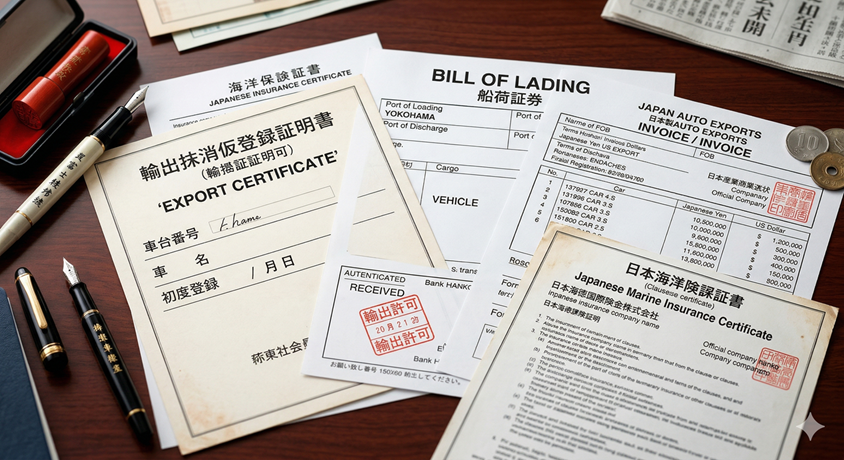
Every vehicle that leaves Japan for an overseas buyer is accompanied by a chain of documents — some physical, some digital, some prepared by the exporter, others by auction houses, freight forwarders, shipping lines, customs brokers, and government agencies. When this chain is complete and accurate, the vehicle moves smoothly from auction to port to destination. When a link is missing or incorrect, the vehicle stops moving, costs accumulate, and buyer confidence erodes.
The export documentation workflow is not a single checklist that you complete once and file away. It is a sequence of documents that must be prepared, verified, and handed off at specific stages — from the moment you register for an auction to the moment your buyer clears the vehicle through customs at the destination. Each document has a specific owner, a specific deadline, and a specific relationship to the documents that come before and after it. Understanding how these documents flow through the export process is what separates exporters who experience chronic paperwork delays from those who rarely think about documents at all.
This guide maps the complete documentation workflow for exporting a used car from Japan. We cover seven stages — pre-purchase, purchase and payment, vehicle handover, export clearance, shipping, post-shipment, and destination clearance — with detailed explanations of every document, who prepares it, what can go wrong, and how to prevent problems. We also provide scenario-specific workflows for different export methods, a common errors table, and a complete document checklist you can use as a reference for every shipment. Whether you export 5 vehicles per month or 50, understanding this workflow is essential for building a reliable, scalable export operation.
If you have not yet read our foundational guides, start with the car export documents overview for a high-level introduction, and the car export process from Japan for the full operational timeline. This guide assumes you understand the basic documents and the overall process, and it zooms in on how those documents flow through each stage of the export cycle.
🕐The Document Timeline: Seven Stages from Purchase to Delivery
The documentation workflow follows the same sequence every time, regardless of the destination market or shipping method. Understanding this timeline helps you know which document needs attention at each stage and who should be working on it.
| Stage | Timing | Key Documents | Owner |
|---|---|---|---|
| 1. Pre-purchase | Before bidding | Auction membership, buyer verification, market rules | Exporter |
| 2. Purchase & payment | At auction win | Auction sheet, sales certificate, payment receipt, proforma invoice | Auction house / Exporter |
| 3. Vehicle handover | 1-3 days post-purchase | Delivery certificate, transportation order, gate pass | Auction house / Transporter |
| 4. Export clearance | 3-10 days post-purchase | Export certificate, customs declaration, inspection certs | JiDensha agent / Customs broker |
| 5. Shipping | 1-4 weeks after purchase | Booking confirmation, commercial invoice, BL, packing list | Freight forwarder / Shipping line |
| 6. Post-shipment | After vessel departure | Insurance cert, shipping advice, certificate of origin | Exporter / Insurer |
| 7. Destination clearance | At arrival | Import declaration, customs bond, market-specific docs | Importer / Clearing agent |
Key principle: Each stage depends on the previous stage being complete. You cannot file the customs declaration without the export certificate. You cannot issue the Bill of Lading without the booking confirmation. You cannot clear customs at destination without the BL and commercial invoice. This dependency chain means a delay at any stage cascades forward. The most reliable exporters identify which documents are critical path items and ensure those are prioritised in the workflow.
📋Stage 1: Pre-Purchase Documentation
The documentation workflow begins before you bid on a single vehicle. Pre-purchase documents establish your identity as an exporter, your access to auctions, and your understanding of the destination market's requirements. Exporters who skip or rush this stage often discover missing paperwork after the vehicle is already purchased — at which point delays become costly.
1.1 Auction Registration and Membership
To bid at Japanese used car auctions, you need membership or access through a registered agent. Major auction houses — USS, JU, Aucnet, HAA, and regional auctions — each have their own membership requirements. Typical documents needed for registration include your company registration certificate (登记簿謄本, toreki), proof of business address, a corporate bank account statement, and a reference letter from an existing member or a dealer license if you are based in Japan. Registration can take 2-4 weeks for direct membership, which is why many international exporters use auction agents who already have membership and bid on their behalf.
1.2 Buyer Verification and KYC Documentation
Most auction houses and agents require Know Your Customer (KYC) documentation before allowing you to bid. This typically includes a copy of your passport or government ID, a utility bill or bank statement confirming your residential address, and proof of business registration in your country of operation. Some agents also require a bank reference letter confirming you have the financial capacity to settle purchases. These requirements have become stricter in recent years due to anti-money laundering (AML) regulations. If you are buying through an agent, confirm their KYC requirements before your first bid — having incomplete KYC at the point of winning a vehicle can delay the entire process.
1.3 Destination Market Rules and Compliance Checks
One of the most important pre-purchase documents is not a document at all — it is the research you do on your destination market's import requirements. Before bidding, you should confirm: the maximum age limit for used vehicles (if any), the steering configuration requirement (RHD vs LHD), emissions standards (Euro 4, Euro 5, etc.), any required pre-shipment inspections (KEBS in Kenya, NZTA in New Zealand, TBS in Tanzania), duty and tax rates that affect your pricing, and any prohibited vehicle types. This research should be documented and attached to each vehicle record so that your buying team can confirm compliance before placing a bid. For detailed market-specific guidance, see our destination market guides for Kenya, Tanzania, Bangladesh, and other markets.
⚠️ Pre-purchase risk: The most expensive document mistake is buying a vehicle that cannot be legally imported into your target market. This happens most often with age-limit violations (buying a 12-year-old vehicle for a market with a 10-year limit), steering configuration mismatches (buying RHD for an LHD-only market), or emissions non-compliance (buying a diesel vehicle for a market that restricts diesel imports). Always verify destination requirements in writing before bidding. Keep a reference document for each market you serve and update it whenever regulations change.
🔨Stage 2: Purchase and Payment Documents
When you win a vehicle at auction, a cascade of documents is generated immediately. These documents establish the legal record of the purchase, the condition of the vehicle at the time of sale, and the financial transaction between buyer and seller. Getting these documents right is essential because they form the foundation for every downstream document in the workflow.
2.1 Auction Sheet (Auction Result Slip)
The auction sheet is the primary document generated when you win a vehicle. It contains: the vehicle identification number (VIN or chassis number), make, model, year, grade, mileage (odometer reading), colour, transmission type, fuel type, equipment list, condition notes (scratches, dents, rust, repairs), inspection grade (AA, A, B, C, R, etc.), auction house name, auction date, and the winning bid price. This document is your baseline evidence of what you purchased and in what condition. Save it carefully — it is often needed for insurance claims, buyer disputes, and export documentation. Verify the details on the auction sheet against the vehicle listing before confirming payment. Discrepancies in VIN, grade, or mileage are the most common source of disputes.
2.2 Sales Certificate and Contract
The sales certificate or sales contract is issued by the auction house or your agent to confirm the transfer of ownership. It includes the buyer information, seller information, vehicle details, purchase price, auction fees, and total amount due. This document serves as the legal proof of purchase. For tax and accounting purposes, it is your primary record of the acquisition cost. Keep both the original and a digital copy in your vehicle record.
2.3 Payment Receipt and Proof of Funds
Once payment is made — typically by bank transfer to the auction house or agent — you receive a payment receipt. This document confirms the settlement of the purchase price and fees. The payment receipt is needed before the auction house releases the vehicle for handover. If you are using trade finance or a Letter of Credit (LC), you will also need to provide proof of the LC opening to the seller before the vehicle is released. For more on financing purchase payments, see our car export financing guide.
2.4 Proforma Invoice for the Buyer
While not strictly part of the Japan-side documentation, many exporters issue a proforma invoice to their overseas buyer immediately after purchasing the vehicle. This document outlines the vehicle details, agreed price, shipping timeline, and Incoterms. It serves as a preliminary agreement that the buyer can use to arrange payment or secure import financing. The proforma invoice is also useful for setting clear expectations about the documents the buyer will receive with the shipment.
Pro tip: Create a standard template for your proforma invoice that includes the information your buyers need for their own import preparations: HS tariff code (8703.21-8703.24 for most passenger cars), vehicle specifications (engine size, fuel type, year of manufacture), CIF value breakdown (FOB price + freight + insurance), and expected vessel departure and arrival dates. Consistent formatting reduces questions from buyers and speeds up their customs clearance process.
🚚Stage 3: Vehicle Handover and Transportation Documents
After a vehicle is won at auction and paid for, it must be transferred from the auction house to the exporter's yard or directly to the port for inspection and loading. This stage generates documents that track the vehicle's physical movement and establish custody transfer.
3.1 Delivery Certificate (Delivery Slip)
The delivery certificate is issued by the auction house when the vehicle is handed over to the buyer or their agent. It confirms the date and time of handover, the vehicle condition at handover, and the receiving party. This document is important for establishing when custody transferred from the auction house to the exporter — it matters for insurance coverage and for determining who is responsible if damage occurs during transportation.
3.2 Transportation Order
If the vehicle is being transported by car carrier truck from the auction house to your yard or to the port, a transportation order is issued. This document specifies the pickup location, delivery location, vehicle identification, and agreed transport fee. The transportation order should include a condition check at both pickup and delivery to document any transit damage.
3.3 Gate Pass and Yard Receipt
When vehicles arrive at your stockyard or at the port, a gate pass or yard receipt is issued to confirm receipt. This is a simple but critical document — it confirms the vehicle is in your custody and can be tracked in your inventory system. For stockyard management best practices, see our stockyard management guide.
⚠️ Handover risk: Transit damage between the auction house and your yard is one of the most common and least-documented problems in car export. Take dated photos of every vehicle when it arrives at your yard — front, rear, both sides, interior, dashboard (showing mileage), and engine bay. Compare these with the auction sheet photos. If you find damage that was not noted on the auction sheet, document it immediately and file a claim with the transporter or auction house. Most auction houses have a claim window of 3-7 days after handover.
🛂Stage 4: Export Clearance Documents
Export clearance is the most document-intensive stage of the workflow. This is where the Japanese government verifies that the vehicle is legally being removed from the Japanese vehicle registry and that all applicable export procedures have been followed. Delays at this stage are common and frustrating because they involve government agencies that do not operate on commercial timelines.
4.1 Export Certificate (Deregistration / JiDensha Export Certificate)
The export certificate is the single most important export document for a used car leaving Japan. It is issued by the Ministry of Land, Infrastructure, Transport and Tourism (MLIT) through the JiDensha system (Japan Inspection and Registration Association) and confirms that the vehicle has been deregistered from the Japanese vehicle registry for export. To obtain the export certificate, the vehicle must pass an export inspection at an authorised inspection centre. The inspection checks: vehicle identification (VIN/chassis number matches the registration), odometer reading, compliance with Japanese safety standards (no illegal modifications, valid lights, tires, brakes), and absence of any outstanding issues (unpaid parking tickets, stolen vehicle flags, finance encumbrances). Once the inspection is passed, the export certificate is issued. It typically takes 2-5 business days from inspection to certificate issuance, and the certificate is valid for 30 days — meaning the vehicle must be exported within that window.
4.2 Export Customs Declaration (NACCS Filing)
The export customs declaration is filed through Japan's NACCS (Nippon Automated Cargo and Port Consolidated System) by a licensed customs broker. This declaration notifies Japan Customs that the vehicle is being exported and provides the details needed for customs to clear the shipment. The declaration includes: exporter information, vehicle details (make, model, VIN, year, value), destination country, shipping method and vessel details, and export certificate reference number. The customs broker will typically require copies of the export certificate, the commercial invoice (your purchase invoice, not the sales invoice to your buyer), and the Bill of Lading (or booking confirmation). The customs clearance process usually takes 1-2 business days once all documents are in order.
4.3 Inspection Certificates (JEVIC, JAAI, and Others)
Depending on the destination market, the vehicle may require a pre-export inspection by an authorised inspection body. Common inspection types include: JEVIC (Japan Export Vehicle Inspection Center) — the most widely used pre-shipment inspection for used vehicles, covering safety, roadworthiness, and compliance with Japanese export standards; JAAI (Japan Auto Appraisal Institute) — provides condition reports and valuations often required for financing or insurance; and YIC (Yokohama Inspection Centre) — another authorised inspection body for pre-export checks. These inspections are separate from the JiDensha export inspection and serve different purposes. The JiDensha inspection is a government requirement for deregistration. The JEVIC/JAAI inspection is a commercial requirement from the destination market or the buyer's financier.
4.4 Weight Certificate
Some shipping lines and destination ports require a weight certificate for the vehicle, particularly for containerised shipments. The weight certificate confirms the actual weight of the vehicle and is used for vessel stowage planning and for verifying container weight limits. It is typically issued by a certified weighbridge operator at the port or at the exporter's yard.
⚠️ Export clearance risk: The most common reasons for JiDensha inspection failure are: vehicle modifications not matching the registration record (aftermarket wheels, suspension, exhaust, body kits), damaged or non-functional safety equipment (lights, seatbelts, tires below legal tread depth), outstanding parking tickets or fines, and discrepancies between the vehicle's registered colour and actual colour. Before sending a vehicle for JiDensha inspection, do a pre-check of these items. A failed inspection means rescheduling, additional transport costs, and a 3-7 day delay to the export timeline.
🚢Stage 5: Shipping Documents
Shipping documents coordinate the physical movement of the vehicle from the Japanese port to the destination port. These documents involve the freight forwarder, the shipping line, and the exporter. Accuracy is critical because shipping documents are used by customs authorities at both origin and destination, by the vessel operator for cargo planning, and by the buyer for payment and clearance.
5.1 Booking Confirmation
Before a vehicle can be loaded onto a vessel, the exporter or freight forwarder must book space with the shipping line. The booking confirmation (sometimes called a booking note or cargo receipt) confirms that the shipping line has allocated space for your vehicle(s) on a specific vessel. It includes: vessel name and voyage number, estimated departure and arrival dates, port of loading and discharge, vehicle details (quantity, type, dimensions), and agreed freight rate. The booking confirmation is usually issued within 1-2 business days of booking and is valid for a limited period (typically 7-14 days).
5.2 Shipping Instruction
The shipping instruction is a document prepared by the exporter or freight forwarder that provides the shipping line with detailed instructions for the shipment. It includes: shipper (exporter) details, consignee (buyer) details, notify party details, vehicle descriptions (make, model, VIN, year), marks and numbers (shipping marks), and special instructions (e.g., "telex release" for BL, "dangerous goods" declaration if applicable). The shipping instruction is the basis for the Bill of Lading — any errors in the shipping instruction will be reflected in the BL, so it must be reviewed carefully before submission.
5.3 Commercial Invoice
The commercial invoice is the primary document for customs clearance at both origin and destination. Unlike the purchase invoice (which records what you paid for the vehicle), the commercial invoice records what you are selling the vehicle for — the transaction between you and your overseas buyer. A well-prepared commercial invoice includes: seller (exporter) name and address, buyer (importer) name and address, invoice number and date, vehicle description (make, model, year, VIN, engine size, colour, mileage), quantity, unit price and total price, Incoterms (FOB, CIF, etc.), currency, payment terms, country of origin (Japan), HS tariff code, and the seller's signature or company stamp. The commercial invoice value must be accurate and consistent with the value declared on the Bill of Lading and the export customs declaration. Inconsistent values are a red flag for customs authorities and can lead to penalties, delays, and additional duties.
5.4 Packing List
The packing list details how the vehicle(s) are packed for shipment. For RoRo shipments, the packing list is simple — it states the vehicle itself is the cargo. For container shipments, the packing list includes details of any additional items packed with the vehicle (spare parts, tools, accessories) and their locations within the container. The packing list should be consistent with the commercial invoice and the Bill of Lading. It is used by the destination customs authority and by the buyer to verify that the shipment matches the documentation.
5.5 Bill of Lading / Sea Waybill
The Bill of Lading (BL) is the most important shipping document. It serves three functions: it is a receipt for the cargo (confirming the shipping line has received the vehicle(s) in stated condition), it is a contract of carriage (defining the terms under which the vehicle will be transported), and it is a document of title (the holder of the original BL has the right to claim the cargo at destination). For car exports, the most common BL types are: Original Bill of Lading — a physical document that must be mailed or couriered to the buyer for them to claim the cargo; it provides the most security for the seller but takes days or weeks to deliver; Telex Release Bill of Lading — the original BL is held at origin and an electronic release is sent to the destination agent; the buyer can claim the cargo without the physical BL; this is faster and increasingly common for car exports; Sea Waybill — a non-negotiable document that is not a document of title; the consignee can claim the cargo without presenting any document at destination; fastest option but offers no security for the seller if the buyer has not paid. The choice of BL type depends on your payment terms and relationship with the buyer. For TT payments, telex release is standard. For LC payments, an original BL (or telex release if the LC permits) is typically required.
5.6 Dangerous Goods Declaration
If the vehicle contains hazardous materials — such as a lead-acid battery, residual fuel, airbag modules, or refrigerant — a dangerous goods declaration may be required, particularly for container shipments. The declaration must follow the International Maritime Dangerous Goods (IMDG) code and includes: proper shipping name, UN number, class, packing group, quantity, and emergency contact information. Most used cars with standard batteries and minimal fuel do not require a full dangerous goods declaration for RoRo shipments, but containerised shipments may require one depending on the shipping line's policy.
Shipping document principle: Consistency is more important than any individual document detail. The VIN, consignee name, goods description, and commercial value must be identical across the commercial invoice, packing list, Bill of Lading, and customs declaration. Even a minor inconsistency — such as a missing hyphen in the VIN or a slightly different buyer name spelling — can trigger a customs hold at the destination. Use a single source of truth for each shipment and generate all documents from that record. For tools that help maintain document consistency across multiple shipments, explore CarDeal365's export management platform.
📬Stage 6: Post-Shipment Documents
Once the vessel has departed, there are still documents to prepare and deliver. These documents enable the buyer to clear the vehicle at destination, claim insurance coverage, and verify the shipment details.
6.1 Marine Insurance Certificate
The marine insurance certificate provides evidence that the vehicle is insured during transit. It covers physical loss or damage to the vehicle from loading at origin to discharge at destination. The certificate includes: insured value, policy number, period of cover, vessel name, voyage, vehicle details, and terms of cover (typically Institute Cargo Clauses A, B, or C). For car exports, the insured value should be the CIF value (cost, insurance, freight) or the full market value of the vehicle. The insurance certificate is usually sent to the buyer along with the other shipping documents. For an explanation of marine insurance options and how to choose the right cover, see our car export shipping complete guide.
6.2 Certificate of Origin
Some destination markets require a Certificate of Origin (CO) to confirm that the vehicle was manufactured in Japan (or another qualifying country). The CO is used to determine eligibility for preferential duty rates under free trade agreements or to verify the origin for non-preferential purposes. The CO is typically issued by a chamber of commerce in Japan — the Japan Chamber of Commerce and Industry (JCCI) is the most common issuer for used vehicle exports. To obtain a CO, you need: an application form with vehicle details, a copy of the commercial invoice, and a copy of the Bill of Lading. The processing time is typically 1-3 business days. Not all destination markets require a CO — check with your buyer or clearing agent before obtaining one.
6.3 Pre-Shipment Inspection Report (for Certain Markets)
Several destination markets require a pre-shipment inspection report issued by an authorised inspection company. For example, Kenya requires a KEBS (Kenya Bureau of Standards) certificate of conformity, Tanzania requires a TBS (Tanzania Bureau of Standards) certificate, and Uganda requires a UNBS certificate. These inspections verify that the vehicle meets the destination country's standards for safety, emissions, and roadworthiness before it is shipped. The inspection is typically conducted at the Japanese port before loading. The inspection report must be issued before the vessel departs — once the vehicle is shipped without the required inspection, it cannot be inspected until it arrives, and it may be refused entry if the inspection fails at destination.
6.4 Shipping Advice and Notice of Shipment
The shipping advice is a notification sent to the buyer (and sometimes their clearing agent) informing them that the vehicle has been loaded and the vessel has departed. It includes: vessel name and voyage number, estimated time of arrival (ETA) at destination, Bill of Lading number, container number (if containerised), and a summary of documents being sent. A prompt shipping advice helps the buyer prepare for customs clearance, arrange payment if not already made, and plan for vehicle collection. Many exporters use automated status updates through their export management software. For more on keeping buyers informed, see our buyer management guide.
Post-shipment best practice: Send a complete document package to your buyer within 24 hours of vessel departure. Use a single PDF with all documents, labelled clearly. Include: commercial invoice, Bill of Lading (telex release or copy of original), packing list, insurance certificate, certificate of origin (if applicable), pre-shipment inspection report (if applicable), and shipping advice. If the buyer's clearing agent is known, send the document package to them as well. Prompt, complete documentation delivery builds trust and helps the buyer prepare for smooth customs clearance.
🏁Stage 7: Destination Clearance Documents
From the exporter's perspective, destination clearance is the buyer's responsibility — but successful exporters actively support their buyers' clearance process because delays at destination reflect poorly on the exporter and can lead to payment disputes, storage fees, and damaged relationships. Understanding what documents the buyer needs helps you prepare them correctly in advance.
7.1 Import Declaration (Single Administrative Document / Customs Entry)
The buyer or their clearing agent must file an import declaration with the destination country's customs authority. In most countries, this is done electronically through a Single Administrative Document (SAD) or equivalent electronic customs entry. The declaration requires: the vehicle's CIF value, HS tariff code, country of origin, consignee details, shipping details (vessel, BL number, container number), and supporting documents (commercial invoice, BL, CO, insurance certificate). The clearing agent uses the documents the exporter provides to prepare this declaration. If any document is missing or inconsistent, the declaration cannot be filed, and the vehicle sits at the port.
7.2 Customs Bond or Guarantee
Some destination markets require the importer to post a customs bond or bank guarantee before the vehicle can be cleared. The bond covers potential duties, taxes, and penalties if the vehicle does not comply with import regulations. The amount of the bond is typically a percentage of the duty payable. The bond is released once the vehicle is formally cleared. This is the buyer's responsibility, but exporters should be aware of bond requirements in their target markets because bond costs affect the buyer's total landed cost and may influence their willingness to purchase.
7.3 Market-Specific Compliance Documents
Each destination market has its own set of compliance documents that must be presented at clearance. Common examples include: Kenya — KEBS Certificate of Conformity (CoC), pre-shipment inspection report, and compliance with the Kenya Vehicle Import Standards; Tanzania — TBS Certificate of Conformity and compliance with the Tanzania Bureau of Standards; Chile — Certificate of LHD conversion (if applicable) and emissions compliance certificate for the Chilean vehicle registry (RRV); New Zealand — NZTA Entry Certificate, compliance with the Clean Car Standard, and evidence of biosecurity clearance; Bangladesh — Bangladesh Bank import permit, REER (Registration for Environment and Emission Reduction) certificate, and compliance with age limit regulations; UAE — Emirates Vehicle Gate (EVG) clearance and compliance with the UAE's import age limit (typically 5 years for used vehicles). Researching and preparing these documents before shipping is essential. See our destination market guides for country-specific requirements.
⚠️ Destination clearance warning: The most common destination-side documentation failure is the buyer receiving a Bill of Lading that lists a slightly different company name or address than their import license or business registration. For example, if the BL shows "John Smith Trading Co." but the buyer's import license is under "John Smith Trading Company", customs may reject the entry. Always confirm the exact legal name of the consignee as it appears on their import documentation before issuing the BL. This is especially important in markets with strict import licensing requirements like Bangladesh, Sri Lanka, and Kenya.
📐Document Workflow by Export Scenario
The document workflow changes slightly depending on the shipping method, payment terms, and Incoterms. Understanding these variations helps you prepare the right documents for each shipment.
RoRo vs Container Shipping
RoRo shipments have simpler documentation than container shipments. For RoRo, you need: a standard commercial invoice, a RoRo Bill of Lading (sometimes called a vehicle BL or straight BL), a packing list (simple — vehicle only), and a shipping instruction. No container packing declaration, no container weight certificate, and usually no dangerous goods declaration are needed for standard vehicles. For container shipments, you additionally need: a container packing declaration (confirming how the vehicle is secured inside the container), a container weight certificate, and potentially a dangerous goods declaration (if packing accessories like extra batteries, fuel cans, or aerosol cans). The Bill of Lading for container shipments is typically a container BL referencing the container number and seal number. For a detailed comparison of the two methods, see our RoRo vs container shipping guide.
FOB vs CIF Incoterms
Under FOB (Free on Board) terms, the exporter is responsible for delivering the vehicle to the port and loading it onto the vessel. The buyer arranges and pays for ocean freight and insurance. Under FOB, the exporter provides: the invoice up to the FOB value, the export certificate, the export customs declaration, the port handling documents (gate pass, delivery order), and the Bill of Lading (as "clean on board"). The buyer arranges the insurance certificate and the certificate of origin if needed. Under CIF (Cost, Insurance, Freight), the exporter is responsible for all transport and insurance to the destination port. Under CIF, the exporter provides: the commercial invoice up to the CIF value, the marine insurance certificate, the Bill of Lading, and all other shipping documents. The exporter also arranges and pays for ocean freight. Most Japanese used car exporters operate on a CIF basis, which gives them more control over the shipping process but also more document responsibility.
LC vs TT Payment Terms
The payment method significantly affects the document workflow. Under TT (Telegraphic Transfer) payment, documents are sent directly to the buyer after payment is confirmed. Under LC (Letter of Credit), documents must be presented to a bank for checking before they can be released to the buyer. LC documents must comply strictly with the LC terms — even minor discrepancies can result in the bank rejecting the documents and delaying payment. Common LC document requirements include: a signed commercial invoice in original, a full set of original Bills of Lading made out to the order of the issuing bank or to order blank endorsed, a marine insurance certificate (if CIF), a certificate of origin (if required), a packing list, and an inspection certificate (if required). For each document, the LC specifies the exact format, content, number of originals, and due date. Exporters who sell under LC terms should work with a trade finance specialist to ensure their document preparation meets LC requirements. For a complete overview of payment methods, see our payment methods guide.
🚢 RoRo Quick Docs
- Commercial invoice
- RoRo Bill of Lading
- Packing list
- Shipping instruction
- Export certificate
- Customs declaration
📦 Container Quick Docs
- All RoRo docs +
- Container packing declaration
- Container weight certificate
- Dangerous goods decl. (if needed)
- Container BL (with seal number)
- Cargo insurance certificate
📋 LC Quick Docs
- Original signed invoice
- Full set of original BLs
- Insurance certificate (CIF only)
- Certificate of origin
- Beneficiary certificate (if req.)
- Strict LC compliance required
⚠️Common Document Errors and How to Prevent Them
Even experienced exporters encounter document errors. The key is recognising which errors are most common and building preventive checks into your workflow. The following table covers the most frequent document errors in Japanese used car export and how to prevent each one.
| Error | Stage | Consequence | Prevention |
|---|---|---|---|
| VIN/chassis number typo | Any stage | Customs hold, ownership dispute | Triple-check VIN against auction sheet. Use copy-paste, never manual re-entry. |
| Invoice value mismatch | Shipping | Customs penalty, duty adjustment | Ensure invoice, BL, and customs declaration values match exactly. Do not issue separate invoices with different values. |
| Consignee name inconsistency | Shipping | Cargo cannot be claimed, storage fees | Confirm exact legal name with buyer before booking. Match across all documents. |
| Missing pre-shipment inspection | Export clearance | Vehicle rejected at destination | Check destination requirements before purchase. Schedule inspection early. |
| Export certificate expired | Shipping | Cannot export, re-inspection required | Track cert validity (30 days). Schedule vessel departure within window. |
| Incorrect HS tariff code | Shipping / destination | Wrong duty rate, clearance delay | Use HS code matching vehicle type, engine size, and age. Verify with destination agent. |
| LC document discrepancy | Post-shipment | Bank rejects documents, payment delayed | Review LC terms carefully. Prepare documents exactly as specified. Consider LC checking service. |
| Insufficient insurance coverage | Shipping / post-shipment | Uninsured loss or damage | Insure for CIF value + 10%. Confirm coverage period matches full transit. |
⚠️ The most expensive document error: A VIN typo in the Bill of Lading or customs declaration. If the VIN on the BL does not match the VIN stamped on the vehicle chassis, the destination customs authority may impound the vehicle for suspected theft or fraud. Fixing a VIN error after the vessel has departed requires amending the BL — a process that takes 1-4 weeks, costs $100-500, and involves the shipping line, customs broker, and sometimes the buyer's bank. The buyer may also face demurrage charges while waiting. This single typo can cost $500-2,000 and damage the buyer relationship permanently.
⚙️Building a Document Management System
As your export volume grows, managing documents through email folders and spreadsheets becomes unsustainable. A proper document management system (DMS) ensures that every document is stored, tracked, and accessible when needed. Here is how to build one that works for car export operations.
Document Storage Structure
Each shipment should have a dedicated folder or record with a consistent naming convention. A recommended structure: Year-Month-BuyerName-VehicleModel-VIN-Last6. For example: 2026-06-KenyaBuyer-Corolla-JE123456. Within each shipment folder, store all documents in subfolders by stage: 01_Purchase (auction sheet, sales cert, payment receipt), 02_Handover (delivery cert, transport order), 03_ExportClearance (export cert, customs declaration, inspection certs), 04_Shipping (booking confirmation, commercial invoice, BL, packing list), and 05_PostShipment (insurance cert, CO, shipping advice). Using a consistent naming convention makes it easy to find any document for any shipment, even months or years later.
Document Tracking and Status
Beyond storage, you need a way to track the status of each document for each active shipment. A simple status dashboard should show: each document required for the shipment, whether it is pending, in progress, or complete, who is responsible for it, and the target completion date. This can be a spreadsheet for low-volume exporters or a software-based dashboard for higher-volume operations. The key is having a single view of document readiness across all active shipments, so you can identify bottlenecks before they cause delays. For more on tracking readiness, see our export document readiness workflow guide.
Document Verification Process
Before any document is sent to a buyer, freight forwarder, or bank, it should go through a verification process. The verification checklist should include: all required documents are present and in the correct format, document details are consistent across all documents (VIN, buyer name, vehicle description, values), signature and stamp (if required) are applied, documents are in the language required by the destination market or LC terms, and digital copies are saved in the shipment folder before originals are sent. Assign one person per shipment to be responsible for document verification. This role is separate from document preparation — having a different person verify the documents catches more errors.
Automating Document Workflow
For exporters handling 20+ vehicles per month, manual document management becomes a bottleneck. Export management software can automate parts of the document workflow: generate commercial invoices and packing lists from vehicle and buyer data entered once; track document status automatically as milestones are completed (auction win → purchased, JiDensha inspection passed → export cert ready); alert team members when documents are due or missing; provide buyer portals where buyers can download their document packages; and maintain a complete audit trail for every shipment. Automation does not eliminate the need for human verification, but it reduces the administrative burden and the risk of forgotten documents. For a comprehensive overview, see our car export software guide.
Start with a simple audit: Review your last 10 completed shipments and identify which documents had issues — late, missing, incorrect, or inconsistent. Categorise each issue by stage (purchase, clearance, shipping, post-shipment) and by root cause (unclear ownership, late start, lack of verification, buyer changed details). This audit will show you exactly where your document workflow is weakest. Focus your improvement effort on the stage that caused the most issues — improving document readiness at that one stage will have a bigger impact than making small improvements across all stages.
✅Complete Document Checklist
Use this checklist for every shipment. Not every document will be required for every shipment, but checking each item ensures you do not miss anything important.
Pre-Purchase Stage
- ☐ Auction membership / agent agreement confirmed
- ☐ KYC documentation submitted and approved
- ☐ Destination market import rules verified
- ☐ Age limit, steering, emissions compliance confirmed
- ☐ Buyer creditworthiness verified / LC opened
Purchase & Payment Stage
- ☐ Auction sheet received and verified
- ☐ Sales certificate / contract obtained
- ☐ Payment receipt received
- ☐ Proforma invoice sent to buyer
- ☐ Vehicle record created in management system
Handover & Clearance Stage
- ☐ Delivery certificate / gate pass obtained
- ☐ JiDensha export inspection passed
- ☐ Export certificate issued and verified
- ☐ Customs declaration filed (NACCS)
- ☐ Pre-shipment inspection completed (if required)
- ☐ Arrival photos taken and saved
Shipping & Post-Shipment Stage
- ☐ Booking confirmed with shipping line
- ☐ Commercial invoice issued (to buyer)
- ☐ Packing list prepared
- ☐ Bill of Lading / Sea Waybill issued and verified
- ☐ Insurance certificate obtained
- ☐ Certificate of origin issued (if required)
- ☐ Document package sent to buyer within 24h of departure
- ☐ Shipping advice sent to buyer and clearing agent
Make this checklist reusable: Copy this checklist into a spreadsheet or your export management software. For each shipment, check off items as they are completed and note the date and person responsible. After 10-20 shipments, review your checklist data to see which items are most often completed late or missed entirely. Those are the items you need to add extra controls for — reminders, earlier start dates, or additional verification steps.
🎯Conclusion: Documentation Is a Competitive Advantage
Most car exporters treat documentation as an administrative chore — something to get through as quickly as possible so they can focus on the real business of buying and selling vehicles. The most successful exporters take a different view. They see documentation as an operational system that, when designed and managed well, gives them a measurable competitive advantage. Faster document processing means faster payment collection. Fewer errors mean fewer delays and lower costs. Better document packages mean happier buyers and stronger relationships. Clean documentation means smoother relationship with freight forwarders, customs brokers, and banks.
The seven-stage workflow we have covered in this guide — pre-purchase, purchase and payment, handover, export clearance, shipping, post-shipment, and destination clearance — provides a framework for thinking about documents as a process, not a checklist. Each stage has its own documents, its own owners, its own risks, and its own dependencies on the stages before and after. When you understand this flow, you can identify bottlenecks before they cause delays, assign clear ownership for each document, and build a system that produces complete, accurate document packages for every shipment, every time.
Start by implementing the checklist from this guide for your next shipment. Use it as a template and adapt it to your specific markets and processes. Track which documents cause the most issues and focus your improvement efforts there. Within 3-6 months, you should see a measurable reduction in document-related delays and a corresponding improvement in your shipment cycle time and buyer satisfaction.
Next steps for your documentation workflow: For a high-level overview of the key documents, read Car Export Documents from Japan. To understand how document readiness fits into your broader workflow automation, see Export Document Readiness Workflow. For the full operational timeline from purchase to delivery, explore the Car Export Process from Japan. And if you are ready to move beyond spreadsheets, learn how CarDeal365's platform helps exporters manage documents as part of a complete export workflow.
❓Frequently Asked Questions About Export Documentation Workflow
What is the first document I need when exporting a used car from Japan?
The first document in the export workflow is the auction sheet, which you receive when you win a vehicle at a Japanese auction. It contains the vehicle identification details, grade, mileage, and condition notes. Immediately after purchase, you need the sales certificate and payment receipt. These documents initiate the downstream process for the export certificate (deregistration from the Japanese transport bureau) and eventually the customs declaration.
How long does it take to get the Japanese export certificate (deregistration)?
The export certificate, also known as the deregistration certificate or JiDensha export certificate, typically takes 3-7 business days to process after the vehicle is purchased at auction. The timeline depends on whether you use a JiDensha agent or handle the MLIT transport bureau filing yourself. The vehicle must pass an export inspection first, which requires the vehicle to be physically present at an inspection centre. Once the inspection is passed and the export certificate is issued, it is valid for a limited period (usually 30 days) during which the vehicle must be exported. Delays are common if the vehicle has outstanding issues such as unpaid parking tickets, missing registration papers, or modifications that do not match the registration record.
What is the difference between a Bill of Lading and a Sea Waybill in car export?
A Bill of Lading (BL) is a document of title — the holder of the original BL has legal ownership of the cargo. It is used when payment is made via Letter of Credit (LC) or when the buyer needs to present the original document to clear customs. A Sea Waybill is not a document of title; it is a contract of carriage and a receipt for the goods. The consignee can claim the cargo at destination without presenting the original document. Sea Waybills are faster and simpler but offer less security for the seller. Most Japanese used car exporters use telex release BLs (where the original BL is held at origin and an electronic release is sent to the destination agent) as a practical middle ground — faster than shipping original documents but still providing document-of-title security.
Which documents does the freight forwarder prepare vs the exporter?
The exporter typically prepares or arranges: the commercial invoice (based on the sale to the overseas buyer), the export certificate (via a JiDensha agent or transport bureau), the packing list, and any market-specific compliance documents (such as KEBS inspection for Kenya or NZTA compliance for New Zealand). The freight forwarder typically prepares or arranges: the booking confirmation, the Bill of Lading or Sea Waybill (issued by the shipping line), the shipping instruction document, the export customs declaration (via a customs broker), and any dangerous goods declaration if applicable. Some forwarders also offer JiDensha processing as a value-added service. Clear ownership of each document should be established before the vehicle is purchased.
What happens if a document is missing or incorrect when the vehicle arrives at the destination port?
Missing or incorrect documents at the destination port can cause several problems: the vehicle may be held in customs custody (bond storage) while documents are corrected, storage fees may accumulate at the port (typically $20-50 per day), customs clearance is delayed until all required documents are in order, and the buyer may charge demurrage or refuse to accept the vehicle if the delay is significant. In the worst case, incorrect documentation can lead to the vehicle being re-exported or destroyed at the exporter's expense. The most common destination-side document problems are: commercial invoice values not matching the BL values, incorrect HS tariff codes, missing certificates of origin, and incomplete consignee details. These are all preventable with a proper document checklist and verification process before the vessel departs.
Related reading
AI Chatbot for Car Dealerships
What an AI chatbot should and shouldn't handle for a car dealership: routine availability and spec questions answered instantly, with a c...
Vehicle Shipping Workflow
How to track a vehicle's shipping status internally, from booking through delivery: defining stages, assigning owners, and connecting shi...
Digital Bill of Lading Management
How exporters manage the Bill of Lading digitally: telex release vs.
Export Compliance Checklist
A scannable export compliance checklist covering business registration, per-market import rules, pre-shipment inspection, documentation, ...
Export Documentation Management Software
What export documentation management software should actually do: pulling documents from the vehicle record, tracking document status aga...
Negotiating Ocean Freight & Shipping Rates
Ultimate exporter guide to negotiating ocean freight and shipping container rates for Japanese used car exports.

About the Author
Muhammad Khabir Uddin
Founder, CarDeal365 · 6+ years in automotive export & SaaS
View LinkedIn Profile