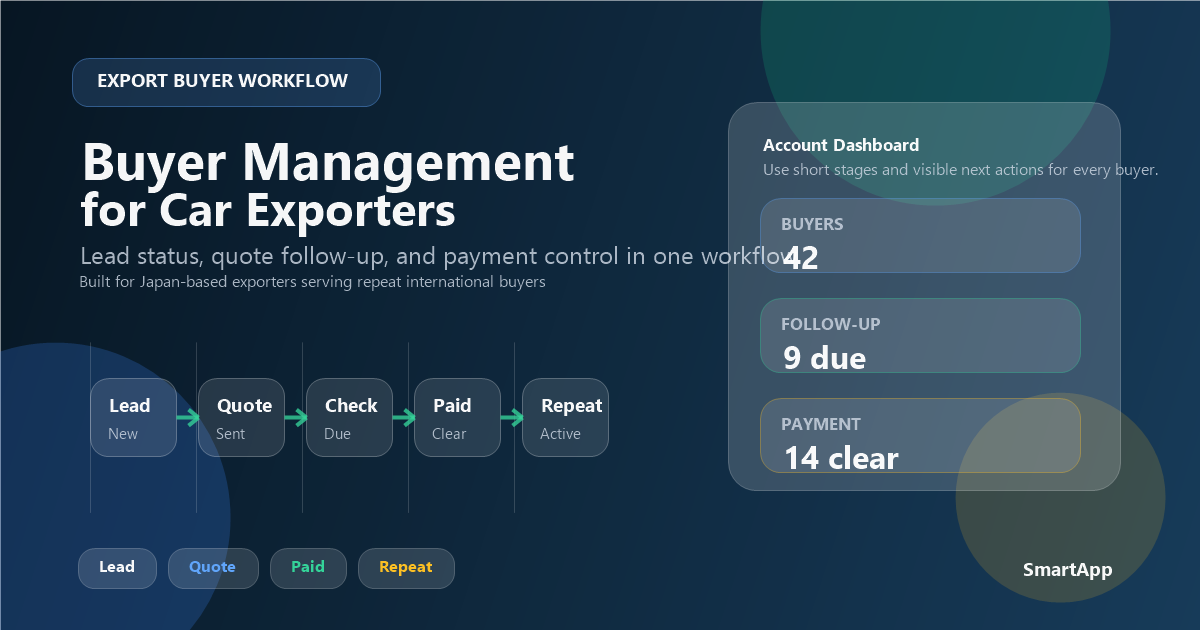
Why a generic CRM is usually too shallow for used car sales
Generic CRM tools are built around a universal idea of a "deal": a contact, a stage, a value, a close date. That model works reasonably well for services or software sales, where the thing being sold doesn't have its own condition, VIN, or physical location. Used car sales don't fit that model cleanly. A buyer isn't just interested in "a deal" — they're interested in a specific unit, or a narrow set of units, with a specific condition and price that changes as the vehicle sits in inventory.
When the CRM doesn't know about the vehicle, salespeople end up doing the connective work manually: checking a separate inventory list, remembering which units they already showed a buyer, and re-explaining vehicle details that should already be attached to the lead. That manual bridge is exactly where deals get dropped.
What a used car CRM actually needs to track
| Field group | Why it matters |
|---|---|
| Preferred vehicle type and budget | Stops staff from quoting stock that was never a real fit |
| Units shown or quoted | Prevents repeating the same pitch or losing track of interest |
| Quote history and outcome | Shows what worked, what didn't, and why |
| Response speed and communication notes | Reveals how engaged the lead really is |
| Payment behavior | Informs how much flexibility to extend on future deals |
None of this is exotic. It's the information a good salesperson already keeps in their head. The point of a CRM is to make that knowledge survive a staff change, a busy week, or a handoff to another team member.
Structuring follow-up instead of relying on memory
Most lost deals aren't lost because the price was wrong. They're lost because follow-up quietly stopped. A lead comes in, a quote goes out, and unless something forces a second touch, the opportunity drifts away while the team gets busy with other things.
A workable fix is a short, defined follow-up cadence: quote sent, follow-up after a set number of days, objection handling if the buyer responds, alternate unit if the first one missed the mark, and a logged reason if the deal doesn't close. That last step matters more than it sounds — a logged no-sale reason turns a lost deal into pricing and sourcing feedback instead of just a disappearing lead.
Why the CRM has to know about real stock, not just contacts
The single biggest upgrade a dealership gets from a purpose-built used car CRM over a generic one is that the CRM and the inventory system are the same system, or at least share the same live data. When a lead is interested in a specific unit, the CRM should know whether that unit is still available, what its current price is, and whether it's been reserved by someone else.
Without that link, sales staff can promise a unit that's already sold, quote outdated pricing, or miss the chance to offer an alternate unit that just came into stock. This is the exact gap covered in our dealer inventory management guide — CRM and inventory need to be two views of the same data, not two separate systems.
The KPIs that show whether your CRM is actually working
| Metric | What it reveals |
|---|---|
| Quote-to-sale conversion | Whether quotes are landing on the right buyers |
| Average response time | Commercial discipline, not just activity |
| No-sale reason mix | Whether losses come from price, fit, or follow-up quality |
| Repeat customer rate | Whether the business is building relationships or only chasing new leads |
Common used car CRM mistakes
Treating the CRM as a contact list, not a workflow
A CRM without a follow-up cadence is just an address book.
Letting buyer history live in personal phones
Once the knowledge sits with one person, the account can't be handed off cleanly.
Never logging why a deal didn't close
Without that, the pipeline looks active but teaches the business nothing.
FAQs
What is a used car CRM?
A used car CRM is a customer relationship system built for dealerships, tracking leads, buyer preferences, quote history, and follow-up, connected directly to the vehicle stock those buyers are interested in.
Why can't a dealership just use a generic CRM?
A generic CRM tracks contacts and deal stages but has no concept of a vehicle, its condition, or its stock status. Sales staff end up manually cross-referencing inventory outside the CRM, which recreates the same disconnect the CRM was meant to solve.
What should a used car CRM track beyond contact details?
Preferred vehicle types and budget, quote history and outcomes, response speed and communication notes, payment behavior, and links to the actual units a buyer has been shown or quoted.
How does a used car CRM help reduce lost leads?
By making follow-up a structured workflow instead of a memory task, and by keeping every lead's status visible to the whole team rather than trapped in one salesperson's phone or inbox.
Supporting guides in this series
Car Dealership Software
See where CRM fits into the wider dealership system.
Dealer Inventory Management
Understand the stock data your CRM should be reading from.
Dealer ERP
When CRM needs to connect to finance and operations too.
ERP vs CRM for Car Dealers
A direct comparison and decision framework.
How to Manage a Used Car Dealership
The pillar guide covering every operational area of the series.
How to Start a Car Export Business from Japan
Complete step-by-step guide to starting a car export business from Japan.
Top Dealer ERP Systems
A fact-checked roundup of leading dealer ERP systems for franchise and multi-location groups: Tekion, CDK Global, Reynolds and Reynolds, ...
CarDeal365 vs AutoManager
An honest comparison of CarDeal365 and AutoManager (DeskManager): what AutoManager does well as a US/Canada domestic dealer management sy...
AI for Used Car Pricing
How AI pricing guidance works for used cars: using grade, condition, and comparable sale data to suggest a starting price, while keeping ...
Vehicle Stock Management
How to manage vehicle stock at the yard level: location tracking, reconditioning workflow, physical stock counts, and keeping the system ...
AI Sales Assistant for Car Dealers
The system a sales assistant's lead data should live in.
Conclusion
A used car CRM earns its keep when it does more than store contacts — when it structures follow-up, tracks quote outcomes, and stays connected to the real vehicles a buyer cares about. If your CRM and your inventory list are still two separate things you mentally cross-reference, the CRM isn't doing its job yet.
See how CarDeal365 connects buyer records directly to live vehicle stock.
Book a Demo
About the Author
Muhammad Khabir Uddin
Founder, CarDeal365 · 6+ years in automotive export & SaaS
View LinkedIn Profile