Why bidding discipline is where dealer margin actually starts
Every dealership conversation about margin eventually circles back to sale price. But margin is decided twice: once when a unit is sold, and earlier, more quietly, when it's bought. A vehicle purchased $500 over its real value at auction needs that $500 clawed back somewhere before it even reaches the lot, usually by cutting into the margin that was supposed to be the point of the deal.
Auction bidding software exists to protect that earlier decision point: setting a clear limit before the bidding starts, and giving buyers a way to stay disciplined once the pace of a live auction makes it easy to get caught up in the moment.
Budget control before the auction starts
The most valuable thing bidding software does happens before a single bid is placed: it forces a maximum bid to be set in advance, based on target resale price minus expected reconditioning, transport, and fees. That number should exist before the buyer is standing in the auction hall or watching a live online feed, not calculated on the fly under time pressure.
| Input | Why it matters |
|---|---|
| Target resale price | Sets the ceiling the whole calculation works backward from |
| Expected reconditioning cost | Prevents surprises once the vehicle is inspected in person |
| Transport and auction fees | Fees are easy to forget and can quietly erase margin |
| Target margin | Keeps the max bid from creeping toward break-even |
Bid tracking during the auction
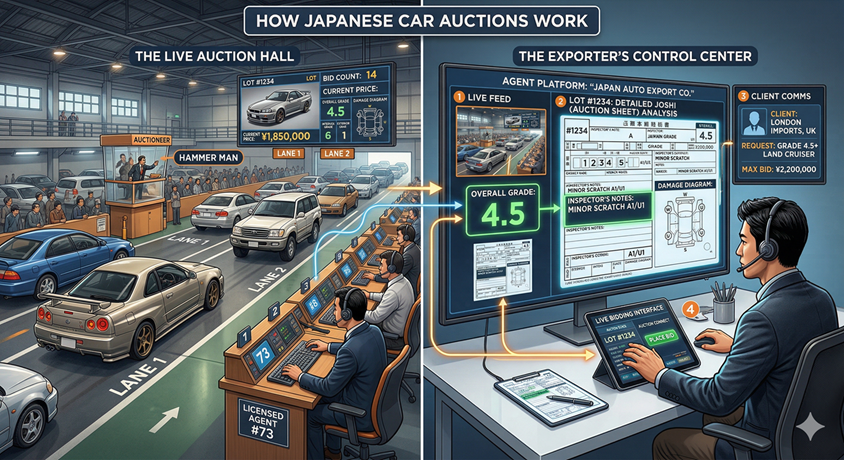
Once bidding is live, the value of software shifts from planning to discipline. A clear running view of current bid against the pre-set maximum, visible in real time, is what stops a buyer from chasing a lot past the number that made sense on paper. This matters even more when several buyers from the same dealership are active across different auctions or lots at once — without shared visibility, two staff members can end up bidding against each other's plans without realizing it.
Practical Rule
If your maximum bid isn't visible on screen while you're bidding, it isn't really a limit — it's a suggestion you'll forget under pressure.
Capturing condition data at the point of sale
A lot's auction sheet or condition report contains the grade, damage notes, mileage, and equipment that will drive its resale price. Good bidding software captures this data at the point of winning, rather than leaving it to be re-transcribed by hand afterward. Systems that use AI to read auction sheets automatically, extracting grade and condition details straight from the document, remove one of the most error-prone manual steps in the whole sourcing process.
From won lot to inventory: the handoff that shouldn't require re-typing
Winning the bid is not the end of the workflow, it's the start of the next one. The purchase price, fees, and condition data captured during bidding should flow directly into the vehicle's inventory record, the same record covered in our dealer inventory management guide. If that handoff requires manually re-entering everything into a separate system, the dealership is paying twice for the same data entry, once implicitly in the software's price and once again in staff time.
Common auction bidding mistakes
Setting the max bid mentally instead of in writing
Numbers that only exist in someone's head are easy to bend in the moment.
Forgetting fees in the budget calculation
Auction and transport fees are easy to underestimate and quietly erase expected margin.
Re-entering condition data by hand after the win
Manual transcription from an auction sheet is slow and error-prone compared to capturing it at the point of sale.
FAQs
What is auction bidding software?
Auction bidding software helps dealers plan, place, and track bids at vehicle auctions, keeping budget limits, bid history, and condition data organized so a won lot can move directly into inventory.
How does auction bidding software help control spending?
By setting a maximum bid per lot in advance based on target resale price and expected costs, and tracking actual bids against that limit in real time so buyers don't get caught up and overpay in the moment.
Can auction bidding software read auction sheets automatically?
Some systems, including CarDeal365, use AI to read auction sheets and extract grade, damage notes, mileage, and equipment automatically, removing manual data entry after a lot is won.
What happens after a lot is won?
A won lot should convert directly into an inventory record with purchase price, fees, and condition data already attached, rather than requiring the details to be re-entered manually into a separate inventory system.
Supporting guides in this series
Vehicle Stock Management
What happens to a won lot once it reaches the yard.
Dealer Inventory Management
The record a won lot should flow directly into.
Car Dealership Software
See where auction sourcing fits into the wider dealership system.
How to Manage a Used Car Dealership
The pillar guide covering every operational area of the series.
Auction Purchase Management
What happens after the win: invoices, fees, and consolidation at volume.
Japanese Car Auction Fees Explained
Every fee you pay when buying at Japanese car auction — USS, TAA, JU buyer fees, transport to port, deregistration, export customs, agent...
AI-Powered Vehicle Description Generator
How an AI vehicle description generator drafts consistent, accurate listing content from real vehicle data, and why it still needs a huma...
Bidding at USS Tokyo & USS Yokohama
Ultimate exporter guide to bidding at USS Tokyo and USS Yokohama used car auctions.
Japanese Used Car Export to Tanzania
Complete guide to exporting Japanese used cars to Tanzania.
Conclusion
Auction bidding software earns its value before the auction even starts, by forcing a real budget number onto paper, and during the auction, by keeping that number visible when it's easiest to ignore. The last piece is making sure a win converts straight into inventory, so the discipline at the auction doesn't get undone by manual re-entry afterward.
See how CarDeal365 connects auction bidding directly to inventory and margin tracking.
Book a Demo
About the Author
Muhammad Khabir Uddin
Founder, CarDeal365 · 6+ years in automotive export & SaaS
View LinkedIn Profile