What TAA is and how it's structured
TAA stands for Toyota Auto Auction, a Toyota-group-affiliated auction network with multiple regional halls across Japan, including TAA Kanto, TAA Chubu, TAA Kyushu, and TAA Yokohama among others. Despite the name, TAA halls sell vehicles from every major manufacturer, not just Toyota, so the make and model range looks similar to what you'd see at any large Japanese auction network.
Each regional hall runs its own weekly or bi-weekly sale, listing everything from ordinary commuter cars to trucks and commercial vehicles, with the volume and mix varying somewhat by region and by which dealer network feeds that particular hall.
How TAA grading and auction sheets work
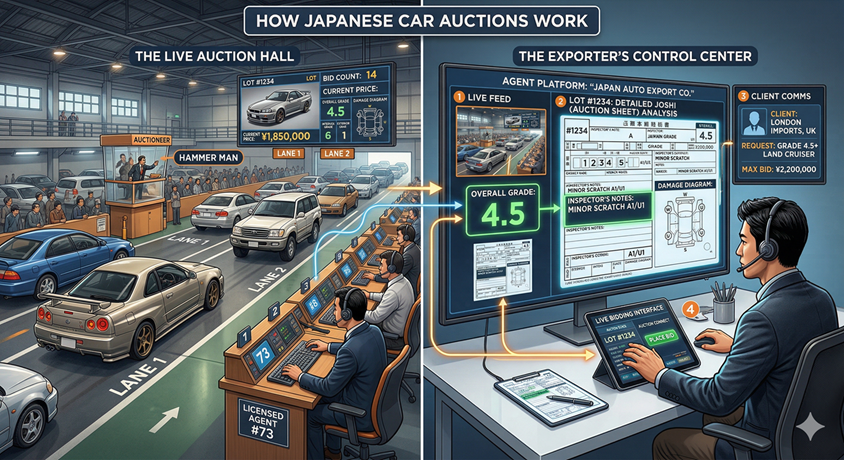
TAA follows the same broad grading conventions used across Japan's auction industry: an overall condition grade roughly on a 3.5 to 5 scale, an "R" designation for vehicles with prior repair history, and separate interior and exterior sub-scores marked on a diagram of the car showing scratches, dents, and repainted panels. The auction sheet itself lists equipment, mileage, and an inspector's written notes, usually in shorthand Japanese.
| Sheet element | What it tells you |
|---|---|
| Overall grade (3.5–5, R) | General condition and accident history at a glance |
| Body diagram markings | Exact panel-by-panel scratch, dent, and repaint locations |
| Interior score | Cabin wear separate from exterior condition |
| Inspector notes | Anything not captured by the standard grade, in shorthand Japanese |
Because the inspector notes are dense, abbreviated Japanese, this is one of the areas where export teams commonly lean on AI-assisted auction sheet translation to avoid misreading a grade or missing a noted defect before bidding.
Registering and bidding as an export buyer
TAA, like most Japanese auction networks, restricts direct membership to licensed dealers registered in Japan. Overseas export buyers almost always bid through an agent, exporter, or affiliated Japanese company that already holds membership, rather than registering directly themselves. That agent places bids on the buyer's behalf, and the buyer's own budget, target grade, and maximum bid are communicated to the agent ahead of the sale.
Practical Rule
Set a firm maximum bid per lot before the sale starts. Auction-day momentum makes it easy to chase a unit past the price where it still makes margin sense for export.
TAA vs USS: what's different
USS is the largest auction network in Japan, both by number of locations and by weekly volume, and is usually the first network export buyers connect to. TAA is smaller in total volume but still a significant network with several active regional halls, and the grading conventions, membership structure, and bidding mechanics are close enough that a buyer comfortable with one can typically pick up the other quickly.
The practical reason to work with more than one network, as covered in our USS Tokyo and Yokohama bidding strategies guide, is inventory access: certain makes, grades, or regional stock can be more available on one network than another in a given week, so buyers sourcing consistently often watch both rather than relying on a single network.
FAQs
What does TAA stand for?
TAA stands for Toyota Auto Auction, a Toyota-affiliated auction network with halls across Japan. It sells vehicles of all makes, not only Toyota, despite the name.
Can an overseas buyer bid directly on TAA?
Almost never directly. Like most Japanese auction networks, TAA requires a membership tied to a licensed dealer registered in Japan, so overseas export buyers bid through an agent or export company that holds that membership.
Is TAA grading different from USS grading?
The core grading scale (roughly 3.5 to 5 for exterior/interior condition, R for repaired history) follows the same industry-standard conventions used across Japanese auctions, though exact notation and auction sheet layout differ slightly by network.
Which is bigger, TAA or USS?
USS is the largest auction network in Japan by volume and number of locations. TAA is smaller but still a major network with multiple regional halls, and is commonly used alongside USS by export buyers sourcing from more than one network.
Supporting guides in this series
Japanese Car Auctions Guide
The pillar guide covering every major auction network.
Bidding at USS Tokyo & Yokohama
Strategies for Japan's largest auction network.
Japanese Car Auction Fees Guide
Every fee layered onto the hammer price, network by network.
Japanese Car Auction Inspection Grades
How to read grade and body diagram notation correctly.
AI Translation for Japanese Auction Sheets
Turning inspector shorthand into usable data before you bid.
How to Buy from Japanese Car Auctions
The end-to-end process from registration to shipment.
Conclusion
TAA is a solid second (or first) network for export buyers once USS is familiar ground: similar grading logic, a comparable agent-bidding structure, and regional halls that can turn up stock a single-network buyer would miss. Treat it the same way you'd treat any auction source — firm bid limits, careful auction sheet reading, and a system that records the purchase the moment the hammer falls.
See how CarDeal365 turns an auction win into inventory automatically, from any network.
Book a Demo
About the Author
Muhammad Khabir Uddin
Founder, CarDeal365 · 6+ years in automotive export & SaaS
View LinkedIn Profile