Introduction
Japanese car auctions are the primary source of used vehicles for the global export trade. Every week, over 100,000 vehicles pass through auction lanes across Japan — from Toyota Corollas and Nissan Notes to Lexus LX570s and Toyota Land Cruisers. These auctions are where exporters around the world source the vehicles that end up on dealer lots in Dubai, Nairobi, Karachi, Auckland, and hundreds of other cities.
Yet for new buyers, the Japanese auction system can feel opaque. The process is conducted in Japanese, requires membership with specific auction houses, and revolves around inspection sheets that use a coding system unique to Japan. International buyers cannot simply walk into an auction and bid. You need a licensed agent, an understanding of the grading system, and a clear strategy for what to buy and at what price.
This guide provides a complete, start-to-finish walkthrough of how to buy cars from Japanese auctions. We cover how the auction system works, how to register with a buying agent, how to read auction inspection sheets, how bidding actually works, what fees to expect, how to arrange shipping after your bid wins, and the most common mistakes new buyers make. Whether you are an experienced exporter looking to refine your auction strategy or a first-time buyer trying to understand how the process works, this guide is designed to give you everything you need.
🏛️How Japanese Car Auctions Work
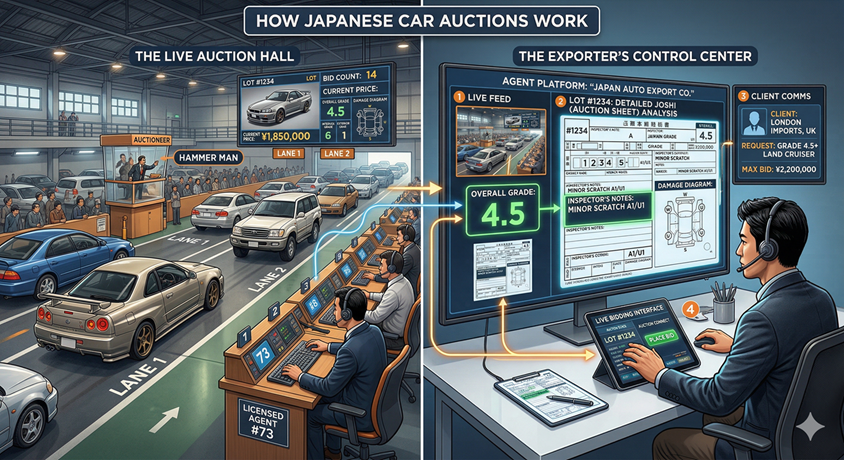
Japanese car auctions are not open to the general public. They are business-to-business marketplaces where registered Japanese dealers buy and sell vehicles. Each auction house has its own membership requirements, and members are typically licensed automobile dealers or exporters operating in Japan.
The auction cycle runs weekly. Most auction houses hold sales on specific days of the week. Vehicles are inspected before each auction and assigned a grade based on their condition. The auction sheet — a standardized inspection document — is created for each vehicle and made available to bidders before the sale begins.
1 Physical Auction
Vehicles are driven through auction lanes while buyers bid in real time. Buyers can inspect vehicles in person before the auction starts. USS and JU locations across Japan host physical auctions on rotating schedules. Physical auctions give you the advantage of seeing the actual vehicle before bidding.
2 Online Auction
Vehicles are listed on digital platforms with auction sheets, photos, and sometimes videos. Bidding happens remotely through an online interface. Aucnet is the dominant online platform, but most physical auction houses also offer online participation. Online auctions have grown to represent over 40% of all Japanese auction transactions.
Auction scale: USS alone sells over 50,000 vehicles per week across its 12 auction locations in Japan. JU operates 18 auction sites nationwide. The total Japanese auction market moves approximately 6-7 million used vehicles annually, making it the largest vehicle auction market in the world.
For a more detailed walkthrough of the overall export process from auction to shipment, read our guide on the Car Export Process from Japan.
🏪Major Japanese Car Auction Houses Compared
There are three major auction groups in Japan, plus several smaller regional houses. Each has distinct strengths that suit different buying strategies.
| Auction House | Type | Weekly Volume | Locations | Best For |
|---|---|---|---|---|
| USS | Physical + Online | 50,000+ vehicles | 12 locations | Largest selection, best for volume exporters |
| JU (Japan Used Car Auction) | Physical + Online | 30,000+ vehicles | 18 locations | Widest geographic coverage, regional variety |
| Aucnet | Online only | 25,000+ vehicles | Nationwide (online) | Remote buying, detailed online listings |
| CAA (Central Auto Auction) | Physical + Online | 10,000+ vehicles | 5 locations | Quality-focused inventory |
| HAA (Hokkaido Auto Auction) | Physical + Online | 5,000+ vehicles | 3 locations | Hokkaido-sourced vehicles (often lower mileage) |
Auction Access Strategy: Most professional exporters maintain access to multiple auction houses through their buying agent. This gives them the widest selection and allows them to compare pricing across different auctions for the same model. If your agent only has access to one auction house, you are limiting your options and likely overpaying.
📝How to Register and Participate in Japanese Car Auctions
As an international buyer, you cannot register directly with Japanese auction houses. You must work through a licensed Japanese buying agent or trading company. Here is how the process works.
Finding a Buying Agent
Your buying agent is the most important relationship in the Japanese auction process. A good agent does more than just bid on your behalf — they inspect vehicles, advise on condition, handle paperwork, and arrange shipping. A bad agent can cost you thousands through overpriced bids, missed inspection issues, or poor communication.
✅ What to Look for in a Buying Agent
- Licensed Japanese dealer with membership at multiple auction houses
- English communication capability (or your language)
- Transparent fee structure with no hidden charges
- Established reputation with verifiable reviews or references
- In-house or partnered shipping arrangements
- Willingness to provide additional photos and video walkarounds
📋 Registration Steps
- Contact your chosen agent and provide your buyer profile (countries you export to, target vehicles, budget range)
- Complete the agent's registration process (typically includes ID verification)
- Agree on fee structure and payment terms
- Deposit funds with your agent (some require a retainer, others operate per-transaction)
- Start searching for vehicles through the auction listings your agent provides
⚠️ Agent Warning: There are unfortunately fraudulent agents operating in the Japanese auction space. Never send money to an agent who cannot provide a valid Japanese dealer license number. Verify their physical address in Japan. Check for reviews on export forums. Start with a small transaction to test their service before committing large amounts. Legitimate agents will welcome this verification process; fraudulent ones will resist.
📄Understanding Japanese Auction Inspection Sheets
The auction inspection sheet is the most important document in the Japanese car buying process. It is a standardized evaluation form created by a certified inspector at the auction house. Learning to read it accurately is essential for making informed buying decisions.
Key Sections of an Auction Sheet
⭐ Overall Grade
The single most important piece of information. Grades run from highest to lowest:
🔍 Exterior Condition Ratings (Panel by Panel)
The auction sheet shows a top-down diagram of the vehicle with a rating for each exterior panel (hood, roof, trunk, doors, fenders). Ratings use a 0-5 scale where 5 is perfect and 0 indicates damage. Common marks include small dents, scratches, rust, or repainted areas. A panel rated 3 or below typically has noticeable cosmetic issues that will need attention.
🏠 Interior Condition Rating
The interior is rated on a A-E scale or descriptive labels. Look for notes about seat wear, carpet condition, dashboard cracks, and functionality of electronics. Air conditioning function is often specifically noted and is a common issue in Japanese used vehicles.
📊 Odometer and Service History
The odometer reading is prominently displayed on the sheet, along with verification of whether it is trusted or unknown. The latest shaken inspection date and next inspection due date are also shown. Service history stamps in the maintenance book add significant value, especially for Middle Eastern and Pakistani buyers.
⚠️ Evaluation Codes and Remarks
The bottom section of the sheet contains evaluation codes for specific conditions: rust, accident history, repair records, modified parts, non-original paint, aftermarket accessories, and more. Your agent should translate all codes and remarks for you. This is where hidden problems are most often found.
Auction Sheet Tip: Never bid based on the grade alone. Two vehicles with the same grade can have very different conditions. Always review the panel-by-panel ratings, evaluation codes, and remarks. If anything is unclear, ask your agent for clarification or additional photos. For high-value vehicles, consider paying for an independent third-party inspection. For a detailed breakdown of every grade and code, see our Japanese Car Auction Inspection Grades Explained guide.
🎯Bidding Strategy and Tactics
Bidding at Japanese auctions is not like eBay. The process moves fast, and having a clear strategy before the auction starts is essential for avoiding overpayment or missing good opportunities.
📊 Set Your Maximum Bid Before the Auction
Calculate your maximum bid based on the vehicle's expected market value in your target destination. Work backward from that price, subtracting shipping, duties, agent fees, auction fees, and your desired margin. This gives you your absolute ceiling. Never exceed this ceiling during bidding, no matter how tempting the vehicle looks. Emotional bidding is the fastest way to destroy your margin.
📈 Understand the Bidding Flow
Japanese auction bidding follows a predictable pattern:
- Opening bid: The seller sets a starting price. If no one bids, the price drops in increments until a buyer enters.
- Incremental bidding: Bids increase in set increments (typically 10,000 JPY / ~$70).
- Reserve price: If bidding does not reach the seller's minimum, the vehicle is "no-sale."
- Final bid: The highest bid at auction close wins.
⚡ Key Bidding Tactics
- Bid late in the auction day when competition is lower and sellers are more motivated
- Target vehicles that have been listed for multiple auctions without selling (the seller is more likely to accept a lower price)
- Watch for "no-sale" vehicles that were relisted — the seller's expectations have likely come down
- Use "max bid" instructions with your agent so they can bid incrementally up to your limit without needing to consult you mid-auction
- For rare or high-demand models, be prepared to bid at or near your ceiling — hesitation loses good vehicles
Pricing Research: The most successful exporters research sold prices for their target models before every auction. Use your agent's sold-price database to understand what similar vehicles actually sold for in recent weeks. This data is more reliable than listed prices. Combine this with your destination market pricing using our pricing and margin strategy guide to build accurate bid ceilings.
💰Auction Fees, Agent Costs, and Total Expenses
The hammer price (winning bid) is only part of the total cost. Understanding the full fee structure is essential for accurate pricing.
Typical Fee Breakdown for a $10,000 Vehicle Purchase
| Cost Item | Amount (USD) | Notes |
|---|---|---|
| Hammer price (winning bid) | $10,000 | Your winning bid amount |
| Auction house fee | $200 - $400 | 5,000 - 30,000 JPY depending on auction house |
| Agent commission | $500 - $1,000 | Typically 5-10% of hammer price |
| Recycling fee | $100 - $200 | Japanese government-mandated fee |
| Domestic transport | $100 - $300 | Transport from auction to port or agent's yard |
| Export certificate (JiDensha) | $50 - $100 | Required for all exported vehicles |
| Total in-Japan cost | $10,950 - $12,000 | Before international shipping and duties |
Cost Optimization: Agent commission is the most negotiable fee. High-volume exporters typically pay 5%, while smaller buyers may pay 8-10%. Some agents offer tiered commission rates based on monthly volume. Shipping costs can be optimized by consolidating multiple vehicles into a single shipment. Plan your purchases in batches rather than one vehicle at a time to reduce per-unit logistics costs.
✅After Your Bid Wins: Payment, Paperwork, and Shipping
Once your bid wins, the clock starts. Japanese auction houses require prompt payment, and the vehicle must be collected within a short window (typically 3-7 days). Here is what happens after the hammer falls.
💳 Payment Process
Your agent will send you an invoice within 24 hours of the winning bid. The invoice includes:
- Hammer price (in JPY, converted to your agreed currency)
- Auction house fee
- Agent commission
- Recycling fee
- Domestic transport to port (if applicable)
- Shipping quotation (separate or included)
📑 Documentation You Will Receive
After payment clears and the vessel departs, you will receive:
- Original Export Certificate (JiDensha or JEVIC)
- Bill of Lading (original or telex release)
- Commercial Invoice
- Packing List
- Original Auction Sheet (required for customs in many destinations)
- Deregistration Certificate (from Japanese authorities)
🚢 Arranging International Shipping
Your agent will typically arrange shipping either through their own logistics desk or a partnered freight forwarder. You can also arrange shipping independently, but this adds complexity. Most exporters use their agent's shipping service for simplicity. The agent will handle port transport, vessel booking, and export customs clearance.
For a detailed comparison of shipping methods and costs, see our RoRo vs Container Shipping for Cars guide.
💻Online Auctions vs Physical Auctions: Which Is Better?
The rise of online auction platforms has changed how international buyers participate in Japanese auctions. Each format has distinct advantages.
1 Physical Auction Advantages
- Vehicle can be inspected in person before bidding
- Real-time sense of competition and pricing
- Larger vehicle selection at major locations
- Start-engine and drive checks possible
2 Online Auction Advantages
- Bid from anywhere in the world
- More time to review sheets and photos
- Search across multiple auctions simultaneously
- Less time pressure during bidding decisions
Hybrid Approach: Most successful exporters use both. They monitor online listings continuously and use physical auction access for high-value purchases where in-person inspection matters. Aucnet is the primary online platform, supplemented by access to USS and JU physical auctions through their agent. The best agents provide online access to multiple auction houses through a single interface.
⚠️Risks in Japanese Car Auctions and How to Avoid Them
Japanese auctions are generally safe and well-regulated, but risks exist. Knowing what they are and how to mitigate them is essential for protecting your capital.
📊 Condition Misrepresentation
While auction inspectors are generally thorough, they do miss things. A vehicle rated grade 4 may have hidden rust, a questionable repair, or mechanical issues not visible from the auction sheet. Mitigation: Request additional photos from your agent, especially underside shots, engine bay close-ups, and video of the engine running. For high-value vehicles, pay for an independent inspection.
🔄 Odometer Rollback
Odometer fraud exists in every used car market, and Japan is not immune. While auction houses verify odometer readings, discrepancies can occur. Mitigation: Cross-reference the odometer reading with the vehicle's service history, interior wear, and overall condition. A 2018 vehicle with 30,000 km but heavy steering wheel wear is suspicious. Compare against shaken inspection records which document mileage at each inspection.
💵 Currency Fluctuation
Japanese auction prices are in JPY. If you transact in USD or another currency, exchange rate movements between bid time and payment time can impact your actual cost. Mitigation: Some agents offer small-window rate locks. Alternatively, keep a JPY balance with your agent to eliminate currency timing risk. For high-value purchases, use forward contracts.
🚢 Shipping Damage
Vehicles can be damaged during loading, transit, or unloading at the destination port. While shipping companies have liability limits, the compensation rarely covers the full cost of repair. Mitigation: Document the vehicle's condition at the time of handover with photos. Use container shipping for high-value vehicles. Ensure your insurance covers in-transit damage adequately.
⚠️ Critical Risk: The biggest risk in Japanese auctions is not the auction itself but the agent you choose. A bad agent can overcharge you, fail to inspect vehicles properly, or disappear with your deposit. Always verify your agent's dealer license, check references, start with small transactions, and never send large deposits without contractual protection. Trust takes months to build and seconds to destroy in the Japanese auction trade.
❌Common Mistakes New Buyers Make at Japanese Auctions
Even experienced exporters make these mistakes. Being aware of them is the first step to avoiding them.
1. Bidding Without a Clear Max Price
Walking into an auction without knowing your maximum bid is the fastest way to overpay. The competitive atmosphere of a live auction — even online — can push you to bid higher than you planned. Always set your ceiling based on destination market math before the auction starts, and stick to it.
2. Ignoring the Evaluation Codes
The grade and overall rating catch your eye, but the evaluation codes at the bottom of the sheet reveal the real story. A grade 4 vehicle with "rust noted on underbody" and "non-original paint on hood" is very different from a clean grade 4. Always review the full sheet, not just the headline grade.
3. Buying Vehicles Not Suited to Your Market
A great deal on a vehicle that your buyers do not want is not a great deal. Know your destination market's preferences before you bid. A grade 4 Toyota Harrier that would sell fast in Africa may struggle in Pakistan due to engine size duties. Stick to models you know move in your target market.
4. Using Only One Agent
Relying on a single buying agent limits your auction access and pricing transparency. Most successful exporters work with 2-3 agents who have access to different auction houses. This gives you broader vehicle selection and allows you to compare commission rates.
5. Not Factoring All Costs Into Your Bid
New buyers often forget to include agent commission, auction fees, and domestic transport when calculating their total cost. A vehicle that looks like a $500 bargain at auction may become a break-even or loss-making transaction once all fees are added. Always use a complete cost template before bidding.
The Bottom Line: Japanese car auctions are the backbone of the global used car export trade. They offer unmatched selection, transparent pricing, and standardized inspections. Success comes from preparation — understanding the auction system, reading sheets accurately, setting disciplined bid limits, and working with trustworthy agents. Master these fundamentals and the Japanese auction market becomes a reliable, profitable vehicle sourcing channel.
❓Frequently Asked Questions
Here are answers to the most common questions about buying from Japanese car auctions.
Can I buy from Japanese auctions without a Japanese address?
No. Japanese auction houses require members to have a Japanese business license and physical address in Japan. You must work through a licensed Japanese buying agent or trading company. The agent uses their membership to bid on your behalf and handles the vehicle until it ships.
How much deposit do Japanese auction agents require?
Deposit requirements vary by agent. Some require a fixed retainer deposit (e.g., $2,000-5,000) before you can start bidding. Others operate per-transaction and require the full purchase amount plus fees within 24-72 hours of a winning bid. New buyers should expect stricter deposit requirements until a relationship is established.
What happens if the vehicle is damaged after I buy it but before it ships?
The auction house or your agent's insurance typically covers damage that occurs between the auction and when the vehicle is handed to the shipping line. Once the vehicle is loaded onto the vessel, the shipping line's insurance applies. Always clarify insurance coverage with your agent before making your first purchase.
Can I return a vehicle if I find problems after purchase?
Japanese auction houses have strict no-return policies for condition issues that were disclosed on the auction sheet. If the auction sheet misrepresented the condition — for example, if the sheet shows grade 4 but the vehicle has significant undisclosed damage — you may have recourse through your agent. However, "buyer's remorse" is not a valid reason for return. Always do your due diligence before bidding.
What is the best day of the week to bid at Japanese auctions?
Auction schedules vary by house. USS holds sales Tuesday through Friday at different locations. JU auctions run on rotating schedules. Generally, mid-week auctions (Tuesday-Thursday) have the largest inventory. Friday auctions often have motivated sellers who want to clear inventory before the weekend. Monday and Saturday auctions tend to have smaller selections. Ask your agent for a schedule of upcoming sales.
🎯Conclusion: Your Roadmap to Buying from Japanese Auctions
Japanese car auctions are the most important vehicle sourcing channel in the global used car trade. They offer an unmatched combination of selection, transparency, and value — but only if you know how to use them effectively.
The path is straightforward: find and verify a trustworthy buying agent, learn to read auction sheets accurately, set disciplined bid limits based on destination market prices, and build a reliable post-purchase workflow for documentation and shipping. Each transaction will teach you something new about the market, the vehicles, and your own bidding strategy.
Start small. Your first few purchases should be for vehicles you understand well and can price accurately. Focus on high-volume models in your target market. Use each transaction to refine your understanding of auction dynamics, agent relationships, and total cost management. As your experience grows, you can expand into more auction houses, more vehicle types, and higher-value transactions.
Next step: Ready to bring your entire auction-to-shipment workflow under control? CarDeal365's export management software helps you track auction purchases, manage vehicle status from bid to delivery, coordinate with your agents, and control your margins — all from one platform.
Related reading
Auction Purchase Management
How to manage auction purchases across a whole buying week: reconciling invoices and fees per lot, consolidating units into shipments, an...
Japanese Car Auction Fees Explained
Every fee you pay when buying at Japanese car auction — USS, TAA, JU buyer fees, transport to port, deregistration, export customs, agent...
Bidding at USS Tokyo & USS Yokohama
Ultimate exporter guide to bidding at USS Tokyo and USS Yokohama used car auctions.
Auction Bidding Software
What auction bidding software should cover for dealers sourcing stock from vehicle auctions: budget control, bid tracking, condition data...
TAA Auction Guide
How Japan's TAA network works for export buyers.

About the Author
Muhammad Khabir Uddin
Founder, CarDeal365 · 6+ years in automotive export & SaaS
View LinkedIn Profile