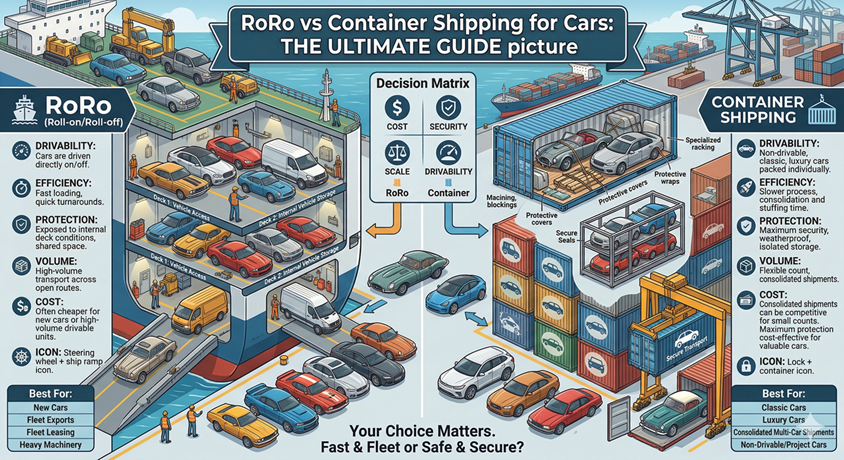
Internal workflow is a different problem from external logistics
Our complete shipping guide and logistics operations guide cover the external side of shipping well: RoRo vs container, Incoterms, ports, and freight forwarder selection. This article is about a different, quieter problem — once you've made those external decisions, how does your own team track where each unit actually is in the process, without relying on someone remembering to check with the forwarder?
That internal tracking is what we mean by "shipping workflow": a defined set of stages, inside your own system, that every vehicle passes through and that anyone on the team can check without a phone call.
Defining shipping stages that match how you actually operate
| Stage | What triggers it |
|---|---|
| Booking requested | Unit is ready and a shipment slot is being sought |
| Booking confirmed | Carrier or forwarder confirms space and vessel |
| Gate-in / loaded | Vehicle physically delivered to port or loaded |
| Departed | Vessel has sailed |
| Arrived | Vessel has reached destination port |
| Delivered | Vehicle released and handed to buyer |
Keep the list short enough that staff actually update it consistently. A workflow with fifteen granular sub-stages tends to get updated less reliably than one with six clear ones.
Assigning ownership so status updates don't depend on memory
Each stage needs an owner responsible for updating it — usually logistics or operations staff — and a clear trigger for when it changes. Without an assigned owner, status updates depend on whoever happens to think of it, which is exactly how a shipment ends up looking "in transit" three days after it actually arrived.
Connecting shipping status to the vehicle record, not a separate tracker
The workflow only pays off if shipping status lives on the same vehicle record as inventory, documents, and buyer information, rather than a separate spreadsheet someone has to cross-reference. This mirrors the same principle covered in our dealer inventory management guide — one record, one source of truth, viewed differently by different teams.
Buyer-facing visibility without extra manual updates
Buyers asking "where's my car?" is one of the most common support requests in an export business. If shipping status already lives on the vehicle record, answering that question — or even sharing a live status view with the buyer directly — doesn't require a separate manual update process layered on top of the internal one.
FAQs
What is a vehicle shipping workflow?
A vehicle shipping workflow is the internal set of tracked stages a unit passes through from booking to delivery, each with a clear status, owner, and connection back to the vehicle's own record.
How is this different from learning how ocean shipping works?
Understanding RoRo vs container, Incoterms, and freight forwarder selection is the external logistics side. Workflow tracking is the internal side: knowing which of your own units are at which stage, and who owns the next step.
What stages should a shipping workflow include?
Common stages include booking requested, booking confirmed, gate-in or loading, departed, in transit, arrived, and delivered, with each stage owned by a specific role and visible to sales, finance, and the buyer.
Why connect shipment status to the vehicle record instead of a separate tracker?
So that anyone looking at a vehicle's record can see its shipping status without cross-referencing a separate spreadsheet or asking the logistics team directly.
Supporting guides in this series
Car Export Shipping Complete Guide
The external logistics decisions this workflow sits on top of.
Digital Bill of Lading Management
The single document most tightly linked to shipment status.
Export Documentation Management Software
Where document readiness connects to shipment booking.
AI Translation for Japanese Auction Sheets
How AI translates Japanese auction sheet notes and grading shorthand into usable data for non-Japanese-speaking export teams, and why tra...
Export Compliance Checklist
A scannable export compliance checklist covering business registration, per-market import rules, pre-shipment inspection, documentation, ...
How to Choose a Freight Forwarder for Car Export from Japan
Complete guide to choosing a freight forwarder for car export from Japan.
Negotiating Ocean Freight & Shipping Rates
Ultimate exporter guide to negotiating ocean freight and shipping container rates for Japanese used car exports.
Export Documentation Workflow for Japanese Used Cars
Complete step-by-step guide to the export documentation workflow for Japanese used car exporters.
Used Car Import Age Limits & Compliance Matrix
Complete country compliance matrix for Japanese used car imports.
Conclusion
A vehicle shipping workflow is what turns "we shipped it, it's somewhere on the water" into an answerable question at any moment. Define a short set of stages, assign clear ownership for each, and keep status on the same record as everything else about the vehicle, so tracking a shipment never depends on catching the right person at the right time.
See how CarDeal365 tracks shipping status against every vehicle, document, and buyer record.
Book a Demo
About the Author
Muhammad Khabir Uddin
Founder, CarDeal365 · 6+ years in automotive export & SaaS
View LinkedIn Profile